
Walking Manchester
The Ringway is a trail through the countryside around Manchester, the city of bees. I followed it for 160 kilometres, then spun off to a town once visited by Gandhi.
Manchester → Sale Water Park
8 July 2025
18,032 steps
18,032 steps
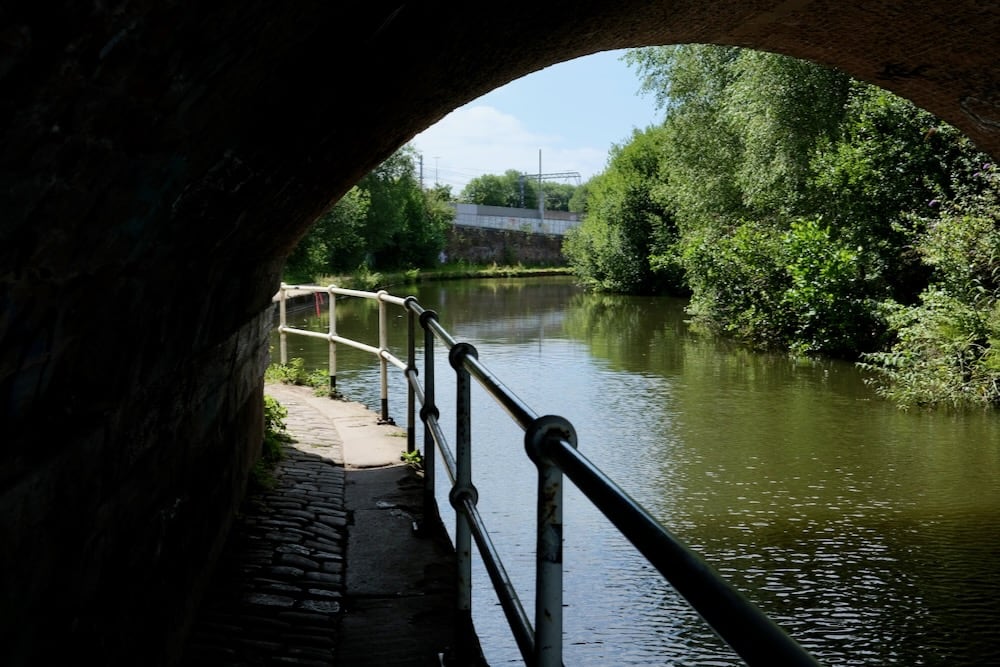
The canal towpaths in the city are narrow and paved with cobblestones rubbed smooth by countless feet. When first constructed in the 18th and 19th centuries, the paths were probably just beaten earth, a flat surface for horses to haul coal-laden boats to Liverpool; on the return trip, as Manchester became the global centre of the textile industry, the same boats would deliver billions of tonnes of slave-grown cotton.
Once an essential conduit of extraction and exploitation for the British Empire, the canal network is now quiet and peaceful. As I walked today I saw not a single passing boat and just the occasional walker, runner or cyclist as I moved west into the industrial heartland of Trafford Park. The number of people picked up again when I entered the woods and meadows along the River Mersey.
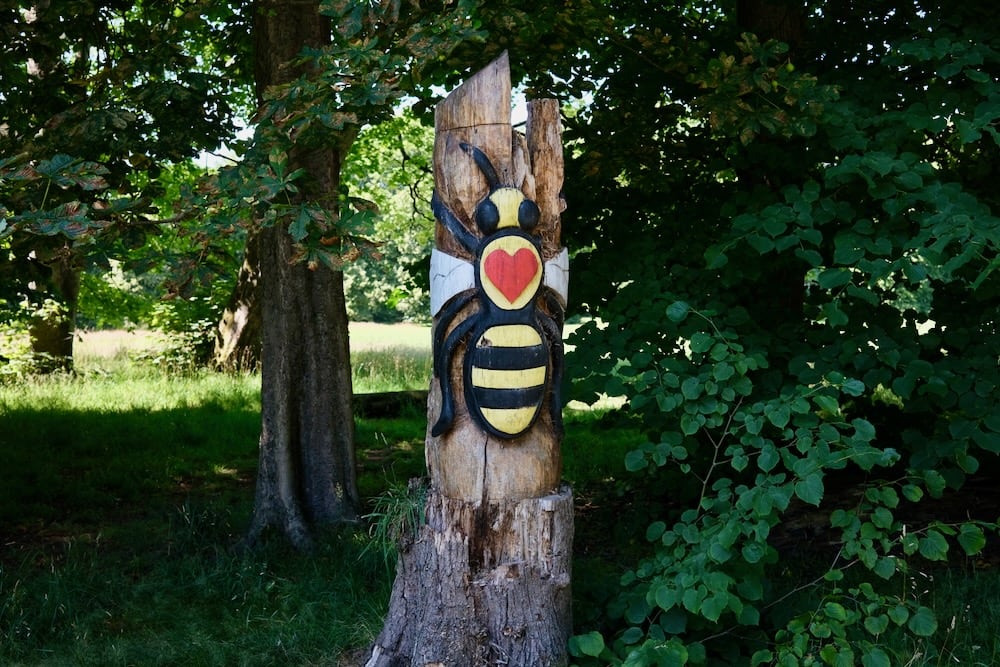
Manchester had been a hive of activity in its heyday. The city has taken on the worker bee as its emblem, and bees decorate the sides of the buses, trams and trains that will transport me to the start of each Ringway stage. I began this first walk, though, at our apartment near Piccadilly, after which I made my way to St Peter’s Square, the trail’s official start and end.
Just a few hours after landing in the UK—11 am local time; 8 pm to my jetlagged body—I touched a cross that marked the former site of the long-demolished St Peter’s Basilica, already visualising how I’d touch it again next month to mark the completion of a very big circle. That was the plan, anyway.
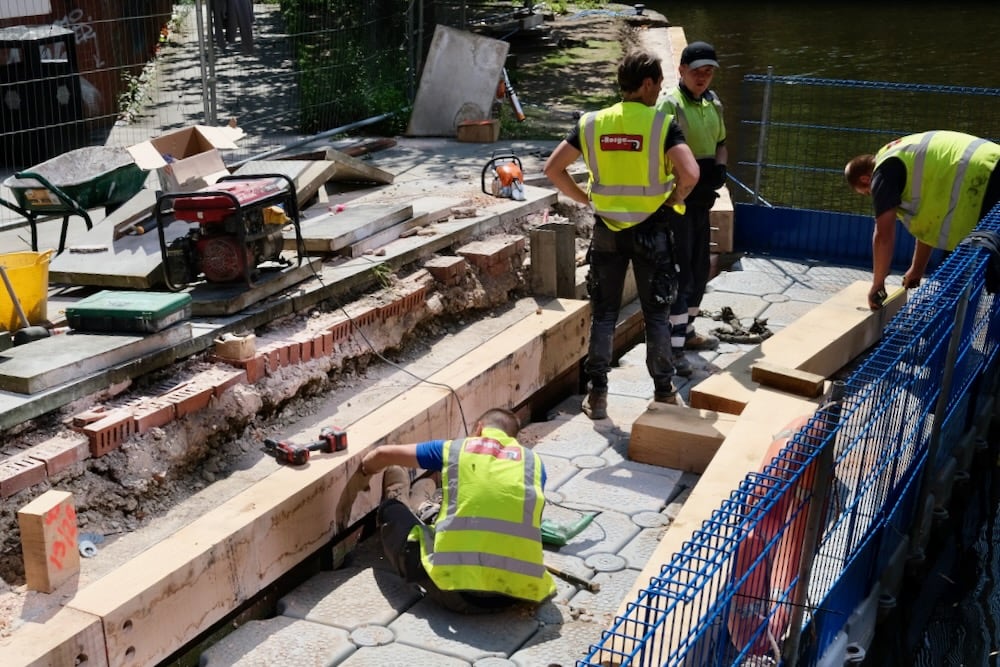
Soon I was beside the Rochdale Canal, walking in the direction of the sea, though the wind sent ripples moving towards me. I passed some workers on a temporary pontoon replacing the timber boards that lined the edge of the canal. At first I wondered why they would install new timber sure to rot. Later I figured the boards served as bumpers for the narrowboats navigating the narrowest parts of the city.
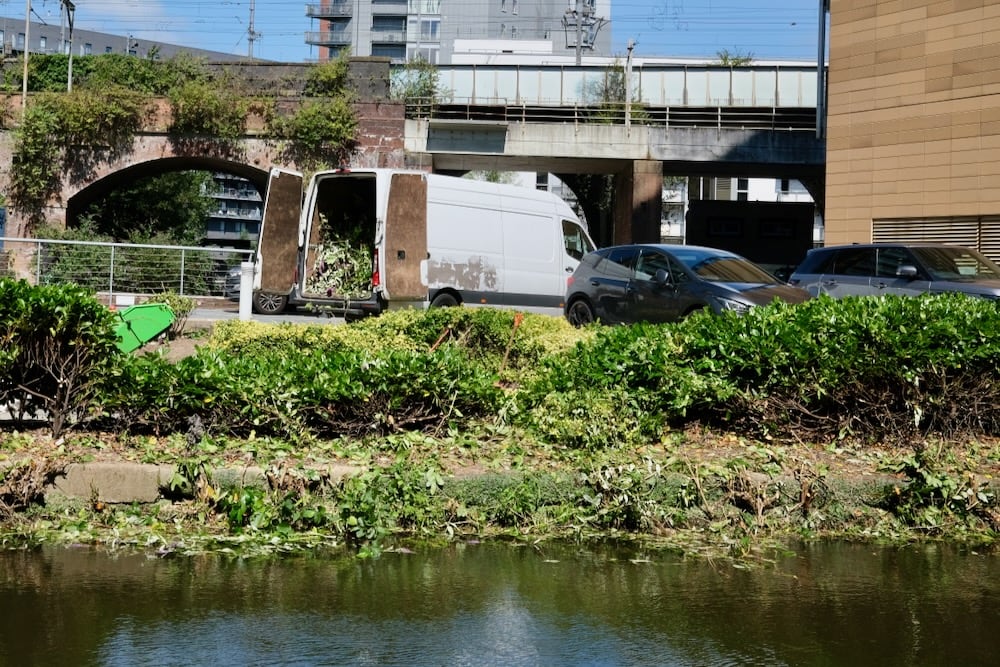
More workers clipped and cleared hedges and flowers and weeds along the edge of the canal, creating a fringe of floating cuttings. As the Rochdale Canal turned into the Bridgewater Canal (which opened in 1761, led to the halving of coal prices and kickstarted “canal mania” in England and Wales) it became surrounded on both sides by trains—the infrastructure that supplanted canals for the transport of goods.
Tempted by wild blackberry as I passed Old Trafford, the gargantuan home stadium of Manchester United, I decided not to risk eating berries that had been coated in the pee of drunk football fans stumbling their way home.
Alone now sometimes for ten minutes at a time, I found myself slipping into a curious, patient and attentive mindset. The feeling that is perhaps the main purpose of the long walk; the feeling that one hopes they can bring to each day of the walk, but also beyond it—in a sense, practising the way I seek to engage the world around me in everyday life. This is facilitated by the decision to go from A to B just to see what happens. No expectations or rush to be anywhere else.
My reverie was interrupted by Roy, a man on a tricycle with a pierced eyebrow. He was reconnoitring for a friend who lived in a narrowboat—“his pride and joy”—that was being terrorised at night by a couple of young boys. Roy’s friend didn’t feel safe. I suggested a spot further up where I had seen boats moored on the far side of the canal, with no direct access for people on the towpath.
After that I left the canal, detouring to a bouldering gym in Trafford Park, the first planned industrial estate in the world. I passed large grey fulfillment centres for Amazon and Adidas. Semi-trailer trucks filled the roads. The gym was huge. Ninety minutes later I retraced my steps to the canal, hands sore, full of ciabatta.

A fisherman on the canal, Phil, hailed from Sale, which was to be my final destination. He’s lived there all his life. He claimed to have caught—and released—fifteen perch in the past hour. Indeed, as we spoke, he put a maggot on a hook, and seconds later reeled in a fish, unsnagged its mouth and slipped it back into the canal. Just to pass the time. Water’s polluted, after all. No good for eating. He’s also caught bream and roach. Once, he said, a large pike came along as he pulled a perch from the water. The pike gobbled up the smaller fish and snapped his line.
It’s quite warm today, and will be warmer tomorrow. He won’t be able to catch as many perch. They prefer cooler water and would stay down low.
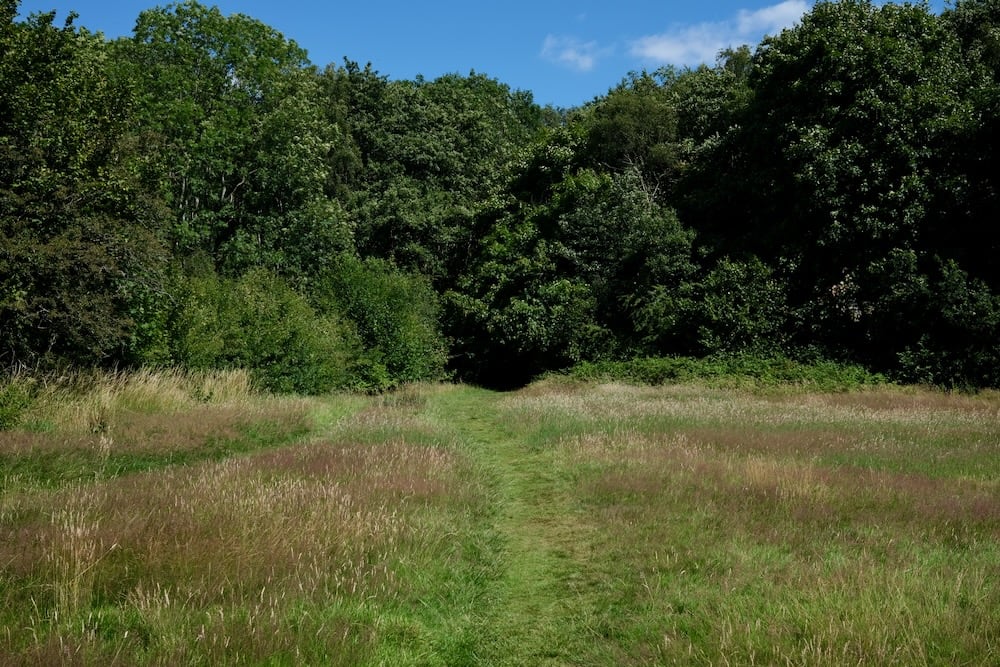
There followed woodland paths, open fields, parks with animal enclosures, alleys and byways, the route taking me beside streams and canals and wetlands. A string of marker arrows on poles, bins, walls, trees, gates. It was a fine first day on the trail.
Sale Water Park → Didsbury Village
10 July 2025
12,548 steps
12,548 steps
“Morning mate, you OK?”
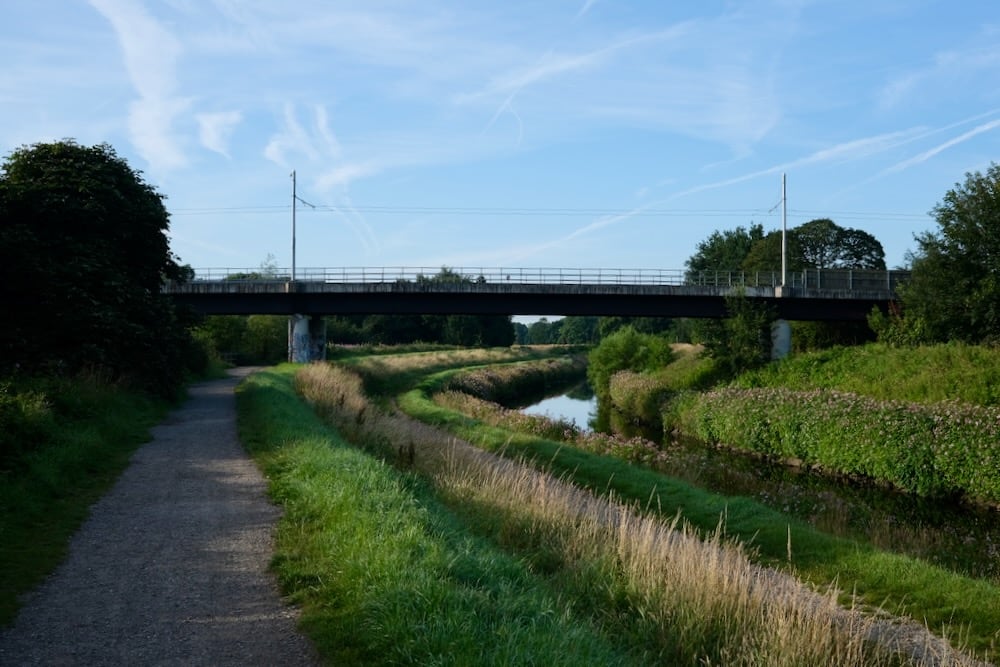
I’m not in the habit of gracefully responding to this, the standard greeting in these parts, it seems. I suppose you just say “Good, you OK?” but the question contains, for me, a niggling trace of concern or condescension. If I dwell on this trivial difference, it’s because today’s walk could almost have taken place along the Merri Creek, complete with folks out walking their dogs before work.
This second stage mostly hewed to the River Mersey, its green-on-green banks dotted by pink spikes of fireweed stretching into the air. The sky was criss-crossed by contrails, plumes of cloud created in the wake of planes high in the sky.
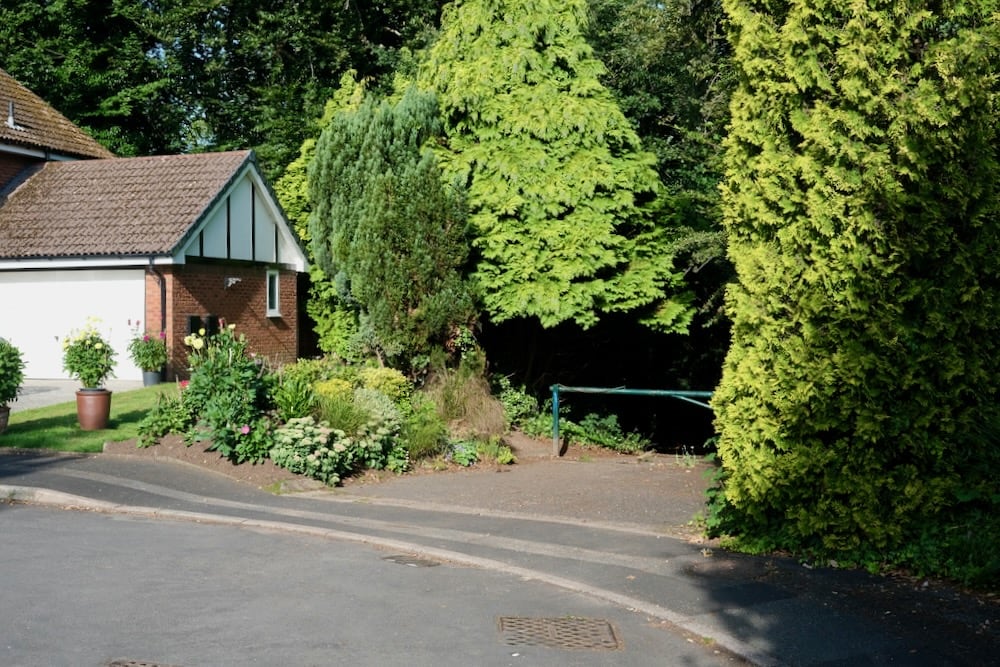
A few times, though, the riverside path was closed—to repair the banks, or build a bridge. One detour took me through some dark woods. I popped out into a cul-de-sac with lovely two-story brick homes. It felt like a fancy pocket. I could see a Porsche, a few Audis. The homes had garages and well-kept yards.
Still, Mancunian streets feel similar regardless of income, with the red-brown Victorian brickwork echoed even in new builds. I suppose it could be oppressive, if you lived here. But as a visitor, the visual cohesion is pleasing. And it befits a hive.
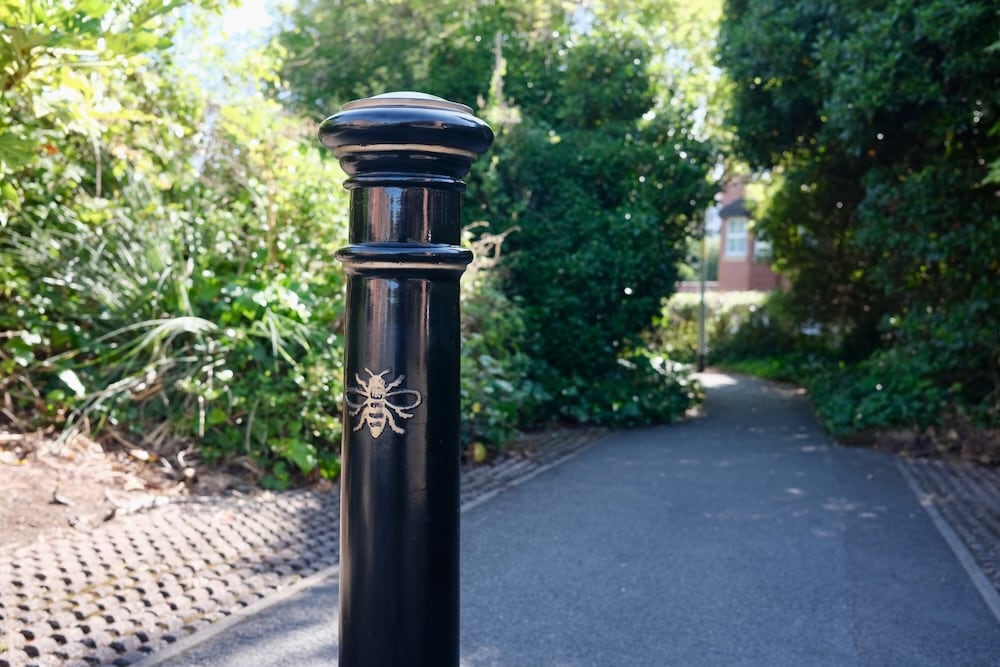
It’s a little surreal ducking in and out of the woods. The sudden drop of temperature from a bright open street or hay meadow. Heat and light blocked by close-growing vine-covered trees. Hooting and tweeting; birds hidden, the occasional grey squirrel. Soft and quiet underfoot. Like an escape is always available, an alternate universe always only a step away. The woods in England hold fairies in glades, mossy stones embedded with swords.
Didsbury Village → Bramhall
11 July 2025
15,238 steps
15,238 steps
The last big walk I did, in Malta, was more difficult than this. There will be hilly days to come on the Ringway, but Malta’s conditions were so hot and humid it was equal parts punishing and hilarious. The paths were rocky and exposed, and I walked day after day; there was no fat in the schedule, as my flight home ruled out taking a break.
Following a route there of my own devising, I was often out of place—sometimes literally, when trespassing, as well as figuratively, being a sweaty stranger with a neon humpback. No starker was the contrast than when I stood on a pier in the Blue Lagoon with my fully loaded pack, long-sleeved shirt and broad-brimmed hat, surrounded by near-naked revellers, waiting in the bright sun for the ferry to Gozo.
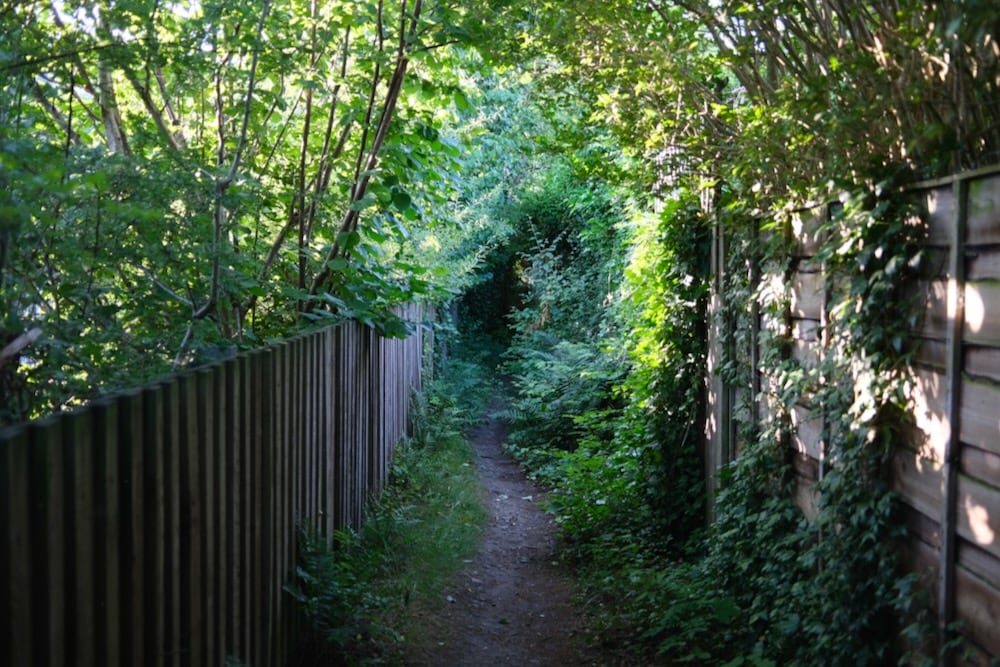
I thought about this today after I mistakenly started off-route by taking the wrong tram stop exit, ending up on the opposite side of the tracks, eventually finding myself in a lush, spiderwebbed corridor between yards and the tram line. It was a minor deviation, but a reminder that each walk is an unpredictable sampling of the world. The same route walked twice deviates, if not in route, then in myriad other factors, chief among them: encounter. And it is encounter that elevates a walk.
Having just watched the latest season of The Rehearsal (and now re-watching Nathan For You), I can’t help but compare this to Nathan Fielder’s work. His brilliance is not only the derangement of his schemes, or his ability to see them through, but in how those combine to produce memorable encounters: a gas station owner who drinks his grandson’s pee; a mall Santa with a closet full of guns; a pilot banned from every dating app he uses. Nathan’s bashful curiosity disarms people, finding fellow spirit in unexpected places.
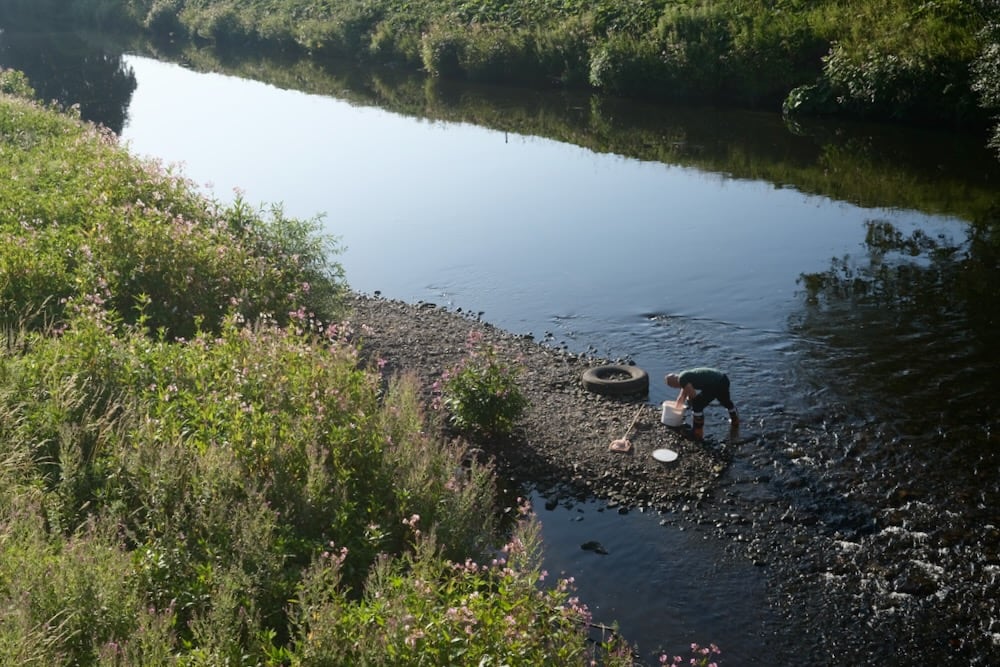
Soon enough I met the gravel path of the marked route, then rejoined the River Mersey. I settled into the rhythm of the walk, not thinking too much. Just as I was to leave the riverside, I saw a man in gum boots carefully turning and examining rocks before placing them into a bucket. At first I thought perhaps he wanted smooth decorative rocks for his garden. We yelled a short conversation over the sound of rushing water. He was checking the health of the river. Picking up rocks from the riverbed whose hosting (or not) of certain insects acted as a diagnostic.
On a road between townships, I detected the first waft of manure so far on this walk. Crossed the eight-lane M60. Went through some woodlands, down a high street that was starting to awaken, then another park with meadows and serious young boys in ties walking in pairs to school.
I was then right under the main approach to the airport, and spent some time looking at the flight radar app on my phone, anticipating the largest planes passing into a gap of the canopy above.
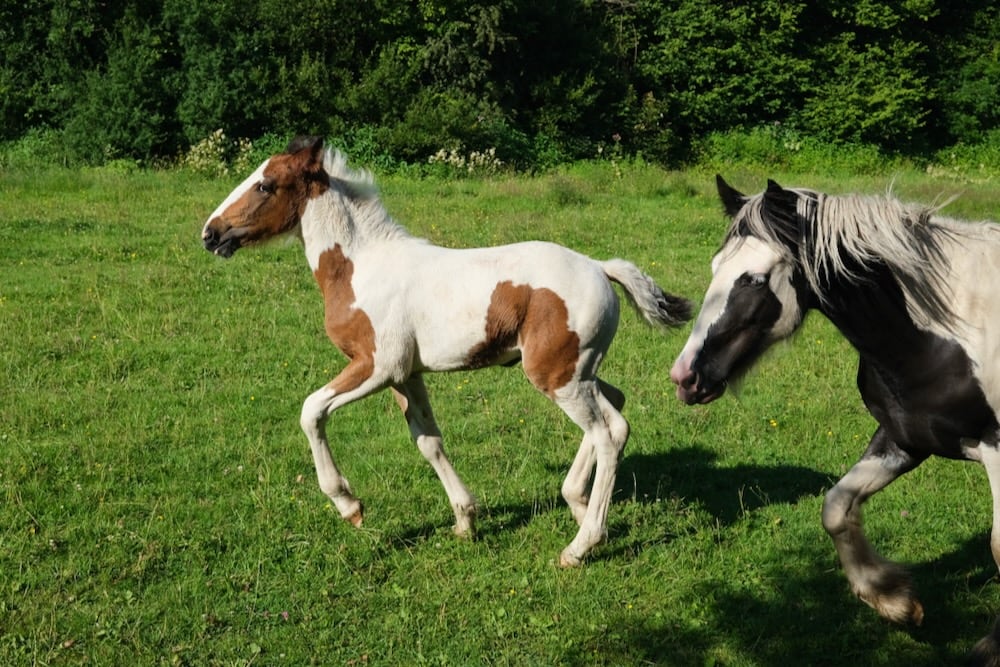
After leaving town, the route continued in the Ladybrook Valley, along a tributary of the Mersey. Pleasant scenes followed—isn’t pleasant the most damning adjective? But the English landscape seems designed with that word as principle. A tickle of impatience in me was stemmed by three horses that displayed no hesitation in grazing so near I could have touched them. Entrancing, even if it made me a little nervous. The horses had bitten people before, one passing walker informed me. They needn’t be fed, but sometimes folks offer treats, which trains the horses to ask passers-by for more. If you won’t oblige…
The horses’ owner, who lives in a house at the top of the hill, recently sold the mare’s foals. I was told the mother stood for a week at the gate where she’d seen her children being loaded onto a truck. It was clear that she pined for their return. In light of this, I would forgive a bite or two.
My walk was elevated at the last by meeting Duck Lady.
In Bramhall Park, I navigated some ponds created in the 1890s filled with placid mallards, moorhens and Canada geese. I spent some time kneeling near a group of ducks sunning themselves on the path. As with the horses, I was amazed by how close they allowed me. I could readily appreciate their little orange legs tucked into their sides.
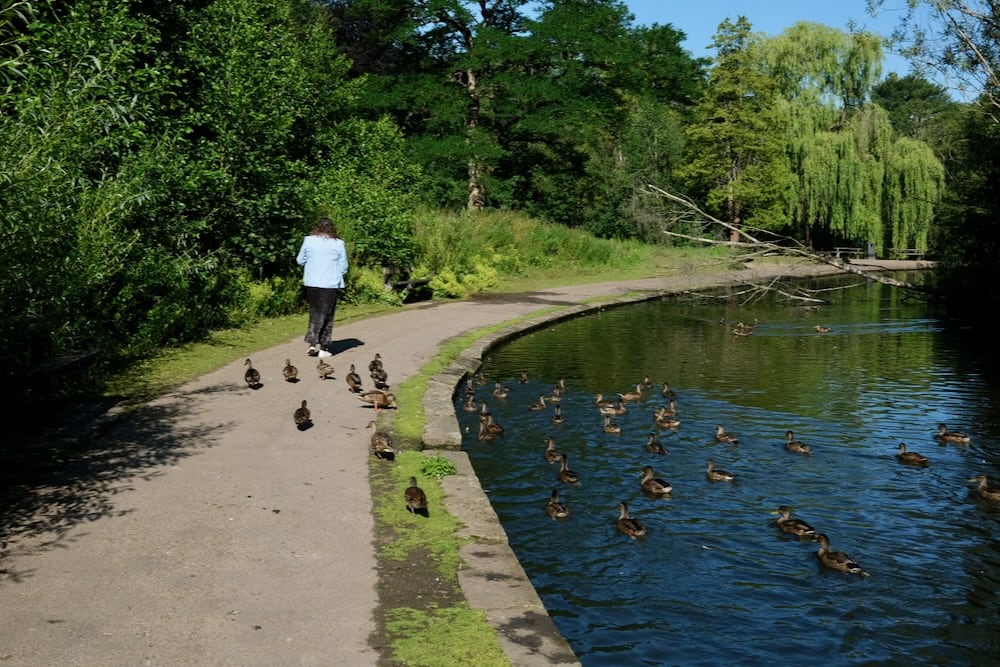
Further along, I saw a woman feeding some ducks bread. (This is, strictly speaking, a no-no—it’s like candy, for one thing.) My ducks ceased sunbathing, waddled into the water and began speeding towards her. I went over to say hello. She was perhaps fifty, with wet hair and circles of rouge on her cheeks, wearing a sky-blue padded jacket over a velvet dress. Incongruous to this outfit, she carried the feed in two large plastic bags. She burbled sentences, smiling all the while. I lobbed offerings into her stream of thought. Some bobbed to the surface and carried further, others sunk without ceremony. The imminent geese migration was our main topic of conversation. Abruptly she continued on her way, tossing handfuls of crumbs as she went, birds in her wake, the Pied Piper of waterfowl.
The decision to walk in a circle around Manchester is, in one sense, simply a way to engineer encounter. It gives an impetus—and sufficient time—to engage with strangers repeatedly across hours, days and weeks. Because while it’s easy to get excited by the encounter of new places, there’s something special, I think, about meeting people far outside of your bubble.
Bramhall → Middlewood
14 July 2025
13,722 steps
13,722 steps
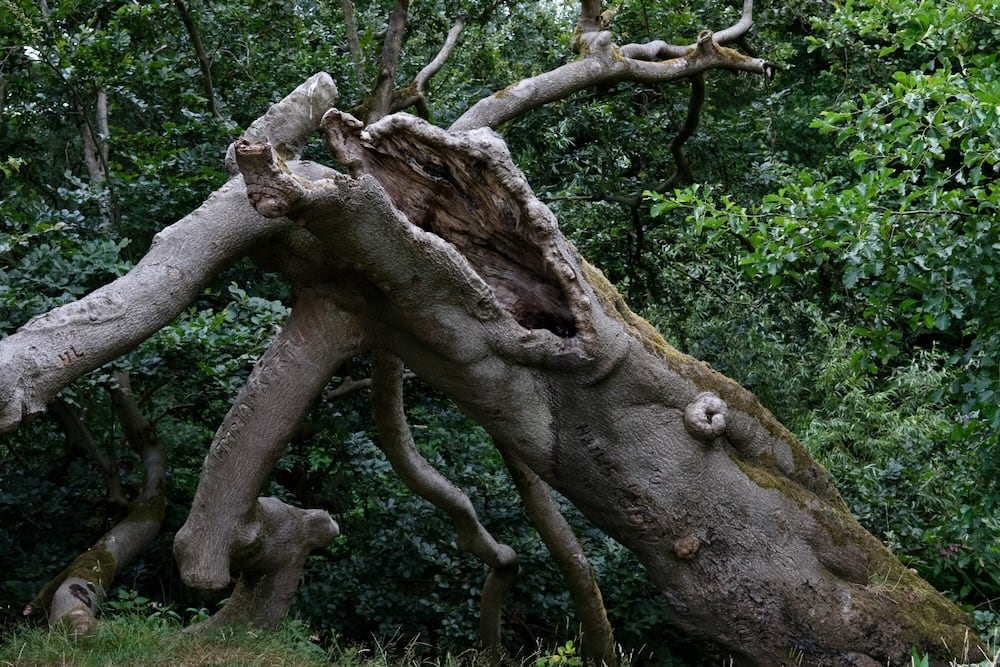
Shortly before I spotted the tree hollow that looked like a moss-covered whale, I carefully climbed over a barbed wire fence to get closer to a grey heron standing tall on a log that jutted over the brook. It was almost in silhouette, neck curved over its shoulder, framed tightly by foliage and the mirrored surface of the water below—picture perfect. But while I was trying to take a picture, it opened its broad wings, beat them twice slowly, and glided away.
From Bramhall I’d walked along Dairyground Road, so named because the area was once a dairy farm; “that’s how it began life, as it were” said one dachshund owner to me. The homes were built in a curious array of post-war styles, and the estate planners had included twice as many narrow alleyways as there were roads, making for an eminently walkable enclave.
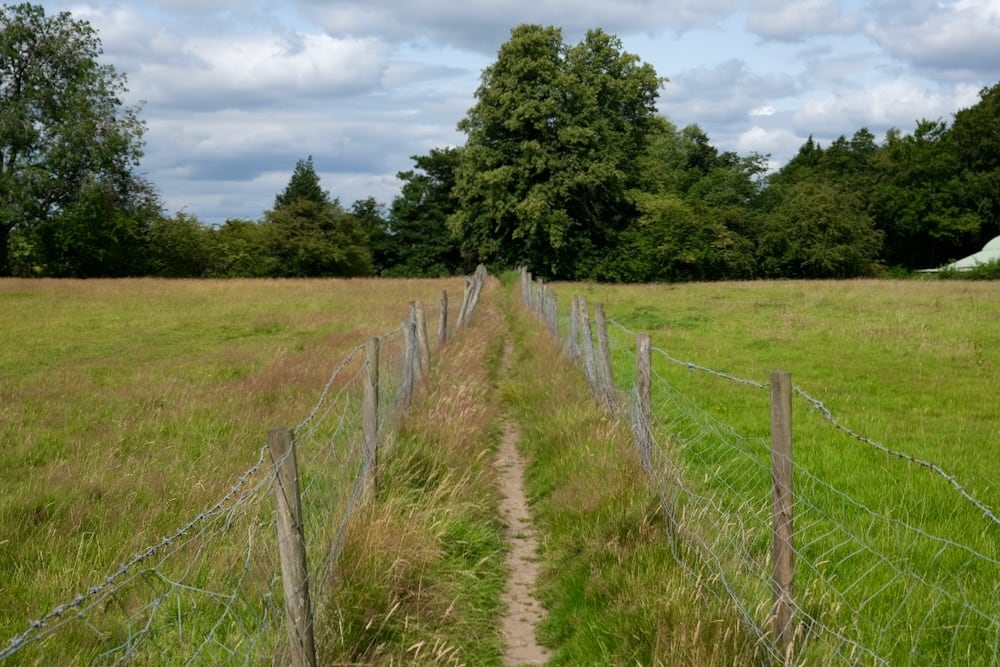
Today’s stage met the countryside proper—I knew this because I began encountering stiles. After the estate I followed an idyllic, gravel-studded brook in the Happy Valley lined by ash, hazel and vine-covered oak trees. There I saw the heron and whale. At the other end of the valley I navigated rural lanes and a path between farms. In one field, sheep piled themselves in a shaded corner. We’re in the grip of a heatwave here—last month was England’s hottest June on record. It’s mild compared to an Australian summer, fine to walk in, but obviously little good comes from local extremes.
Walking around a lake, I saw what I thought was a second grey heron on a clump of sedge, magnificent and stock-still until the moment it decided to up and leave, heaving itself across the water.
I confirmed my sighting with Phil, a birdwatcher I met a few minutes later. He was very tall, with a camouflage-patterned cap and binoculars around his neck. (“Binos”, as the parlance goes.) I also asked him about Canada geese. Duck Lady had noted with concern that they were still to migrate. Turns out that once the goslings hatch, the adults shed their feathers, rendering them flightless during the month their young come into independence.
We had paused in a place that happened to light his face perfectly, with the lake to his left and a handsome shrub on the right. It could have been the encyclopedia image of a birdwatcher. We had been chatting for a while before I asked, for the first time on this trip, whether I could take a picture.
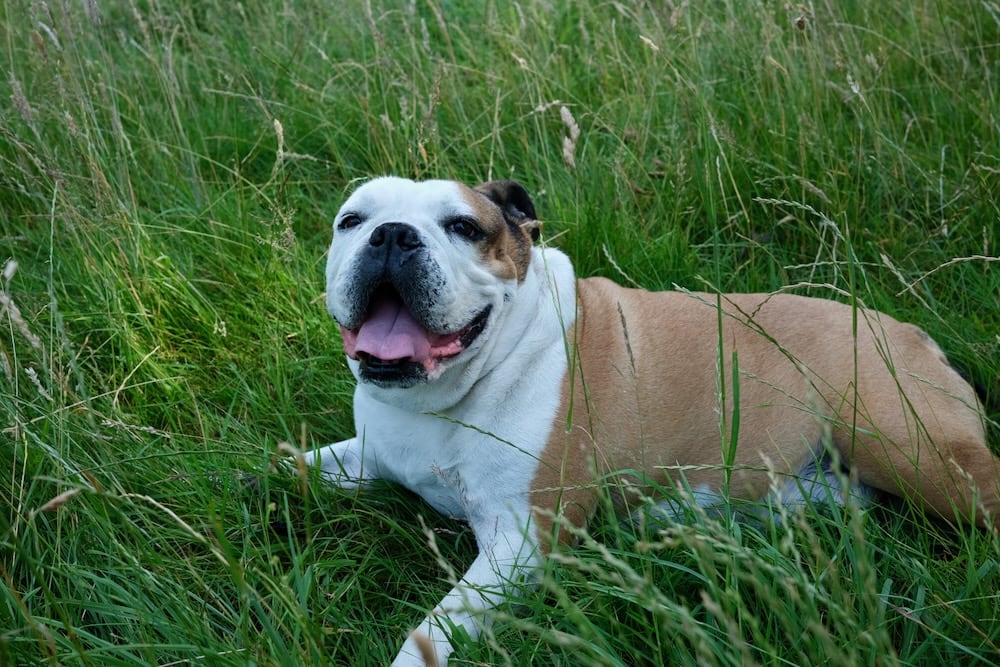
“No, that’s quite alright,” he replied, which I took to be a polite way of saying “No, please never consider it again, dear God, why would you ask me that.” I couldn’t blame him. I’d say the same. Who is this stranger? Where would my picture go? Later in the park as a kind of consolation prize I asked a lady if I could take a picture of her dog, which was an easier request to make. He posed happily.
On the Prince’s Incline, a former coal-cart track that runs past manor homes—each with a name plaque on the gate: Beechwood; Tree Tops; Oxton House; Dovecotes—there was a rusting oil tank with hand-painted pleas to keep dogs on lead. I was told that the farmer had put up the signs at the height of the pandemic; more people were walking dogs then, some of which attacked sheep.
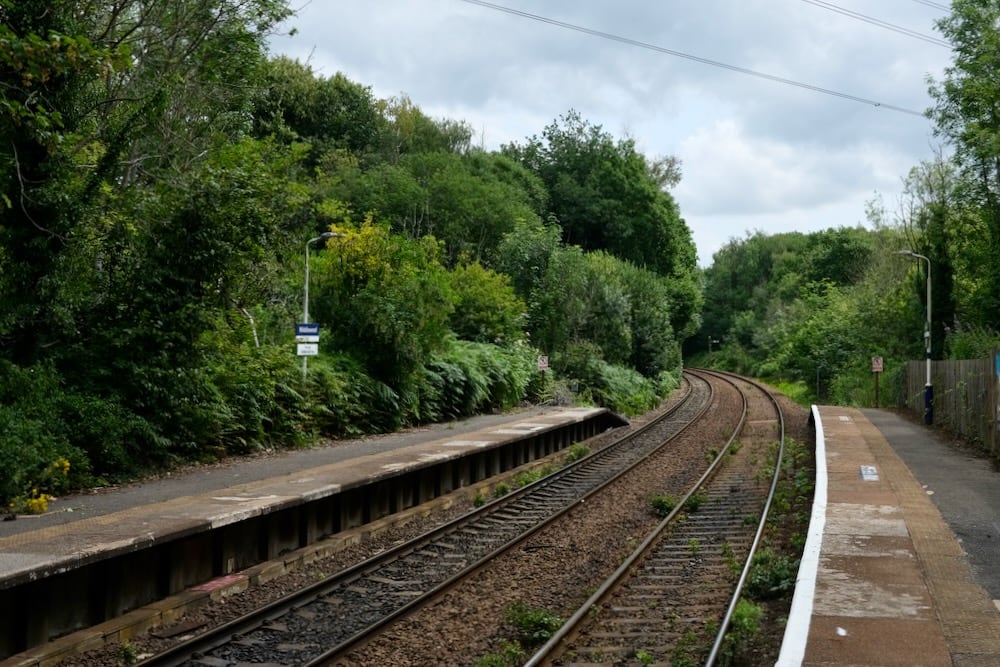
Gaining elevation now amid neatly mown fields on land reclaimed from open-cast mines of the past, I could see the towers of central Manchester poking above the border hedges. Then down into a fairytale gully, brook bubbling, with brand-new teepee tents flashing white through the verdure—the algorithm-ready architecture of a wedding venue. Finally, I made it to the end: a pedestrian-only station in the middle of the woods called… Middlewood.
Middlewood → Strines
16 July 2025
14,402 steps
14,402 steps
Today I went for a “ramble in the park”, to quote the avid perambulator Miss Elizabeth Bennet in Pride & Prejudice, which I read yesterday for the first time. (Five stars! So funny!) See, the latter part of the walk would bring me to Lyme Park, which stood in for Mr Darcy’s sprawling estate in the 1995 BBC adaptation, and some say was Jane Austen’s inspiration.
First, though, I continued into the woods where the last stage left me. Tractors in the surrounding fields droned; insects bumped against my neck and calves. The sky was overcast; the path was muddy. Rain had bucketed down yesterday. Soon enough the route joined Macclesfield Canal, which crossed the top of the railway line I had just been on—further betraying the artificiality of the strip of water beside me, which kept on straight over the ravine.
There were a lot of narrowboats in this area. I find them a little bit creepy, maybe because it’s difficult to tell when they’re occupied. Was someone watching me through the curtain? I couldn’t be sure.
Diverging from the canal, I walked through patches of forest and private land, along streams and byways; over stiles and cute wooden bridges no longer than a few steps. Then I took a gravel road that catered to a handful of large stone houses. One home stood high up on a hill, which reminded me that a driveway can be long indeed. This made sense of how the Bennets would hear or see someone enter their drive and have time to change clothes before an unexpected visitor arrived at the door.
Swinging open a large wooden gate, I entered Lyme Park from a little-trafficked corner, and stepping off the road into the shelter of woods, I was alone on a track that went steadily uphill.
Some way in I caught a glimpse through the trees, over the edge of a hill, of what I thought was a wing of the mansion. I later realised it was merely the standalone hunting lodge called The Cage. It soon disappeared from view, but I was left with a sudden feeling of approach, like I was a supplicant on my way to visit the mistress of Pemberley.
As I left the forest, this sense of grandeur was shattered by the anachronistic vision of a man and his daughter clad in logo-emblazoned sports clothes, a neon energy drink in his hand—and then, a minute later, a mountain biker barrelling down the trail.
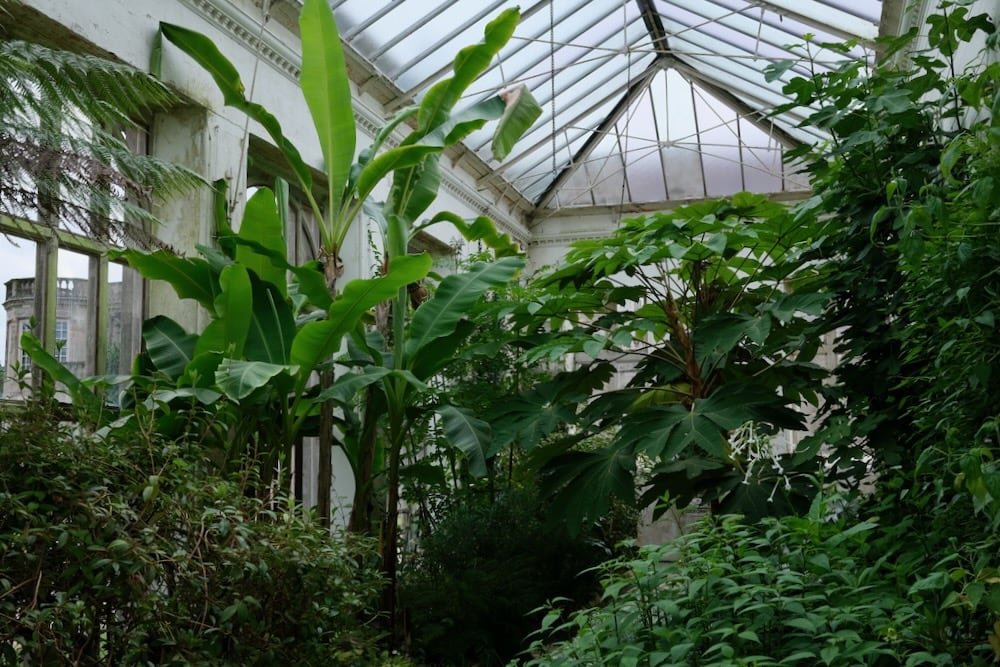
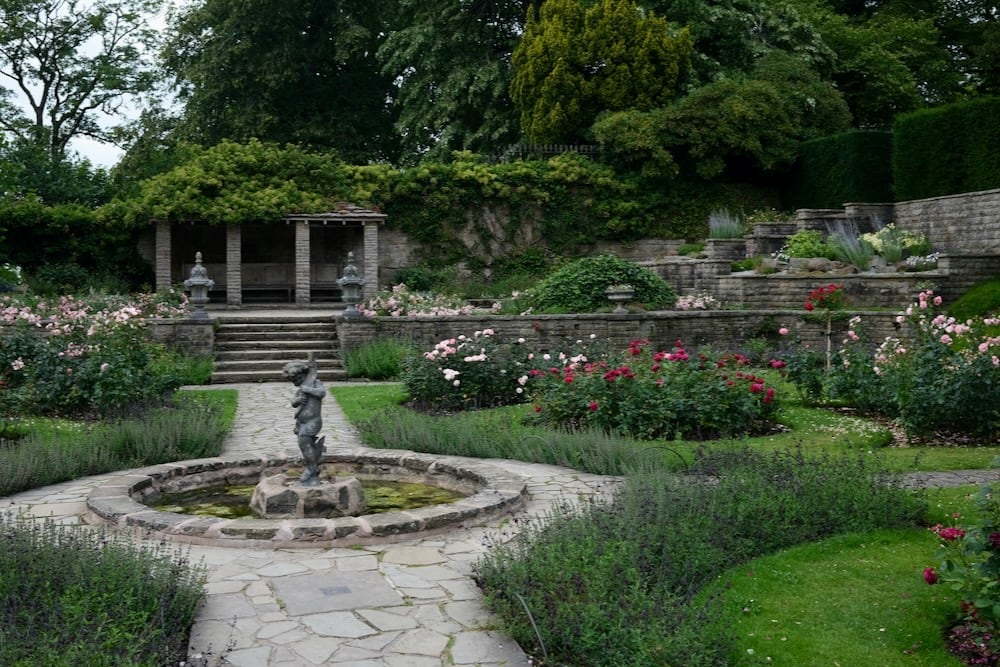
Up and up went the trail, winding between stately oaks. The estate included the entire raised body of land between two rivers. The lodge sat at the highest point of this croissant, visible for miles around; the mansion, garden and lake were set lower and further back. I reached the house around five o’clock. Few people were about. The building was closed for conservation work, but I could pass through the internal courtyard to enter the well-manicured gardens. My favourite part was the former orangery, pictured up top, now a conservatory.
I shortly left the walled grounds by passing back through the mansion, and set to walking up the spine of the croissant, gaining the last few metres of elevation to The Cage. All was quiet but for the wind. This was the most impressive part; not anything built by hand, but simply the views past the edges of the estate where red deer roamed, onto the neighbouring hills and out to the city.
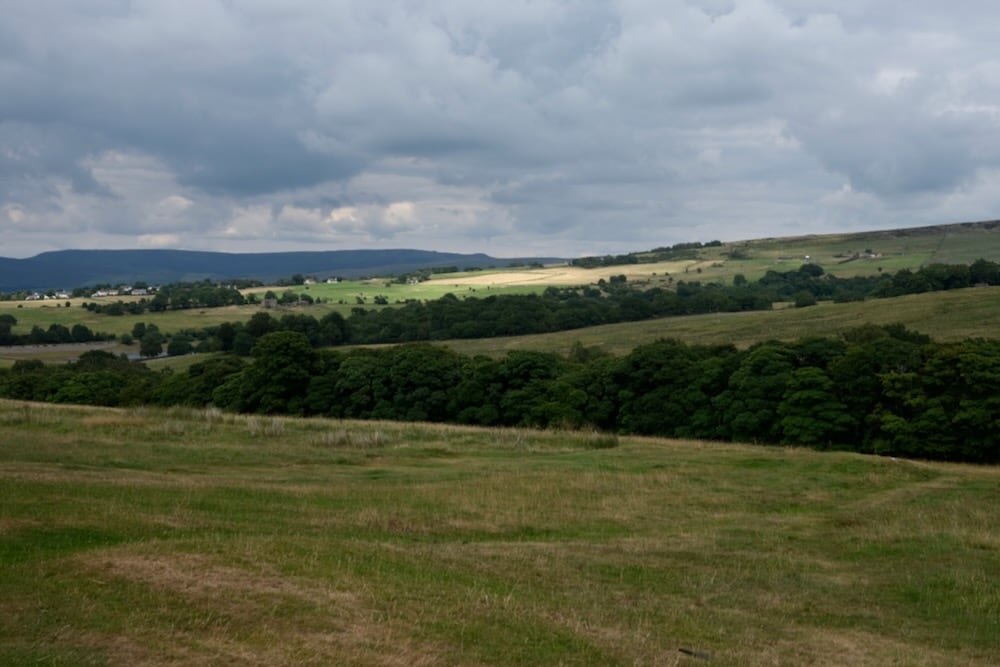
I was struck by how little of the estate was given over to formal gardens; most of the land was open, only lightly shaped. Later, passing through a golf course, I realised I’d expected a landscape closer to that: neatly groomed and designed. But that’s more Victorian, whereas Austen’s characters favoured the picturesque, studiously avoiding ostentation.
I could see how Elizabeth could be contented with this estate, each step offering “a nobler fall of ground, or a finer reach of the woods”, in lieu of a visit to the Lake District. The latter was something else, of course, but here was something special, doubly so if it was where you rekindled the connection to your enemy-turned-lover.
Strines → Marple
22 July 2025
18,834 steps
18,834 steps
The heatwave broke on the weekend while I was staying with a friend in London. I went to sleep in Whitechapel on top of the bedsheets, windows wide open, and woke to the patter of rain, a pied wagtail fluffing itself beneath a neighbours’ balcony, the cluster of Canary Wharf towers to the east little more than dim shapes in the clammy air.
Three mornings later, keen to pick up where I left off in Manchester despite the dismal forecast, I donned a rain jacket, laced my boots and ran to catch a train to Strines.
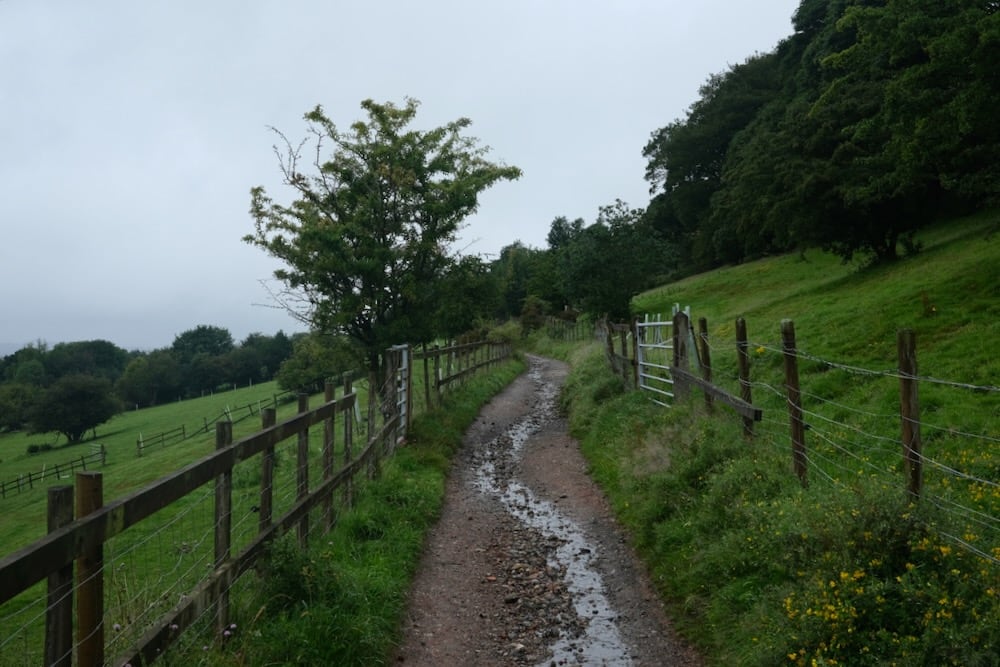
The trail I started upon was rocky and muddy. A mist curtained the surrounding fields and forested hills. I went steadily uphill through woods, then a cluster of buildings, including one that was once—according to a plaque—a chapel for the Primitive Methodists, built in 1874. (The “primitive” part of the movement’s name, I learned, was a call to shed formalism and return to a spiritual Christian impulse.) The S-bend of that village had offered bitumen, then it became a more primitive track, with grass growing between the tire tracks and a dry stone wall on my left. The view opened up. The top of The Cage was visible, sitting proud on its bare ridge. To the northwest, between fog-obscured hilltops, I could see clear to Blackpool and the Irish Sea.
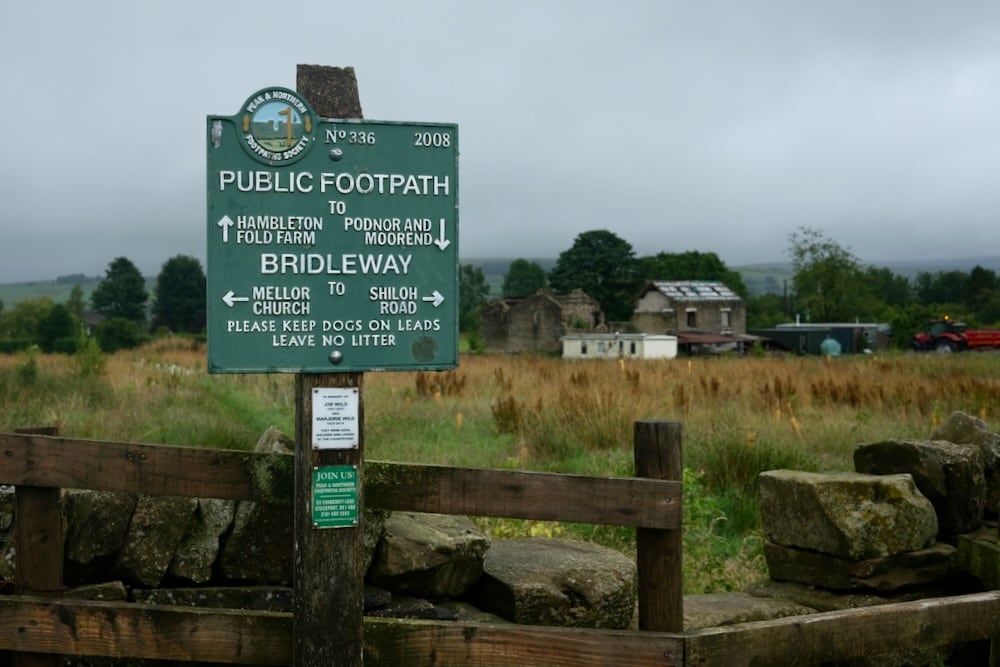
There were many ups and downs, the strain of voices in farmhouses, cocks crowing, sheep with rectangular eye. The path widened. The path tapered. Got steep. Steeper. Eventually I reached a plateau. Gravel pitted with pools of water, fields whited out, no sound but for the squelch of my boots in the mud, the patter of rain, and sometimes the tweet of a bird or a breath of wind.
At Castle Edge Road I entertained little hope of seeing a castle through the gloom, if there was one to see. I looked at the surface of the road instead. Only one rider had passed, their steed stamping crescent shapes in the mud.
Yellow-brown finches flitted in and out of the hedges; a surprised pigeon burst with a flutter across my field of view. I wandered a cemetery, found a grave-top sundial inscribed with Tempus fugit: time flies. Then into a town proper, with charming interwar designs—bay windows, pebbledash rendering, white-columned porches—then back into a wood, past the archery zone and rope course of a scout camp, and a stately Georgian mansion listed for sale. (I looked it up later: built in 1790, asking for a million pounds, furnished Airbnb style, though it was a family home; tackier than I had imagined it would look.)
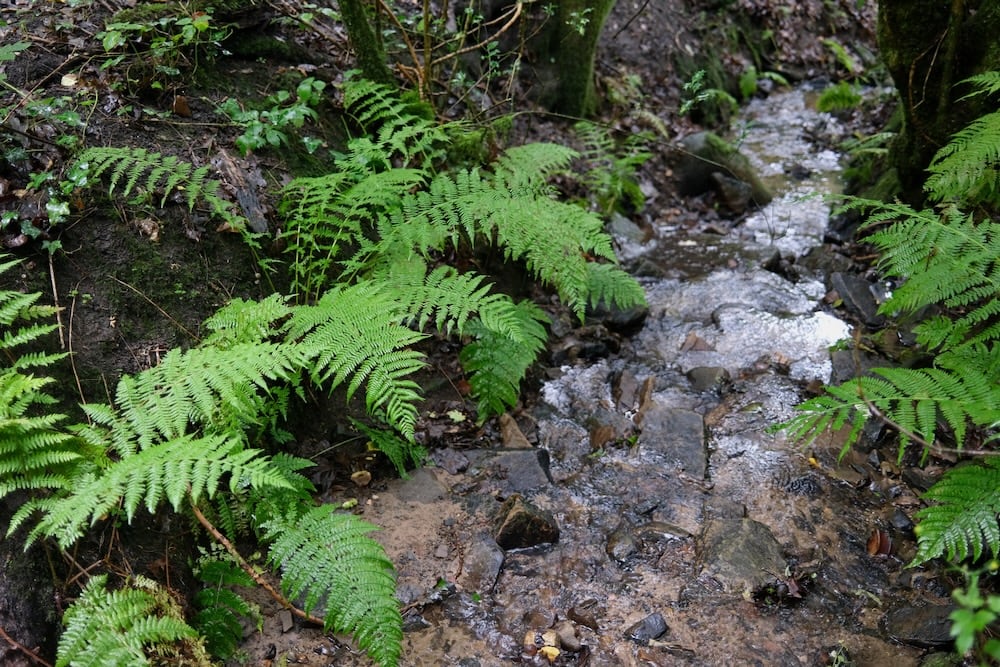
Ferns really pop when it’s damp, looking greener than usual, the water putting a gloss on their fronds. I paid attention to them, and pictured myself as a Victorian collector at the height of “pteridomania”. The ferns are petite here, though; Australian tree ferns are the biggest in the world, giving a taste of what Manchester’s prehistoric forests might have looked like hundreds of millions of years ago, before they collapsed into the drying swamps, formed peat, and became compressed into the coal that fuelled the factories of the revolution.
I went past a field with black plastic-wrapped hay bales placed in a grid, between which mingled a dozen ducks and a few black jackdaws, feeding companionably in the worm-rich soil. Down a smooth country lane crowded with purple willowherb spikes and the white trumpet flowers of the bindweed. A thundering weir announced the appearance of a railway viaduct. I walked under its vaulted brick arches, then crossed the River Goyt over a pack bridge. I admired its curved ironwork and moss-covered stone deck, a relic from a more romantic age.
The drizzle turned into proper drenching rain near the end of my walk as I skirted the Peak Forest Canal into Marple. I took shelter in a Cambodian restaurant, and I can report that my food, when it arrived, was utterly delicious, with glistening flat rice noodles and green pops of sliced spring onion.
Marple → Broadbottom
25 July 2025
15,430 steps
15,430 steps
I almost quit after the last stage, because it had taken me about as easterly as the route goes, and I felt a desire to continue into the Peak District proper, to do longer, more challenging walks. I could strike east from Marple, over the mountains, perhaps as far as the North Sea, keeping between train stations, albeit increasingly distant ones. But the Ringway won out for the same reasons I chose it in the first place. For better and worse, it fit around my other occupations here, and the whole would be greater than the parts.
So my Manchester circuit continued on a warm Friday afternoon, the birds sheltering in the trees that crowded the Peak Forest Canal. Starlings chirped, gravel beneath my feet crunched, water sluiced through the locks. Soon I crossed the impressive Marple Aqueduct, thirty metres above the River Goyt. As usual, seeing water carry on straight and narrow across a gorge had a surreal aspect.
Through farms and meadows, a horse feeding at my elbow as I unlatched one gate, and along a dirt track by a tributary, brambles scratching limbs. Through a town, the publican talking to a local across the road as he set out furniture: “What’s he drink? Half the time I don’t know ’em by their names, I know ’em by their drinks.”
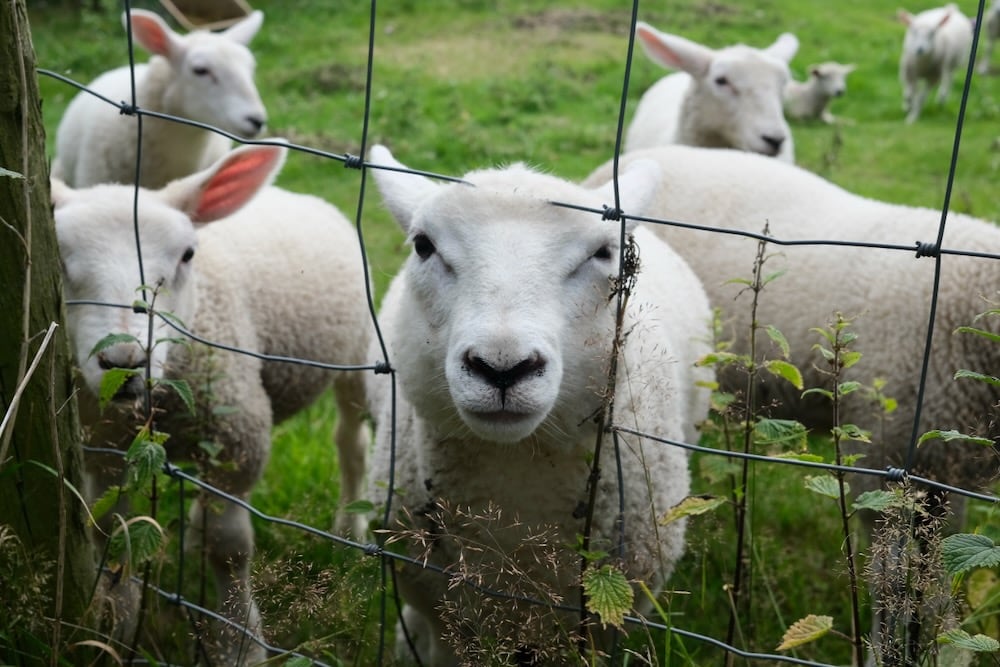
At one point I walked along a field with lambs and to my surprise they ran towards me. Sheep usually bolted on my approach, but these younger ones seemed to want me to pet them, sticking their heads and feet through the fence. Maybe they confused me with the farmer who fed them. I held back from touching them, and when they clocked that I had nothing to offer, they wandered away.
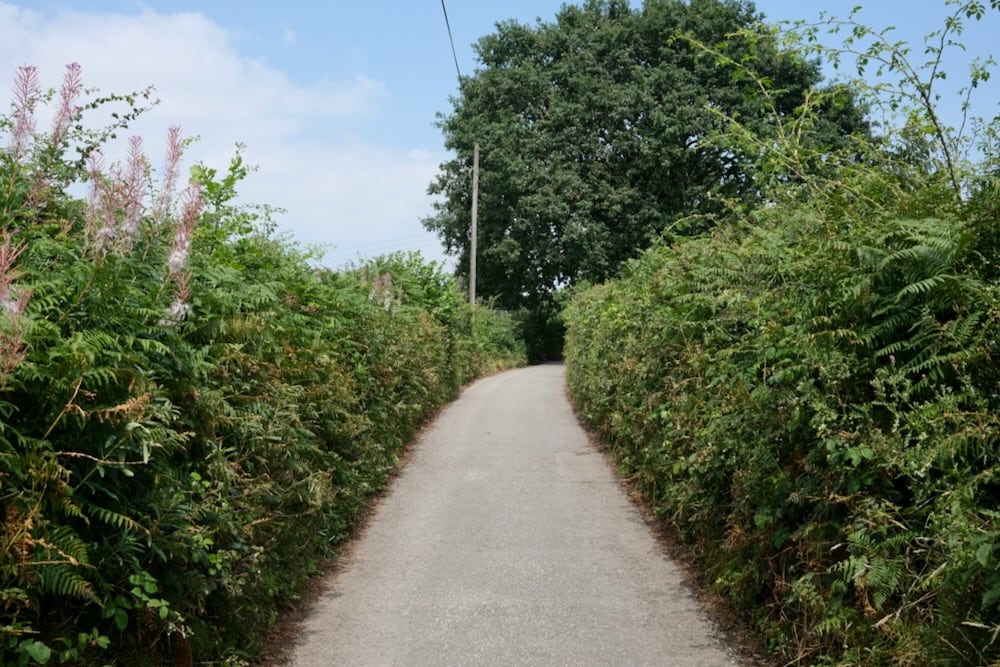
I went up a long country lane with piles of horse dung smack bang in the middle and hedges either side, narrow enough that I had to press myself into the holly and brambles to let pass the one vehicle I saw in an hour of walking uphill, an electric delivery van. This section reminded me of how, before I had ever been to England, which is to say before last year, I took an odd delight in dangling the orange Google Street View figure over the zoomed-out country and dropping it anywhere into the mass of blue that traced the roads, because the figure seemed to unerringly land in this kind of bucolic scene: a simple road, orderly hedges, and verdant fields beyond.
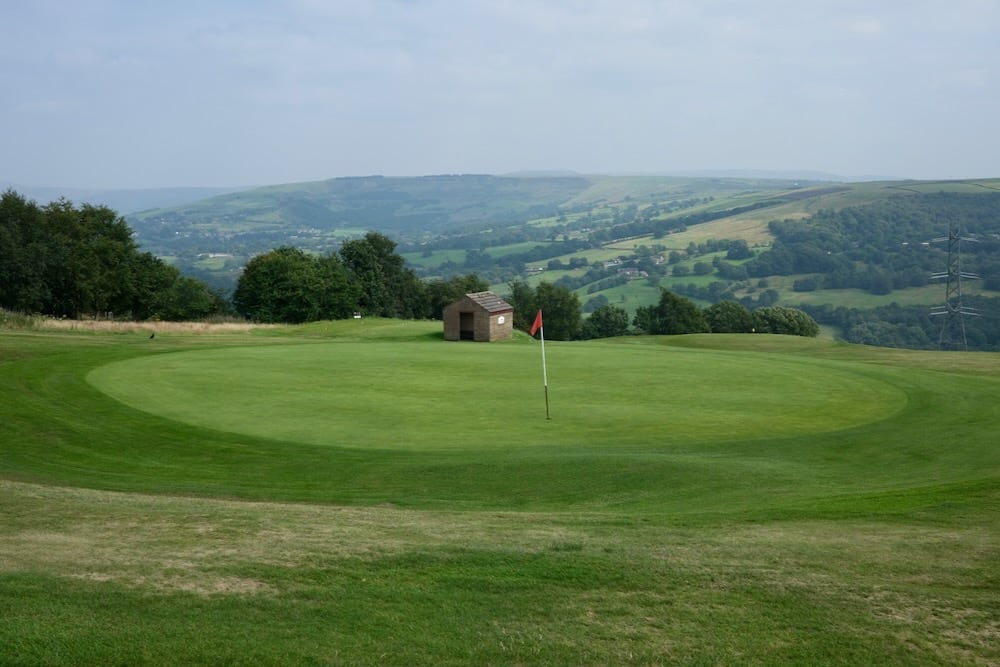
The lane kept going and going. Near the top I crossed beneath pylons carrying power lines that crackled with unsettling intensity, then walked through a property—a farmhouse with exposed timber gables, a large covered well and stables that commanded a majestic position over the valley. I went through a hilltop golf course with a similar view, then into a reserve, where I sat in the shade near a war memorial obelisk and gazed around, the altitude of 250 metres being the highest point around for some way.
Eventually I arrived at Broadbottom, where I met Jim, a retired gardener who’s lived in the village for 45 years—though he was born a few miles away, so when I asked if he was a local, he said yes, “or near enough”. He had a cropped white beard and straight white hair that fell in a somewhat boyish cut, and wore a short-sleeved button-up shirt with embroidery down the middle. If it had been an orange shirt, I’d call it tropical, but it was purple, so it seemed royal instead. And when I sat with him at the pub, it was like sitting with the King of Broadbottom: he knew by name every person who walked past our table.
Jim (Man United fan) and I were joined by Steve (Man City fan). The two had connected only the year before last; they’d gone to the same school, but Steve was about two decades younger. They said there used to be eleven pubs in Broadbottom. Now there was just the one we sat in, The Harewood Arms, and even this was for sale. The villagers were trying to collectively buy it. I could see how it was a place of community, and on a winter’s day, with the fireplace going, how charming it would be. They shouted me a pint of stout, and then another, and they told me their stories, and on the train home I found myself happy that I had continued the circuit, after all.
Broadbottom → Greenfield
28 July 2025
23,986 steps
23,986 steps
I was unintentionally stalking a pheasant. It was at the edge of the Peak District, where I arrived after having walked out of town, past an imposing mansion—named THE HAGUE—with a driveway that bifurcated around a Cedar of Lebanon that Jack could have climbed to the clouds in lieu of a beanstalk. Past old farm outbuildings, windows busted, vines trailing from the rafters. Up a hoof-churned track, squelching through mud laced with fresh cow dung, a dozen pendulous beasts watching me.
I went up a rocky lane where the fence posts had all but rotted away, leaving only short lengths of mossy timber every ten paces dangling between the barbed wires. The wires were still taut because they’d been secured to the scraggly trees lining the lane, and where a tree’s trunk had swallowed the attachment rings, the wires appeared to be organic extensions of the tree, like thin metal limbs.
There was a steady climb in the shade of oaks, my world reduced to leaves shaking in the wind. Then into a sheep field, and there I spotted the pheasant, a brown shape moving along the grassy bank beside the track, staying just ahead of me. It paused when I paused. I took in the view: dry stone walls implacably bisecting the rolling fields, the grey stripe of a town, and further back, the treeless red-brown moors that rose to 500 metres before levelling off into a boggy plateau, which I’d be on shortly.
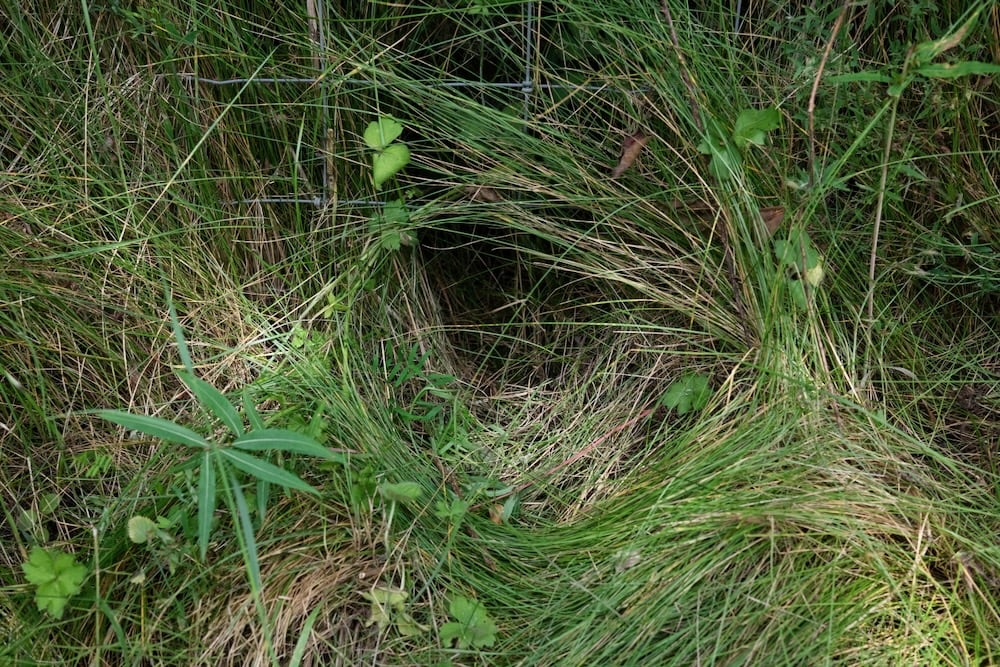
I kept moving, the pheasant running ahead another fifty metres before it darted under the fence in a place where the grass had been parted like a tunnel through regular use. Similar tunnels could be spied at many other points along the fence. Tree cover reduced to naught. A breeze ruffled the grass, bringing baaing and the bark of a dog who was shepherding some distance below me, assisted by a man on a quad bike.
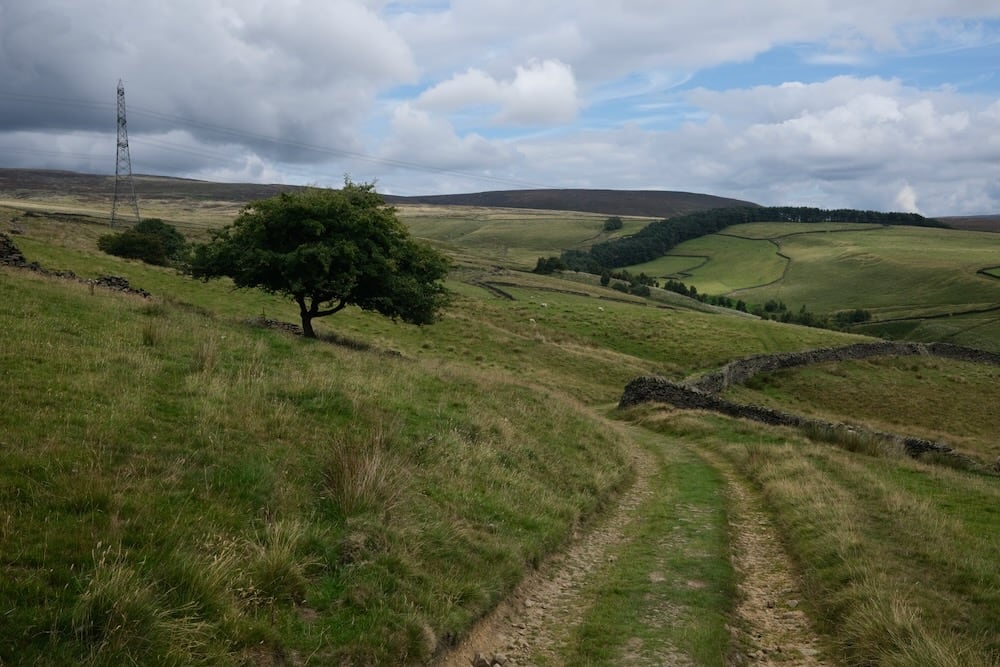
After hopping another stile, there were no more fields. I followed a narrow dirt track through the pink-purple of heather in bloom, set against bright green, low-growing bilberry shrubs sometimes decorated with tufts of wool snagged from sheep who roamed outside their realm. On pausing to tie my laces, I heard the trickle of a stream, clear and pleasing, and the chitter of hidden stonechats.
After gaining the plateau, the path faded. The ground became bouncy, covered in sphagnum moss that sunk a half-inch each step, with patches that gave way even more. A scene from The Last of Us in my mind, I pictured still-clothed bodies just beneath the surface, awakened by my passage, hands bursting up to grope for my ankles. Not altogether outlandish, really.
The extensive morass I was picking my way through is named “Wilderness” on Ordnance Survey maps, which seems ridiculous when you can see skyscrapers glinting over your shoulder and an occasional plane overhead—not to mention that every inch of the UK is man-made, with moors like these, for instance, drained and burned to shoot grouse. The South Pennines, in particular, has been degraded by industrial activity. I mean, “acid rain” was coined in Manchester in 1872. Tells ya something, no? But my phone signal dropped to one bar, so sure, I’ll grant that I was in wilderness.
Regardless, finding myself in that empty watery terrain, and then later on, walking down a reservoir access road into the steep-sided Chew Valley, I had the same feeling of tranquility as in the Lake District, or on the side of far-flung mountains.
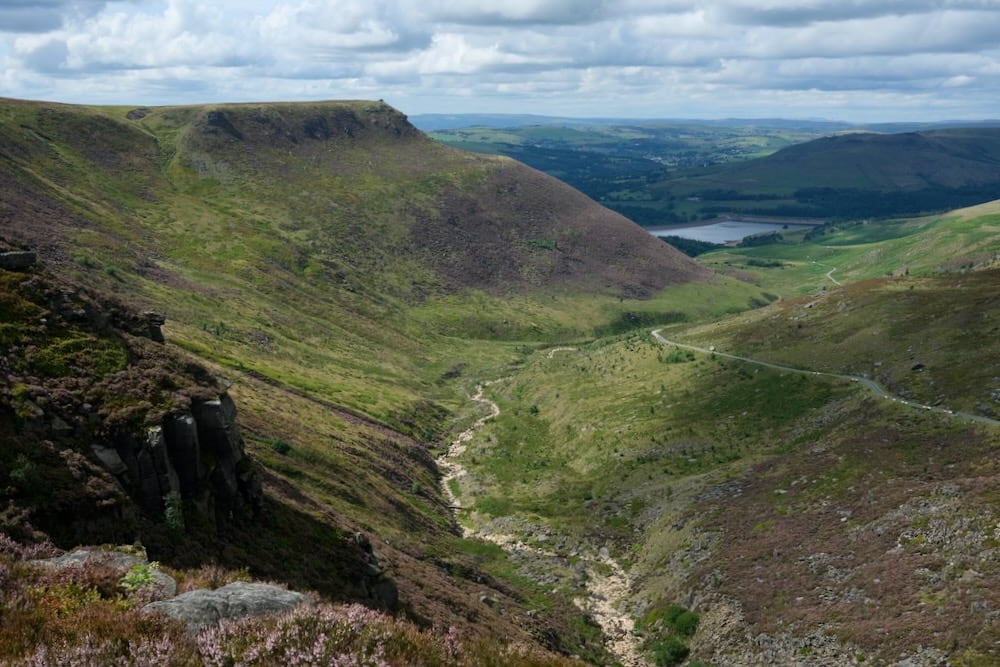
The key ingredient is the play of light and shadow. When some part of the gorge is lit up before my eyes and then the light spreads and moves to another part of the scree and scrub, directing the eye, I feel a wonderful sense of aliveness in the earth, and something more: an elusive significance in the patterns made by the ceaseless sliding of clouds beneath the sun.
I descended back to town, and townfolk. A white-haired man stood in his driveway, staring at an unremarkable bush. Nigel was considering whether to replace it with something else. His house was relatively new—built 23 years ago—but, to my pleasure, had a plaque: Swallow Bank. Named thus because he’d seen swallows dive and bank through the scaffolding as the house was erected. I realised that the houses in heritage areas are named not (only) as a matter of pride, but because they don’t have numbers. It’s how to identify the house. Um, duh. Who knows what else I’ve missed? One day I might understand the clouds.
Greenfield → Newhey
3 August 2025
24,708 steps
24,708 steps
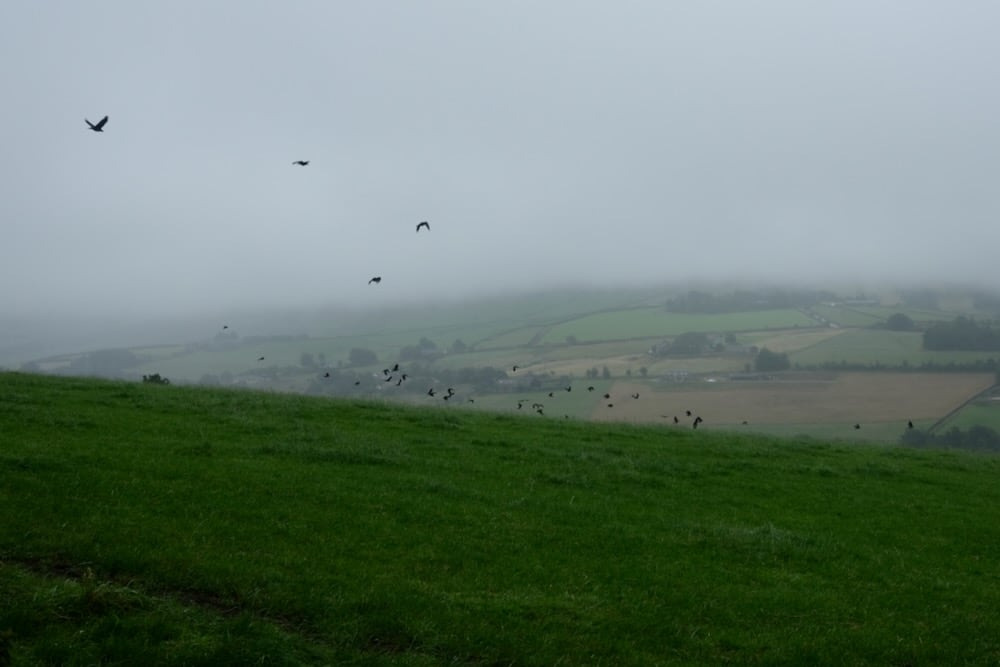
Heavy drizzle along the canal. Sunday walkers in rain jackets holding umbrellas. I wore only a t-shirt; I had faith the weather would clear up. And it did, but first: country lanes and farm tracks, the pungency of manure, wheeling jackdaws, curls of woodsmoke merging with a veil of mist.
As I walked, I wondered what portion of my attraction to farmland, especially the hilly, rock-studded variety, was rooted in childhood memories of my grandparents’ farms, and what portion was just the attraction of the countryside since time immemorial—that of fresh air, openness, quiet—felt in varying degrees by everyone. The Pyrenees, the furthest tip of Ireland, the middle of Mongolia: all these places I’ve had the momentary sense of transportation through time and space to myself as a twelve-year-old looking across the paddocks of a farm in country New South Wales.
I went through an overgrown right-of-way between two fields, two hundred metres dense with reeds and long grasses that deposited all the morning’s moisture onto my clothes. At the other side, I stooped to wring water from the bottom of my pants, pulling and bunching them one leg at a time.
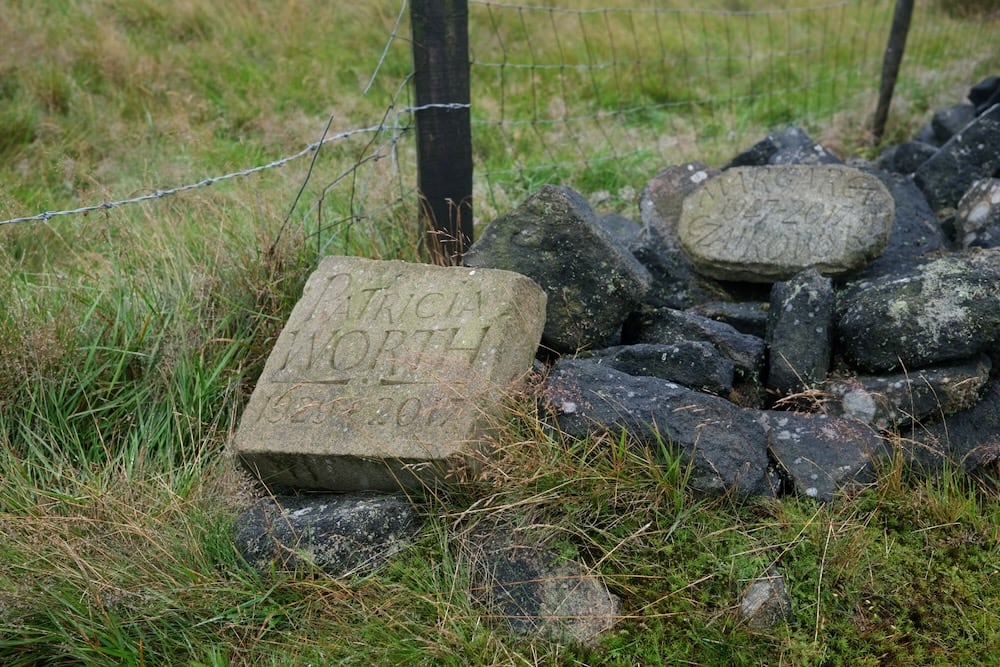
A ridge on my route was now in sight, barely. A woman passing by showed a photo of the view the day before. ”You could see for miles.” Her father-in-law’s plaque was near the ordnance survey triangle. She visited it again today, but the ground was marshy, with fog all around.
But it was lifting, here and there. My pants dried thanks to the wind over the exposed moor. As I walked up the hill, the valley to my left became revealed through shreds of fog, light playing over the fields. An upside-down triangle of white hovered on the horizon: a cleft between steep hills with a lintel of cloud closing the V. Sometimes it darkened suddenly. With the broken landscape of jutting shale and the fierce wind continuing to blow over the ridge, the coming and going of that shade felt like an escape from the Nazgûl.
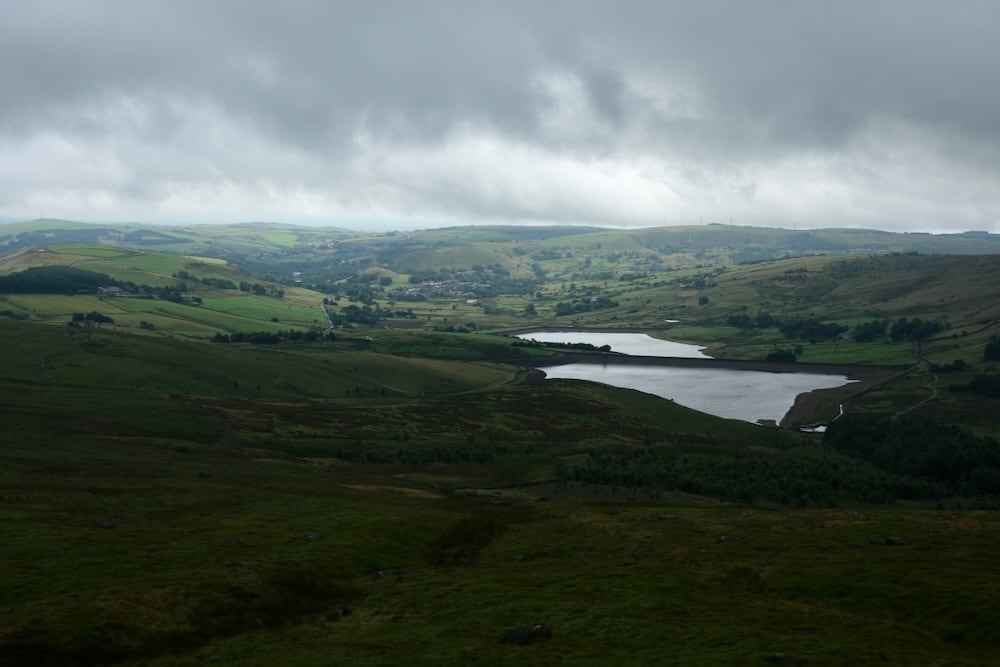
The mist streamed by. When I got to the ordnance survey marker—which painted white in the glare I mistook for a pillar of solid silver—the valley to my left was again hidden, but now the right-hand side had opened up, with a sharp ridge picked out in gold.
As I continued there was an exchange of views in every direction. Ten kilometres in, I had exhausted my meagre food supply: a fruit bar, three choc-chip cookies, and a single piece of individually packaged tofu that had been marinated in a spicy sauce. I watched a young brown sparrowhawk soar above the reservoir. There were lambs in the fields, and two black calves.
I stopped for a late lunch at a pub in Denshaw, and sat there for a while in bare feet, socks drying, reading The Narrative of Arthur Gordon Pym of Nantucket, the only novel by Edgar Allen Poe. Eventually I decided I should get on. Outside the day had brightened up, still cloudy but considerably more blue. It was straight uphill from the pub, and I was lethargic from the meal. Mentally, I felt trapped in the hold of a ship at sea with Pym. In the chapter I had just read, he was delirious after ten days of hiding in the belly of the ship, having sustained himself on peach liqueur and sausage, barely moving except to stand and stretch now and then between crates in the dark. But within half an hour I found my legs again and enjoyed the view of moors peppered with wind turbines.
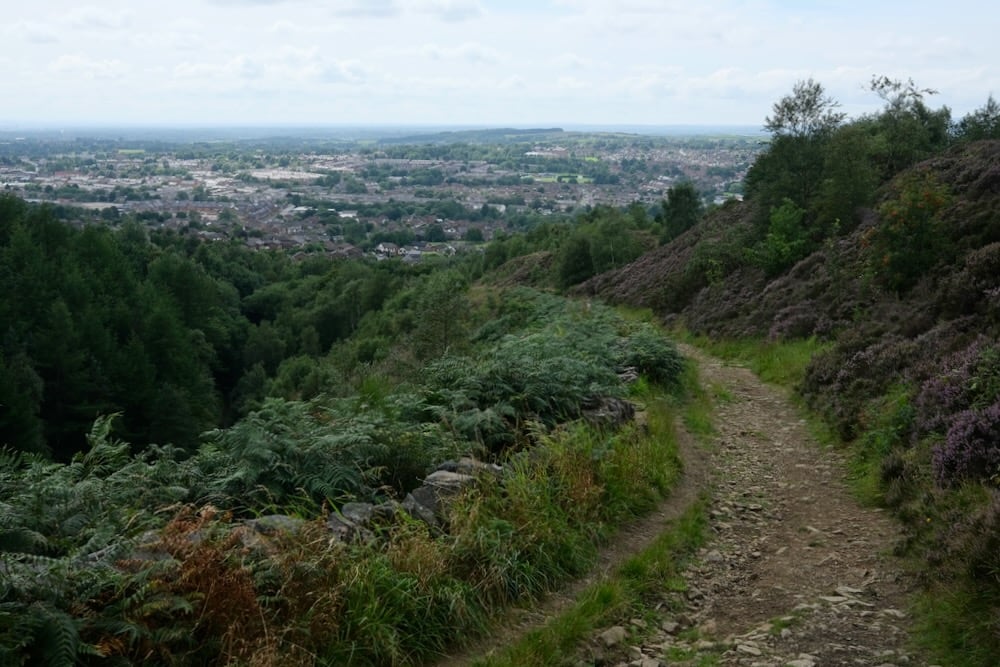
Downhill then, for the most part, towards smoke stacks and chimneys. I saw a man step back to size up his fence, place a stone, tap gently with a hammer. A tractor crawled along the lane. The clouds were all billowy. Grass quivered; swallows flew in and out of the arched entrance to a barn. The hum of traffic filtered up the hillside, pulling me back to town. I met a woman who’d lived in the area for 26 years. “Has it changed much in that time?” I asked. She turned her head to the fields, thinking about my question for a few seconds, then said: “No, not at all.”
Newhey → Littleborough
5 August 2025
21,546 steps
21,546 steps
I have a minor obsession with travelling light, even at home. If I can get away with stuffing things into the capacious pockets of my climbing pants, and leave my pannier at home, so much the better. I’ve never really been bitten by this. The worst I can remember is being denied entry someplace by dint of having left photo ID in a wallet on my desk, having plucked out just my train card, the only card I thought necessary for that evening.
Given the weather in Manchester, it was foolish today to think a rain jacket unimportant. Gloves and a buff would also have been welcome. These were incredibly light items. I deigned to pack a first-aid kit, so why not a bit of extra clothing? Why did I find myself at 8:30 am crossing the city to the train station in a t-shirt, effecting a brisk pace to offset the chill wind and drizzle, office workers around me drawing their parkas close? I was obtusely confident that the weather would turn for me as it had on the last stage. Surprise: it did not.
Up to the reservoir I went. A father and son stood fishing where the steep artificial slope met a very low waterline. England really did seem to be running out of water. Up a cobbled path. Past a disused quarry. Along a private road marked for “fishers only”. (Funnily, the first people I passed in an hour were locals walking their dogs along this short stretch of so-called private road.) Past another low reservoir to higher, more exposed ground. Terrific views through eyes squinted against the wind. I’d left my sunglasses at home, of course.
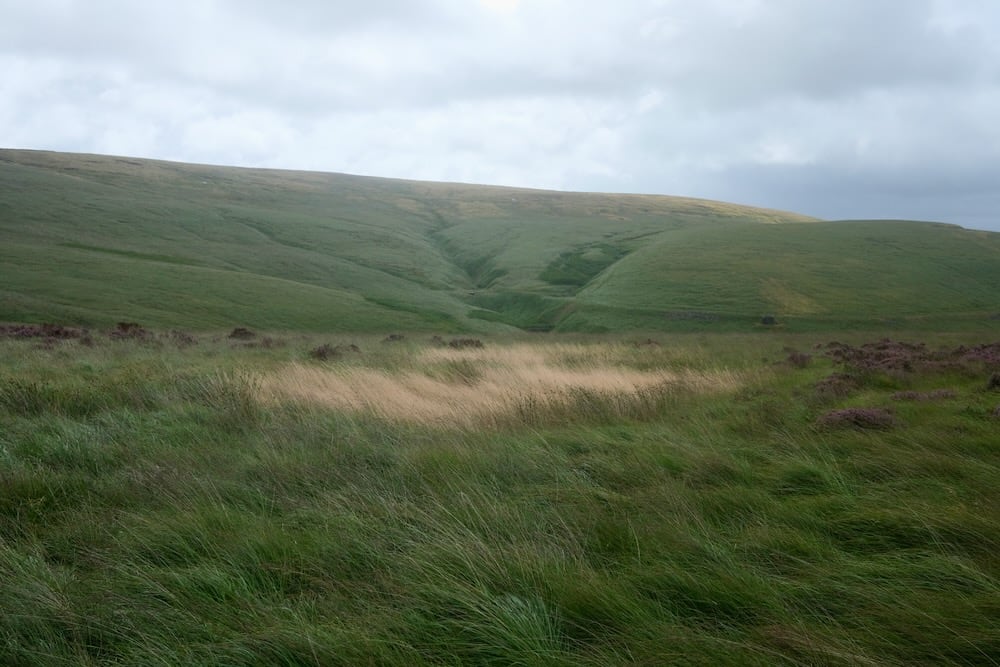
The valley extended before me. A huge landscape of scalloped hills with a major highway running through its middle. I kept climbing up one side, wondering how I would cross it. Thinking of all the people in their cars zooming between cities. Thinking of how I chose to use my time. I was grateful to be out here, but also, the undersides of my upper arms were numbed by the wind.
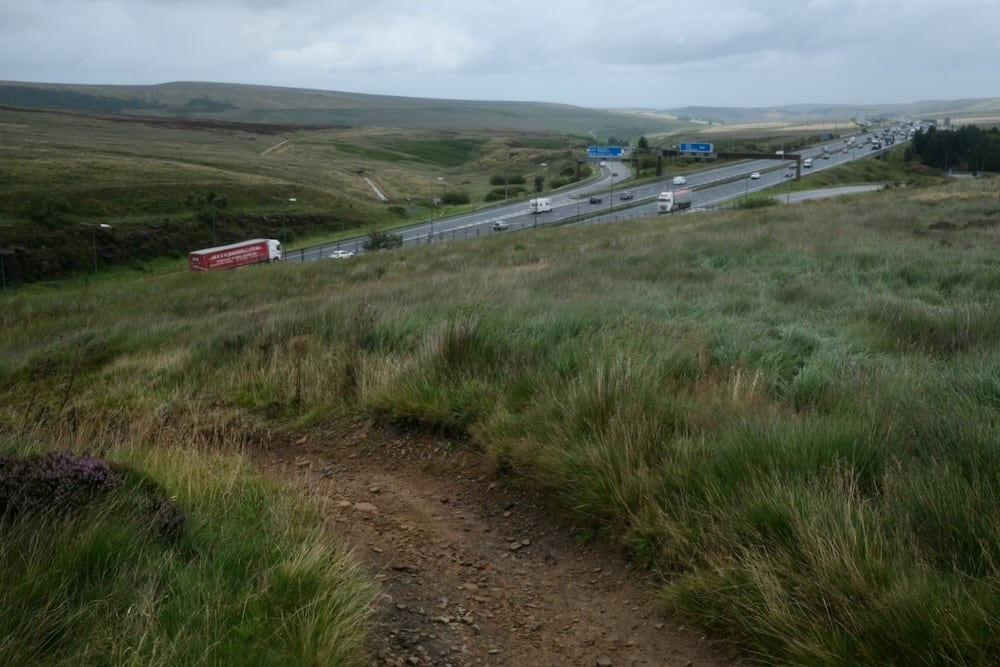
After hopscotching across a bog, I went uphill to a radio tower, and from there to a narrow footbridge over the highway where it ran through a deep road cutting. The footbridge had surprisingly low sides, and a hard current of air channelled into the cutting from up the valley. A procession of trucks screamed below. My palm turned black with dust and particulate matter from running my hand along the railing the whole way across the bridge. Then it was behind me and hidden and there was 360 degrees of moors, no fences, irregular raindrops hurled with stinging force.
And a beautiful path of large rectangular stones laid end to end, a fairytale path, slick and shining when a patch of sun snuck through the clouds.
The path snaked upward. At the top the wind was fiercer than ever; a fresh fusillade of rain bullets struck my face and neck. But no complaints. The walk was elevated by adversarial weather into a higher category: exhilarating.
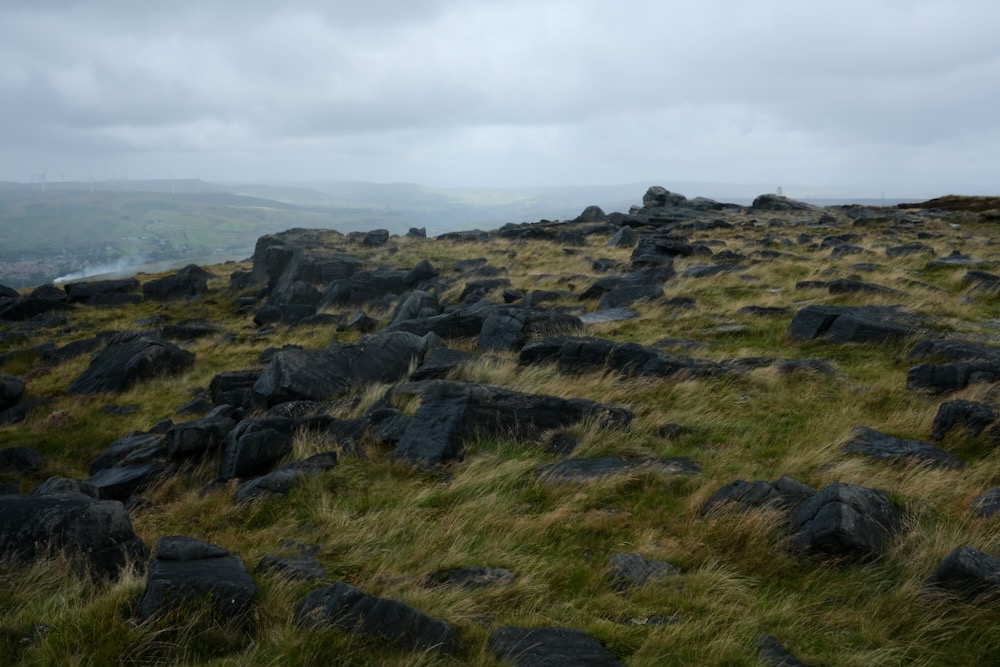
Near the ordnance marker, I met a young German hiker called Tim, who huddled in a hooded poncho and gaiters like a bundle of moss, consulting his plastic-covered map. He was walking the Pennine Way. He’d flown into England on Saturday and immediately set off. This was day three of fifteen.
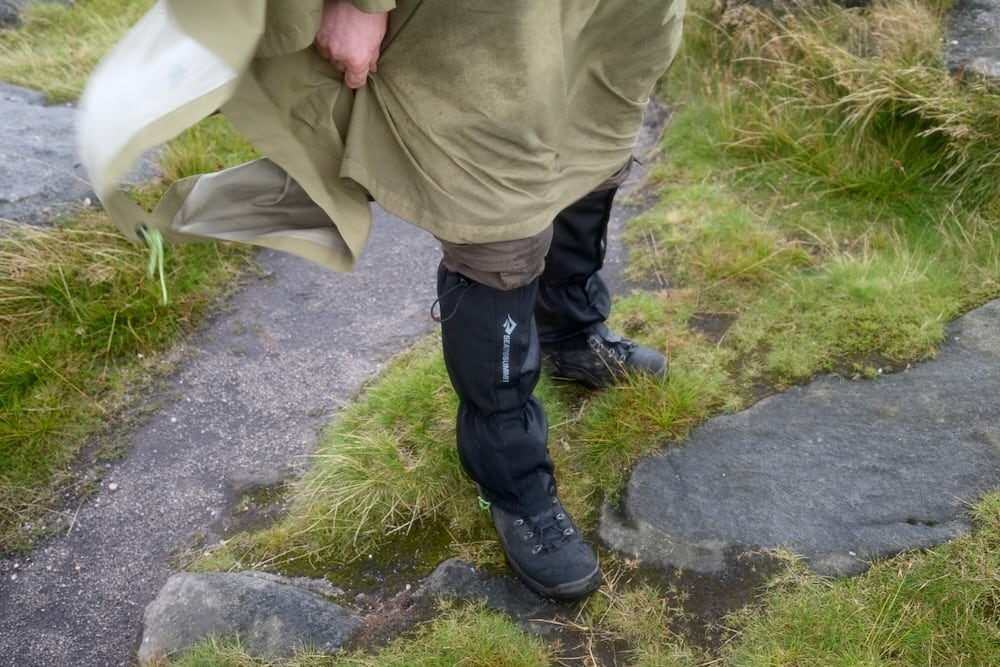
He looked at me in my cotton tee. “Aren’t you cold?!” he yelled. We were in arm’s reach but struggled to hear each other, using our hands as helpless shields against the relentless stream of air rushing over the crest of the hill. I shrugged, yelled back: “It’s not too bad!” A bald-faced disavowal of my inner rumination. He was planning to stop at the next pub. It would’ve been nice to get a drink, but the Pennine Way kept north along the ridge, while my route struck west, losing altitude. We farewelled. I went ahead, buoyed by my only social encounter of the day, leaping spritely from boulder to boulder, bounding down the valley. After a few minutes I glanced back toward the clouds. There he was, a dark figure now, proceeding cautiously around the rocks, back bent beneath his pack.
Littleborough → Norden
11 August 2025
20,622 steps
20,622 steps
A cheese-and-onion pie, please. Sure, OK, home-made. Hold the beans. The woman who served me could have been, probably was related to the older man beside her. An easy familiarity flowed between the two of them and the patrons who shouldered through the plastic strip door of the bakery. They inquired about holidays, held a package behind the counter for someone’s friend to pick up. Once I stepped back into the heat outside, white paper bag in hand, the high street felt more real, a place where lives were lived, a community.
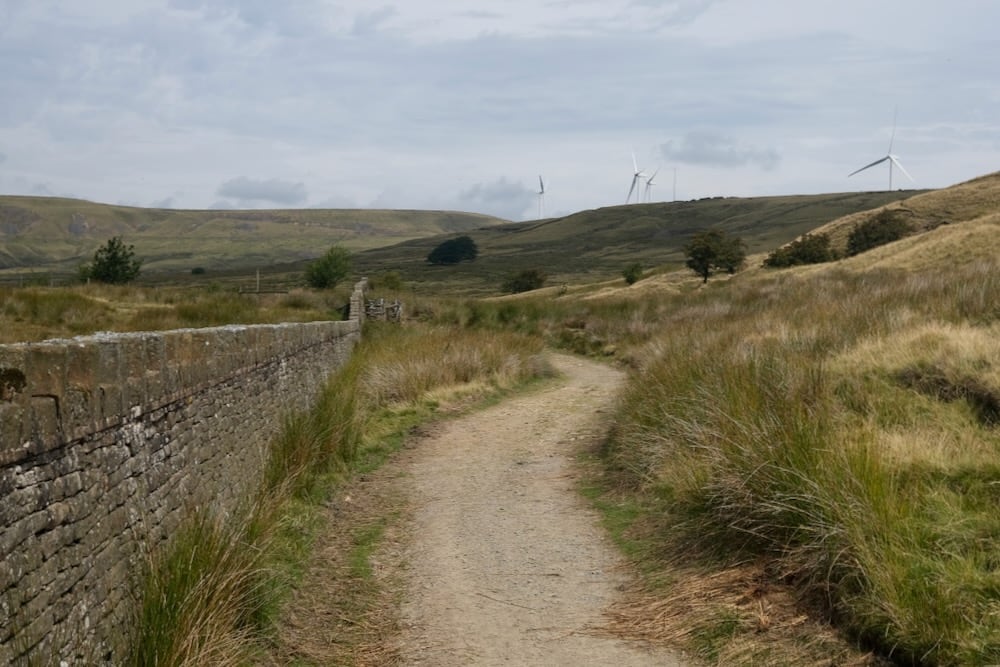
Which was a nice way to start, because I soon left the village for the even quieter company of turbines. Their white blades kept in my periphery throughout the day, some still, others barely shifting, like a conversation held in hammocks. On vacation too were the sheep, chewing lazily with circular movements of the jaws. The whole country was glazed and steaming. Hills enlarged and retreated. Clumps of reeds dotted the land like large green echidnas huddled beneath clouds massed in much the same manner.
At times, I admit, I was bored. Last week marked the end of the “Exhilarating East”, as the trail branded stages 5 to 10. Today began the “Noble North”. Not quite as enticing. But pushing into “boredom”—more canals, more fields, more little towns—is a way of forcing myself to look past the sameness, or appreciate it. To sharpen my attention, to push beyond the reach of algorithms. Put another way, boredom is freedom. It opens space and time for thought.
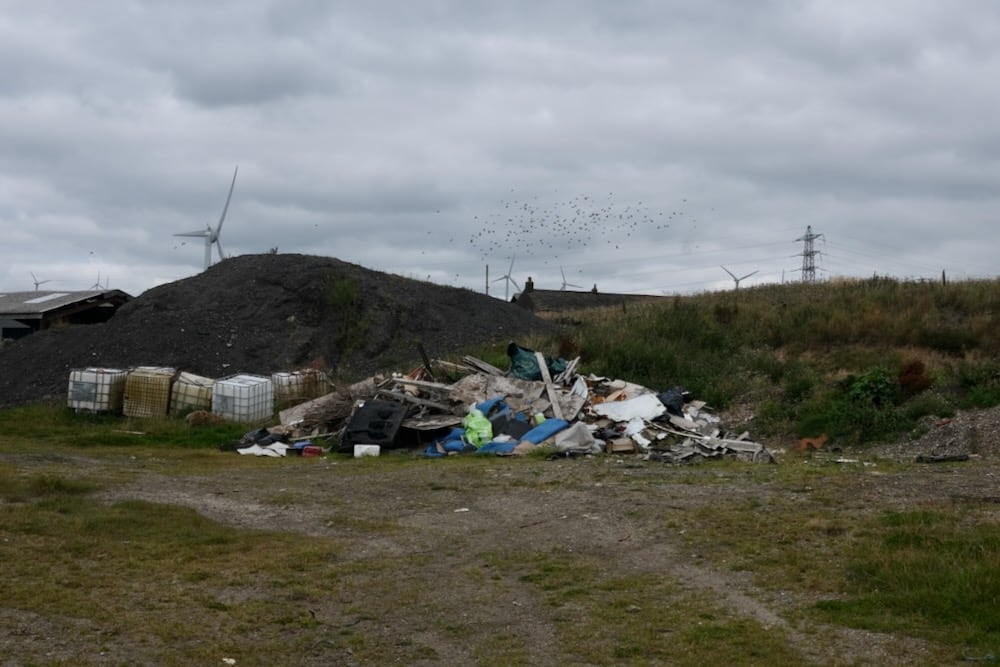
In one storybook nature reserve, I crossed a high viaduct above a river. Dense bright-green foliage, snatches of blue, murmur of water. Elsewhere, I crossed a wasteland. Dozens of fissured mounds beneath powerlines, sheep trails doubling as mountain bike tracks, parcels of land sacrificed to rusted cars and scrap metal; all enveloped by a humid, baking air. Soon enough I was waiting at a bus stop by a developing estate, then boarding a cute three-quarter bus to begin a circuitous journey towards the city.
Norden → Darwen
20 August 2025
31,166 steps
31,166 steps
Back at the bus stop, I went off-route immediately. This would be my last and longest stage, a stage of my own devising. A change in my partner’s plans meant I had a solo fortnight and no need to remain in Manchester. I could stay here to squeeze in the final stages… or I could go someplace new. Having read City of Djinns recently, I was drawn to India, which was also conveniently en route home; no extra time in the air. After some research, I learned that Ahmedabad, in western India, is known as the “Manchester of the East” due to its textile history. This piqued my interest, obviously. Ahmedabad is also the city where Gandhi lived some of his most influential years—and following the thread, I learned that in 1931, Gandhi had visited Darwen, just a day’s walk from where I ended the last stage.
That settled it. I’d walk to Darwen. A coda to a route cut short, a segue into India. That narrative was the cover I needed to abandon the Ringway. I booked flights to arrive in Ahmedabad as soon as the visa process allowed. The next day—yesterday—I got vaxxed for hepatitis A and typhoid. Too last-minute to be effective, really; I’d be back home before the antibodies formed ranks. But I’m a sucker for jabs.
When hastily sketching my route, I hadn’t thought to consult a rights-of-way map. The lane I’d gone up from the bus stop soon became gravel, and hit a private property sign. Fortunately, in much smaller print, the sign declared it was a public footpath and bridleway. That was good. A kilometre later, my route would’ve had me cross a stream via a bridge that didn’t exist. Not so good.
I beat a path along the side of the stream until I found a place to ford it. Eventually I made it back onto the route, finding a quiet country road between blackberries and alpacas. A few more of these detours and this could end up being a very long walk indeed.
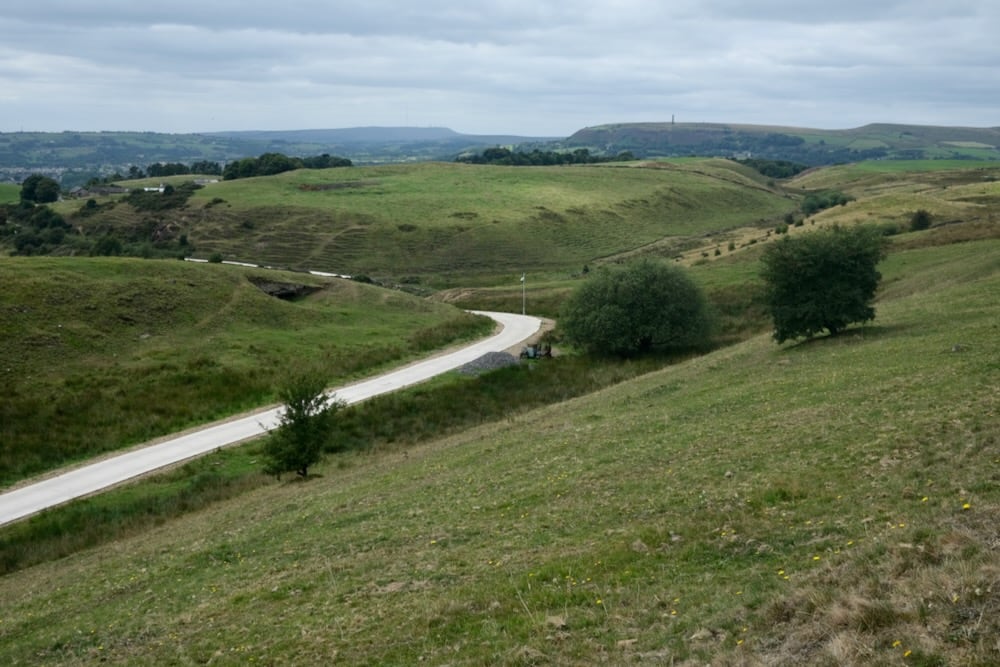
A long walk would be apropos, though. I was, after a fashion, walking in the footsteps of Gandhi, and Gandhi was, famously, a walker. A few days ago, after I’d decided to head to India, I began reading his autobiography, The Story of My Experiments with Truth. He wasn’t one for sport; he tried to avoid cricket and gymnastics in school. However, he’d read about “the benefits of long walks in the open air”, so from his teenage years began a lifelong habit of walking for exercise, economical transport, and activism. He claims to have once clocked 88 km in one day, but I don’t know how reliable Garmin watches were in the early 20th century.
Gandhi didn’t often walk in the fashion I was, though—skirting gullies, roaming to find a way forward, climbing fences. I passed close to the wind turbines, maybe a couple of hundred metres away. They were huge and impressive and the blades eerily quiet and fast-rotating considering their incredible tonnage, a contrast that reminded me of seals: ungainly on land, breathtakingly agile underwater. The last time I’d walked in this area every turbine had been still. Now the wind blew. Every one moved at a good clip.
From how the GPS line followed the land’s contours, and from markings and stones underfoot here and there, it seemed that I was following paths that had once been in better condition. Now, fallen into disuse, they had in some places almost disappeared altogether. It felt good to tramp through, keeping them alive.
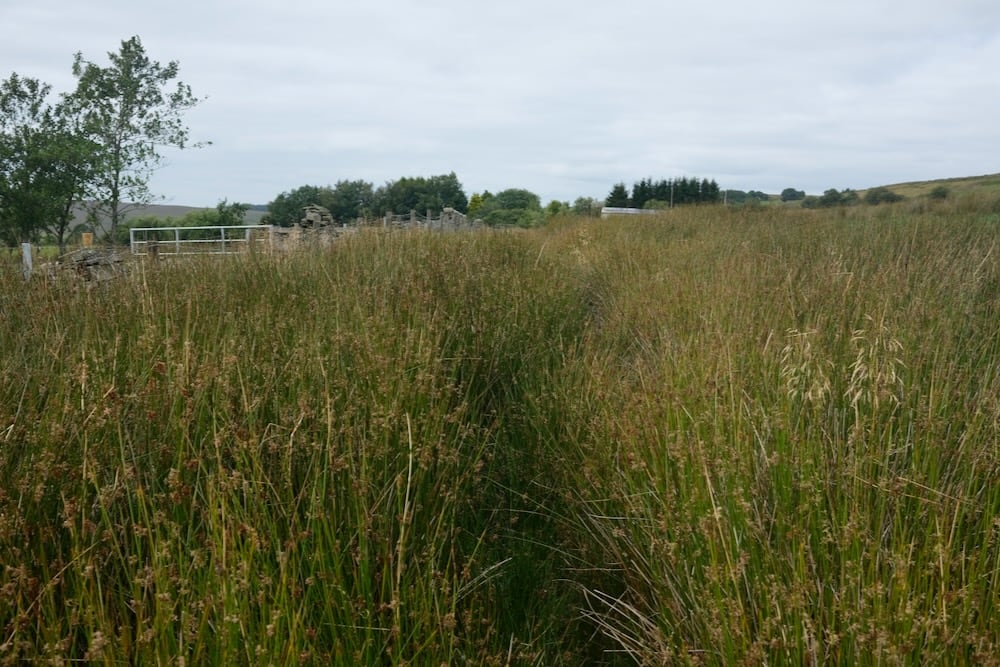
I was having to think so much about where I was putting my feet that I found it difficult to meditate on what I was doing in the first place. Going this way. Perhaps it simply didn’t call for much attention. It’s an odd thing, choosing to walk to a spot where Gandhi had once stopped for a night, a brief entry in his extensive travels that happened to coincide with my own. I wasn’t literally retracing his footsteps. These fields I walked were of no significance. Ultimately, I was connecting the dots of Norden and Darwen just because I discovered there were two dots to connect.
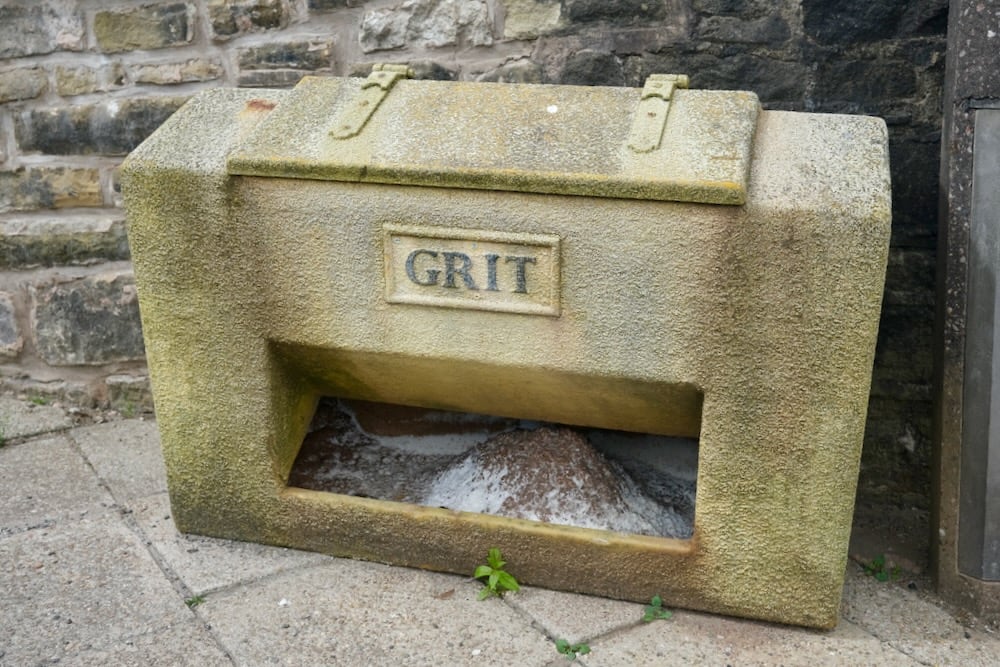
A rocky path led me to Ramsbottom, a picturesque town of stone that I crossed in a blink. On the steep rise up the opposite side of the valley, just before a leafy glen with owls hooting, I passed another instance of an object I’d seen repeatedly on the walk: a yellow roadside box labelled “grit”. A scatter of the coarse sand, often mixed with salt to melt ice, improves road conditions in winter.
I was reminded of Gandhi’s Salt March, taken in protest of the British government’s impoverishing taxation of salt in 1930—the year before he visited Darwen. He and seventy-eight fellow satyagrahis walked almost 400 kilometres, stopping at multiple villages every day, with Gandhi giving speeches to thousands. Encouraging mass civil disobedience around the salt tax—notably by picking up a clod from the beach at the conclusion of the march and boiling it to produce salt—Gandhi also pushed for a boycott of foreign (British) cloth in favour of Indian-produced khadi.
In 1750, prior to the arrival of the British, one-quarter of the world’s industrial output was produced by India. By 1900 this had fallen to just 2 percent. India’s de-industrialisation was the yin to the yang of Britain’s industrial rise, which saw the building of many cotton weaving mills in Lancashire, where I was walking today.
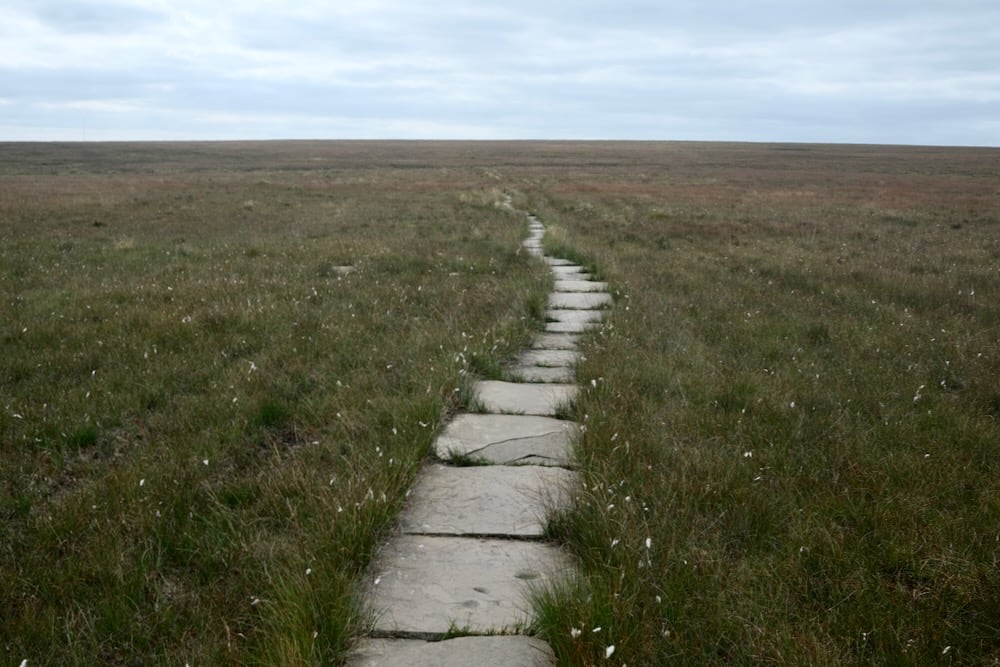
I was on a wide open way now, the Holcombe Moor with its far-reaching views. One knoll was sometimes used as a military firing range. There was a brisk breeze, no sound but the wind: an old familiar peace. A long snaking line of stone blocks, similar to those on the Pennine Way, led me over land with little in the way of decoration but for bog cotton. Landscape like a two-stripe flag: heavy white cloud on top, brown below. As the path curved ahead and behind, it disappeared behind tall grass, like it was being pulled up behind me and laid in front by invisible hands.
Halfway. I started talking to myself. As I got closer to the town where Gandhi had stayed, I found myself focused outwardly, as if to burn scenes in my retina for a double exposure in Ahmedabad, two days hence—or if the rush of newness there blotted out the English countryside, I was at least burying some kernel of this windswept plateau, of the stretch of fields that followed, the neck-high reed tunnels, collapsed stiles, steampunk turbines.
It had been 18 km of unstable footing now, tramping through fields where a path may or may not have once existed. I sat to snack on a peanut bar. Two horses ambled towards me, stuck their heads over the fence. I watched them a while, admiring; I had never been within arm’s reach of a horse without another human present. One chestnut mare scratched her neck for a full minute using the top of a fence post. Licked her knees. Snorted. Necked the other horse. Stared back at me over the fence.
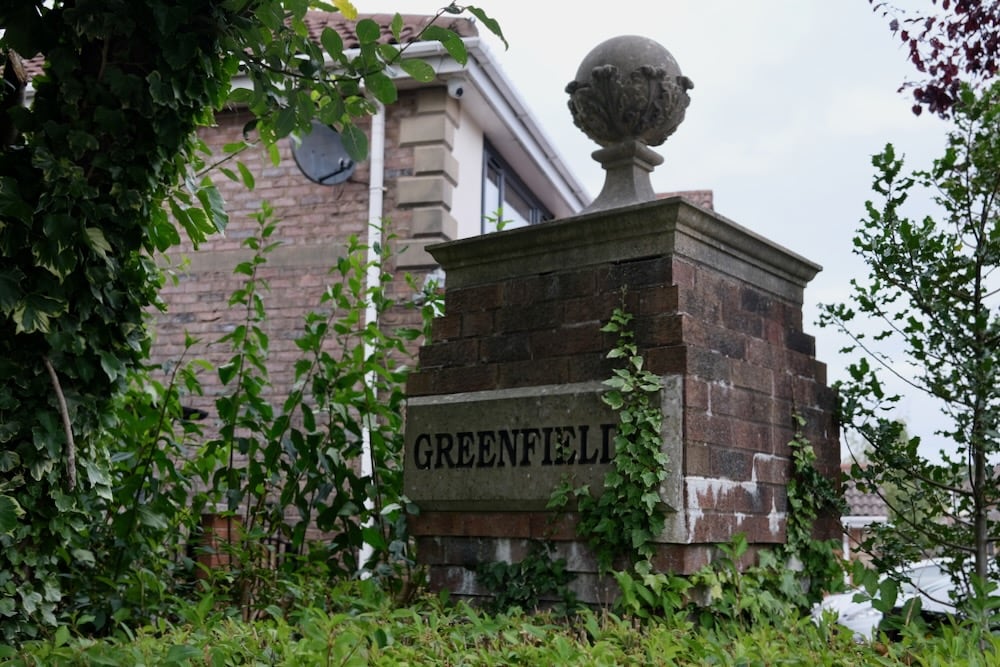
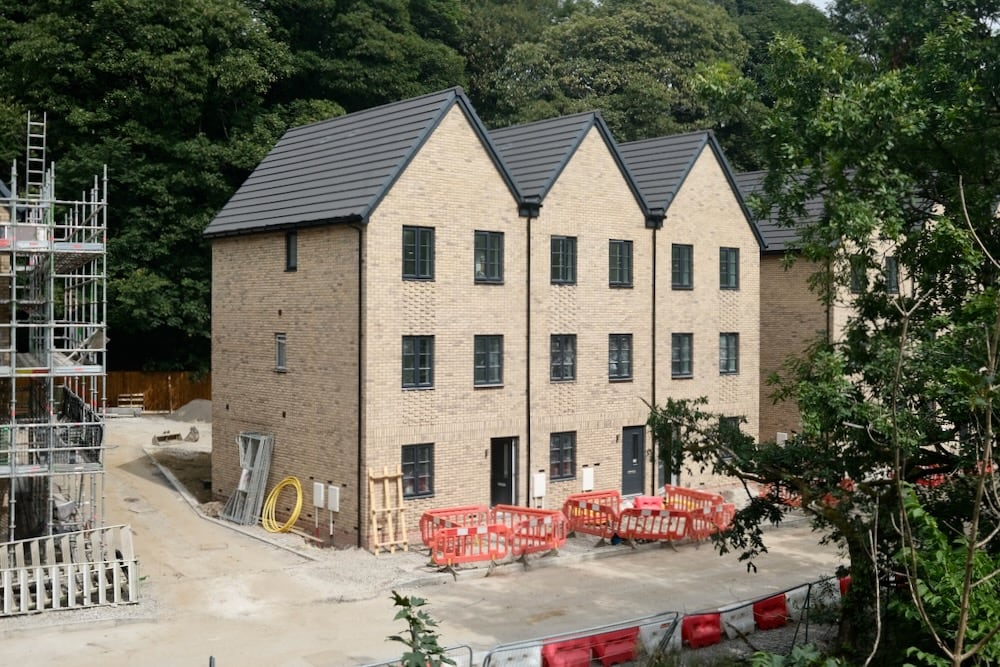
A few fields later I reached the urban edge of Darwen. I was at the head of a valley, looking at the town spread below, the India Mill chimney lit by a low sun. I walked down the road, alert for any vestige of the mill Gandhi had visited—Greenfield Mill, built in 1865. It had closed in 1959 and, according to an undated heritage webpage, was now a housing site. I came upon a fresh housing estate of cream brick houses with white-trimmed double-glazed windows and slate roofs. Could that be the site?
Across the road, in an undeveloped plot of grass, two young girls rode horses in circles; I could hear their yelled conversation. One girl held her phone high, camera pointed back at herself, smiling as she repeatedly hit the horse with a crop to perform a manoeuvre she wanted to film just right for TikTok.
I kept going down the road, unsettled by the sight of the child’s innocent violence. At the entrance to another, older estate, I saw a plaque reading ‘Greenfields’. This was probably it then—the former site of Greenfield Mill. I wandered into the cul-de-sac of big brick houses with concrete roof tiles and large-windowed facades. Nothing else of note. Opposite the estate were even older homes, built of natural stone and slate, encircling a shared green: a terrace estate built for the mill workers. Gandhi had stayed at Number 3 Garden Village on 26 September 1931, according to the blue historic marker high on its facade.
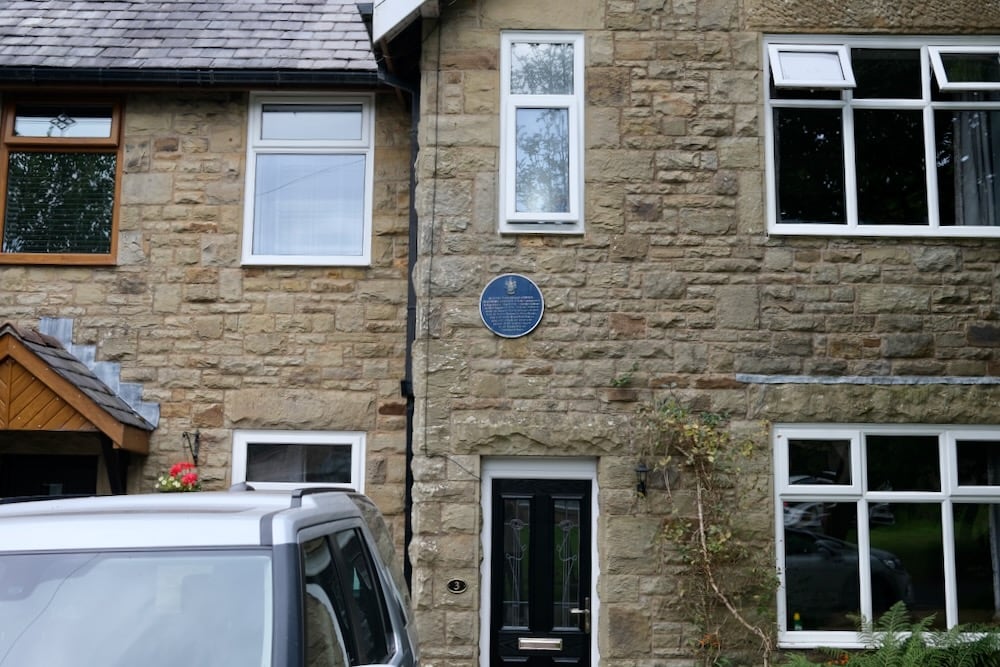
He’d been invited to Darwen by a local mill owner whose interests were impacted by the Indian independence movement’s boycott of British textiles. The owner had hoped that Gandhi would be moved by hearing the workers’ experiences of Lancashire’s downturn. But it didn’t have the effect they sought; Gandhi, though sympathetic, is said to have remarked to one worker: “My dear, you have no idea what poverty is.”
The blue marker was a kind of inflection point. It was an icon for the only Gandhi I had known—the international figure of nonviolent resistance who, shortly after visiting Darwen’s mill owners and workers, met King George V at Buckingham Palace in his sandals and loincloth. Each step I took after Number 3 Garden Village felt like moving into the past. The next day I would fly to Ahmedabad, where Gandhi spent the 13 years preceding his march to Dandi. I would visit Sabarmati Ashram, where it began.
The rest of the walk passed quickly: run-down flats and factories with roadside industrial heritage, and not just textiles: a massive cylinder for drying paper, a rotary drive for cutting. The replacement of human labour with machines. It felt apt that I hadn’t spoken to a soul all day.