Quiet country upriver
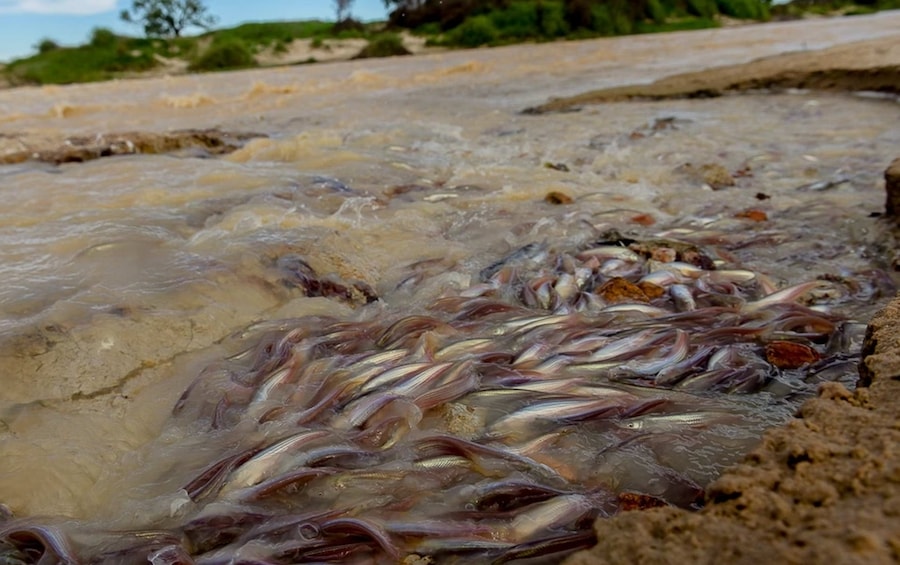
Hundreds of fish in Birdsville make their way upstream
What counts as “wilderness”? A lot has been said about this. As good a starting point as any is Kathleen Jamie’s excoriation of the notion that there’s any distinction between wild and not-wild in the UK, where
every square inch of it is ‘owned’, much has seen centuries of bitter dispute; the whole landscape is man-made, deforested, drained, burned for grouse moor, long cleared of its peasants or abandoned by them. It’s turned into prairie, or designated by this or that acronym; it’s subject to planning regulations and management plans. It’s shot over by royalty, flown over by the RAF, or trampled underfoot in the wind-farm gold-rush. Of course there are animals and birds, which look wild and free, but you may be sure they’ve been counted, ringed maybe, even radio-tagged, and all for good scientific reasons.
The distinction is fraught in Australia, too. Land that a British person might call “wild” has likely been stewarded by Aboriginal folk, some of whom use “wild” in a markedly different way. When Deborah Bird Rose visited a cattle station in the Northern Territory where extreme erosion was evident, she asked Daly Pulkara, one of her teachers, what he called the country:
He looked at it long and heavily before he said: ‘It’s the wild. Just the wild.’ Daly went on to speak of quiet country – the country in which all the care of generations of people is evident to those who know how to see it. Quiet country stands in contrast to the wild: we were looking at a wilderness, man-made and cattle-made. This ‘wild’ was a place where the life of the country was falling into the gullies and washing away with rains.
According to Rose, “quiet” is a Kriol term that means “tame, domesticated, not dangerous, under control”. An uncanny implication that I find here, based on the meaning of quiet in standard English, is that degraded country is loud—perhaps because it’s crying out for respect.
Elsewhere, William Cronon has argued that the issue with wilderness is that it represents
the false hope of an escape from responsibility, the illusion that we can somehow wipe clean the slate of our past and return to the tabula rasa that supposedly existed before we began to leave our marks on the world. […] This, then, is the central paradox: wilderness embodies a dualistic vision in which the human is entirely outside the natural. If we allow ourselves to believe that nature, to be true, must also be wild, then our very presence in nature represents its fall.
He later writes:
Wilderness is the place where, symbolically at least, we try to withhold our power to dominate. […] In the broadest sense, wilderness teaches us to ask whether the Other must always bend to our will, and, if not, under what circumstances it should be allowed to flourish without our intervention.
I’m reminded of Kati Thanda, a vast salt lake in South Australia that drains hundreds of kilometres of arid desert, a watershed that extends into Queensland and the Northern Territory. When those places get flooded (sometimes destructively so), the lake’s ecosystem—months later—blooms. Red turns green. Millions of birds fly in from far-off coastlines. Insects multiply. Fish swim upstream, keen to travel newly opened channels.
All of this is aided by the fact that the basin’s flows encounter a distinct lack of interference: no dams, diversions or large-scale extraction of water, as suffered by the Murray-Darling system. It’s not as if nobody lives in the watershed. Many do. But the boom-bust cycle of the land means people along the rivers understand how drawing excess water could affect people downstream. The only problem is the gas industry.