Going with the tide
On the topic of how language reflects relationship to country, I went down a rabbit hole learning about frames of spatial reference. You might have known that Australian Aboriginal languages tend to use geocentric (e.g. “north” and “east”) direction terms rather than egocentric terms like “left” or “right”. Speakers on the Cape York Peninsula say things like “move your cup over to the north-northwest a little bit” or “the boy standing to the south of Mary is my brother”.
What was new to me (though not surprising) is that this dependence on geocentric terms goes beyond abstract cardinal directions. Many languages have direction terms tied to the landscape, especially the river, coast, winds, elevation and sun. One language, Bardi, even has terms linked to tidal flow that reverse every six hours: joodarrarr “with the tide” and arrinarr “against the tide”.
But even concepts like “north” have variation across cultures based on physical context. Alice Gaby and colleagues interviewed speakers of Marshallese (an Oceanic language of the Marshall Islands, the nation north of Nauru) and found that when an island’s orientation wasn’t perfectly perpendicular to a cardinal axis, “the cardinal axes rotate such that … the orientation of iōn̄ ‘north’ [can become] quite skewed away from ‘true’ north.”
This is easily seen on Kili Island, where the iōn̄-rōk “north-south” and rear-rilik “east-west” axes actually run parallel:
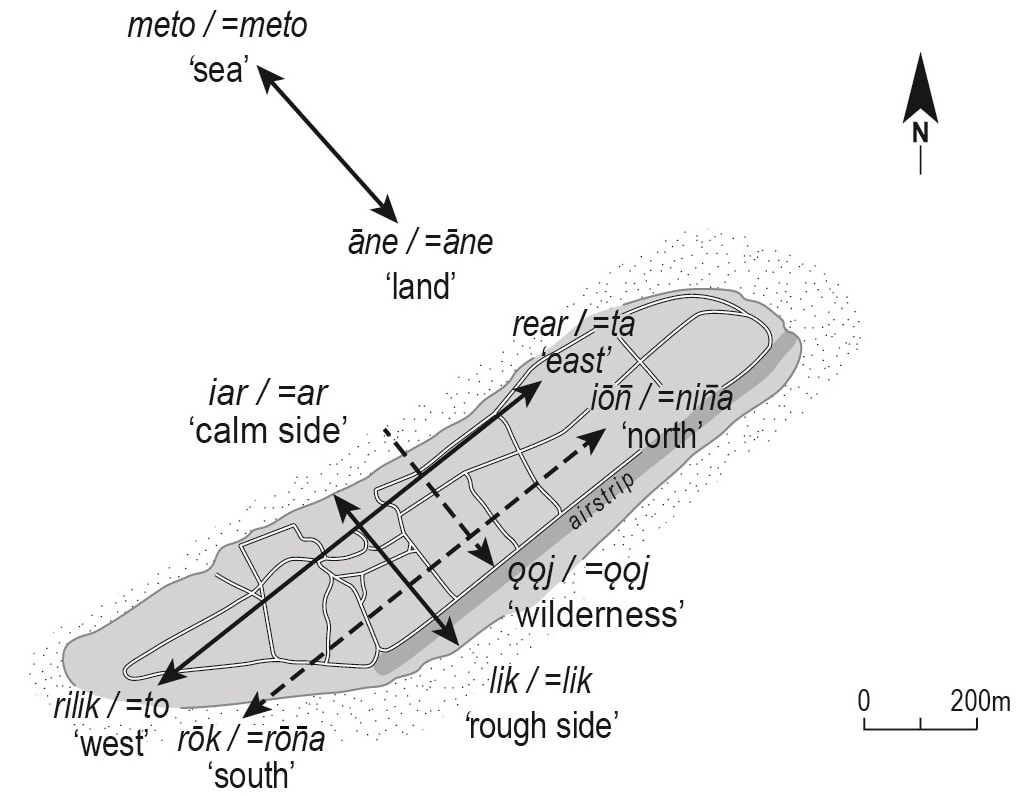
Geocentric system of spatial reference on Kili
That said, given the almost east-west lay of the island, the use of iōn̄ and rōk is rare. Interestingly, Kili Islanders use o̧o̧j “wildernessward” to refer to movement away from the calm, sheltered interior of the island to the rough-water side, though it’s just an airstrip. The land cleared for the airstrip was once uninhabited forest, and the usage has stuck.
As we commonly represent time with reference to space (“forward”, “back”, “long”, “short”), researchers have also investigated how different frames of spatial reference correspond with cultural representations of time. In one remote Aboriginal community, time follows the sun’s path, such that east—where the sun rises—is associated with the past, and time proceeds along an axis to the west.
I find this cognitive variety beautiful and instructive. Maybe alternate systems of spatial and temporal orientation, even briefly tried on as an imaginative exercise, can foster a greater sense of belonging to the land around us. What kinds of geocentric axes exist where you live?