The promenades lining the river that divides the city are so far below street level that as you descend to them the honking of traffic becomes soft and the urgency of daily life ebbs away. It was a muggy August. I had flown to Ahmedabad from Manchester a few days before. I was having broken, feverish sleep; my body couldn’t decide if it was hot or cold. At the five-way roundabout below my three-star hotel I flagged the driver of an immaculate auto-rickshaw with bright-red laminate seats. We joined the dance of mostly two- and three-wheeled traffic and air moved blessedly against my skin. The Sabarmati was swollen today. Twice since I had arrived the promenades had been covered by water that upon receding left behind dozens of snakes and turtles and even once a monitor lizard. I watched the river surge, an implacable force, birds wheeling between the moving islets of water hyacinth torn free from upstream, on the hunt for snails and mosquito larvae.
I wandered the muddy roads and monsoon-stained buildings just past the ashram, peacocks everywhere. With the aid of a passerby I located what I was looking for: Kalamkhush, a paper workshop. In a stroke of great fortune my visit coincided with that of two women studying journalism. We were partners in wonder. More than that—they could translate the workers’ explanations. We watched men beat and soak and press scraps of khadi cotton. These strips were hung until dry, smoothed and cut into a thick paper whose texture is a joy beneath the hand. I purchased three small khadi notebooks, a meagre 320-rupee transaction documented in triplicate: a receipt for me, two carbon copies for the shop. When I observed the careful, unhurried creation of these records, did I grin like an idiot? Maybe. It was a ritual of trade, and the use of an accounting pad made in the workshop itself had an auteuristic quality that recalled Gandhi’s role as an author-publisher.
Behind the paper workshop lay a complex of other village industries that we were invited to freely explore—the Gujarat Khadi Gramodyog Mandal, founded in 1940 as part of the movement to promote Indian self-sufficiency. After taking in the cavernous paper-making room of pulp vats and sheet moulds and drying racks, the three of us walked to a matching pair of two-story concrete buildings whose frames were picked out in faded terracotta red, their external staircases lightened by cantilevered landings and delicate handrails. Criss-crossing a grass courtyard beneath neem trees, we entered one room after another. A man sat cross-legged on the floor assembling spinning wheels, the completed ones in teetering piles around him. A second man sanded chairs; too humid right now to commence varnishing. Women offered us intense mango pickles from shelves lined with jars of cold-pressed sesame oil and herbal tooth powders and skin ointment for buffaloes.
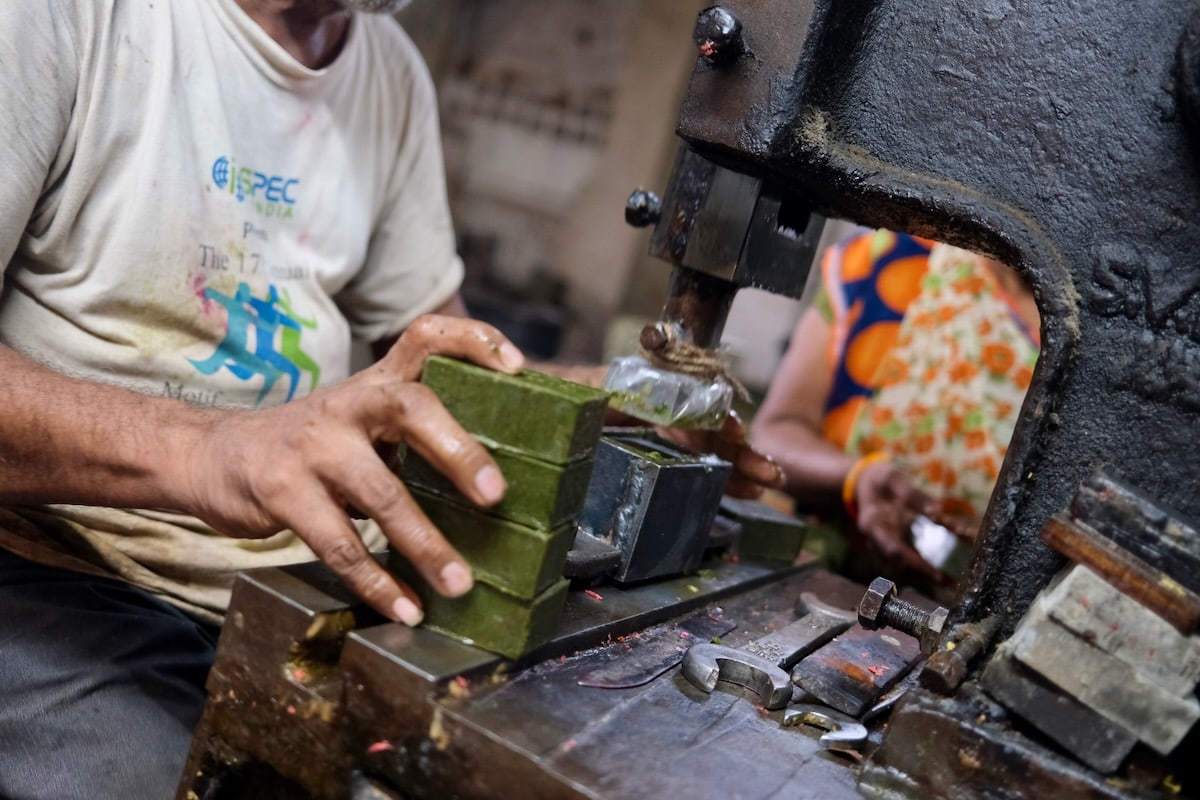
Most memorable for me was the soap production. In a white-walled room with soap-slick floors—I’ve forgotten how to describe the smell exactly; pungent but not unpleasant—trays containing hundreds of bars made with neem sat ready for packaging up. It’s done by just two people, Baldev and Urmila, a married couple who have been making soap for forty years. The process starts by combining oils with flakes of lye poured from large white sacks, ladling the mix into setting trays, and slicing those with a wire cutter. Then they imprint each bar using a treadle press as old as Gandhi, so Baldev said. We watched this last step. Urmila stacked blank billets as Baldev stamped them one by one in a rhythmic, clattering pattern. Did they ever swap tasks? Urmila laughed and said no: if she lost a finger, what would she do at home? As I recall this I think of my mother’s hands, my nanna’s, her father’s, swinging and grasping and twisting, and of my fingers tapping away.
When I met my neighbour Corrie, a 96-year-old Dutch lady who does the rounds each morning with her terrier, she knew me not by name but as The Gardener. This pleased me immensely. I’ve been speedrunning the vocation.
Things began modestly at the Shed. I picked up a few plants whenever I ducked in for other supplies. Already partial to native gardens, I soon learned about the distinction of indigenous species—those that had evolved in the local soil and climate. This confirmed that the Shed’s inventory does, in fact, have lacunae: it stocks few indigenous plants, and all are cultivars. One gardener I spoke to described cultivars as “turbocharged sports cars”. They dazzle, but they’re less resilient and less useful for birds and insects. (One of my grevillea cultivars, after a gasp of neon pink, has already died.)
Easily converted to the church of VINC, I smothered kikuyu, ripped out ivy, wisteria and white jasmine, and planted dollar-coin backyard-grown tubestock. I grew Poa, Rytidosperma and Austrostipa grasses from seed. I put Acacia paradoxa in a place of honour atop a mound, rejecting its undeserved reputation as an “unattractive and thorny shrub”. As the soil warms again, I’m keen to see everything crowd in.
Corrie won’t share my enthusiasm. The gardens I adore, with big trees and tussocks spilling over the footpaths, she considers fine in the country, but not the city. I tried to defend them. They’re less work in summer! “I’m too old to change,” she said, watering her roses, both of us smiling.
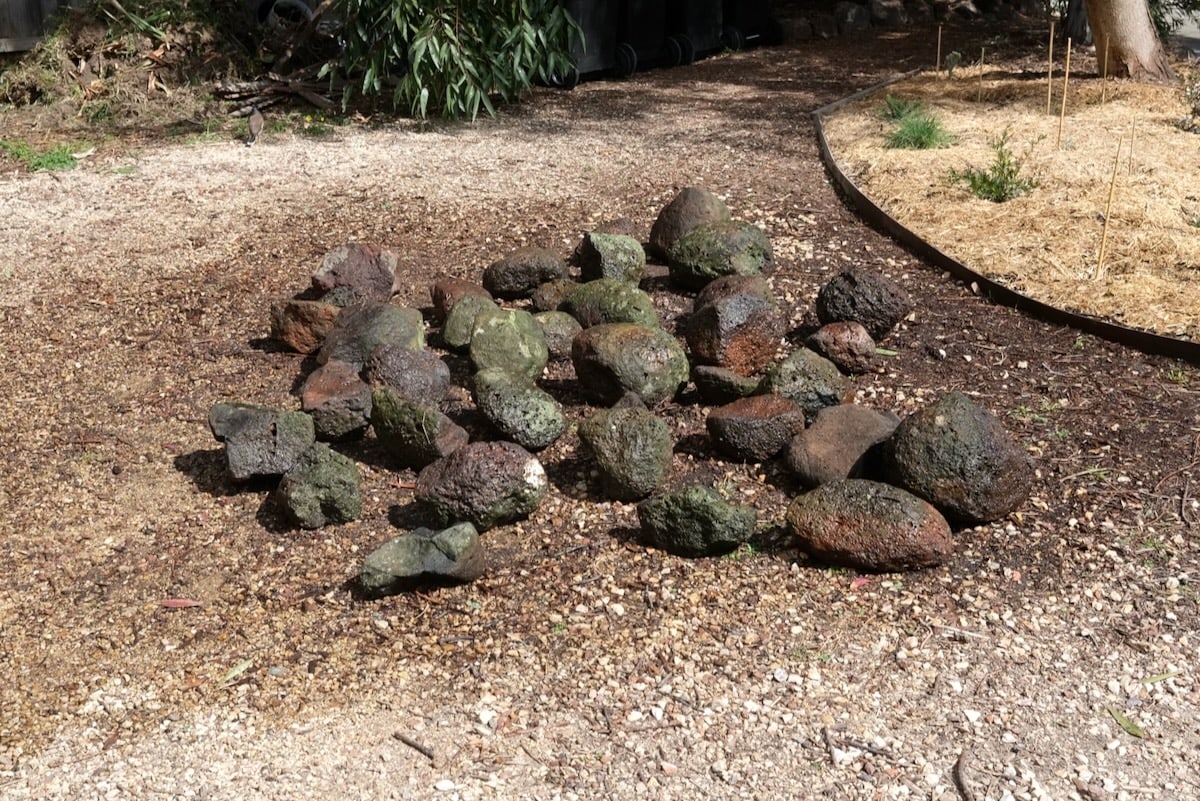
It’s funny, the pursuit of a “natural” look, which requires more effort than letting nature take charge. So much artful deliberation, like how exactly to position a rock. My placement is a kind of instinct, an echo of the hills with half-buried boulders where I flew kites and tossed cow pats as a child, shaping my landscape preferences thereafter. Add to this the fact that I was geology-pilled during lockdown, and it’s not surprising that I began visiting strangers to pick up their unwanted scoria rocks. Sometimes a couple dozen, sometimes one big boulder.
One of my hauls freshly gorgeous and ready to place
I noticed that many listings were south of the river, well outside the volcanic flows that produced the rocks. Obviously here I was moving them around at my whim—but Caulfield? Glen Waverley? Frankston? Where are the glossy brochures encouraging indigenous rocks? The books, the TV specials? Someone had to raise awareness of this issue. How? By rescuing some scoria from the sedimentary outlands of Melbourne’s south-east and returning them whence they (probably) came: the closest volcano.
So over three days in March, I pushed a wheelbarrow of rocks for 60 kilometres. As evidenced by my encounters with the public, there is widespread support—and bemusement—for this volcanic repatriation initiative. Take a look at the video.
Around the same time, I began a ten-week nature stewardship course subsidised by local government. We participants were a motley crew of all ages and backgrounds but a shared dorkiness. We carpooled to grand civic buildings and field trips across the north-western suburbs. It was an exercise in looking closely. We went birding (of course). We tried to tell apart two very similar kinds of grasses. We learned about fire regimes, the secrets of animal scat, and how a legless lizard differs from a snake.
For geology week, we visited Organ Pipes National Park to admire columnar jointing and test the soil. I noticed a path had been topped with graded scoria rock, vibrant red and highly vesicular. It was a bizarre choice, in the uncanny valley of possible surfaces: worse for being almost right. I raised this with a council worker, who recalled that a Wurundjeri person had educated them on this issue during a consultation for another project. They called it “rock pollution”. A few foreign rocks might be low on the scale of harm, but these days, my connection to place starts with appreciating what’s beneath my feet.
In the Shed, which some have called the Universe, there are infinite aisles, infinite shelves, containing every piece of equipment and every kind of material that can or will exist, for projects both real and yet to be imagined. It can be difficult to find what you are looking for. Aisle 8 has door knobs. Aisle 75 has bidets. Aisle 56732 has DIY teleportation kits. A passing attendant advises you that the brackets suggested by the tele-kit are overkill; you can swap them for cheaper parts from the children’s dresser in Aisle 455 if you don’t mind hearing the whump of the air-vacuum and can accept a point-zero-three percent chance of each teleport being misaligned (perhaps a pinky toe’s worth). Such are the arcane trade-offs being weighed by the indeterminately vast number of customers who occupy the Shed at all hours. Their circular deliberations continue long after they exit the building, its low profile receding into the horizon. Nobody has seen the totality of the Shed, or even its sides, but most experts agree that it’s a rectangle whose surface has been painted in one solid colour, a forest green with superior weather resistance that can be obtained from Aisle 31 for $17 per litre.
In David Malouf’s novel An Imaginary Life, a wolf boy learns how to speak by placing his hands on Ovid’s throat, pressing his fingers on the poet’s lips, feeling each puff of air. But in forming our words, the boy adopts more than the bend of a tongue. Just as he so uncannily warbles by taking the bird into his nature, so too, by speaking, does he enter the realm of humans.
There is endless advice about how to learn a language. What of the wolf boy’s method? Become the creature. Become the frog, the bird, the man. This is the result of immersion, of using a new language in daily life. After all, immersion is a game of massive input—and that changes us, whether it’s a thousand hours of Tamil or of Joe Rogan. We become new beings, hybrids, the lineaments recognisable but rearranged.
The wolf boy also harnesses mimicry. One must practice the right sounds. Mimicking native speakers is called shadowing when done in turns, or chorusing when done simultaneously. Shadowing is key to Pimsleur’s listen-and-repeat tapes, which I find enjoyable. But the tapes promote reflexivity more than pronunciation. To sound better, chorusing seems most effective.
Chorusing for pleasure goes way back. In How Religion Evolved, Robin Dunbar claims that singing is part of the endorphin-rich “shamanic” core of today’s religions, along with dancing, fasting/feasting and synchronised movements. This goes some way to explaining the cult of English as a Shouted Language. For the most part, though, linguistic chorusing takes place not in an arena crammed shoulder-to-shoulder with thousands of ecstatic learners, but sitting alone at a computer, hunched over a mic, bathed in the grey light of an audio-editing tool.
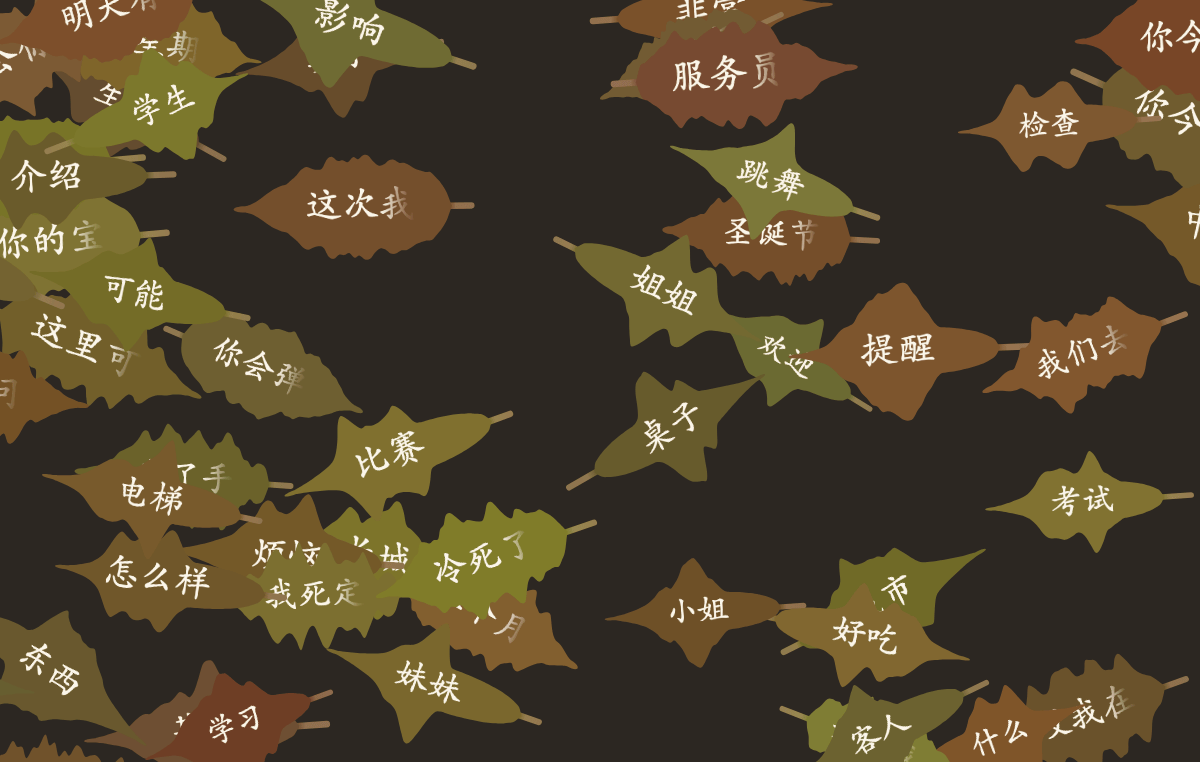
As promising as the technique seemed, it required a fiddly workflow in a joyless interface. To make chorusing more seamless and attractive, I built a dedicated tool: Warble. It’s designed for importing your own material, and I included samples so you can immediately see how it works, like looping snippets, adjusting tempo and recording takes.
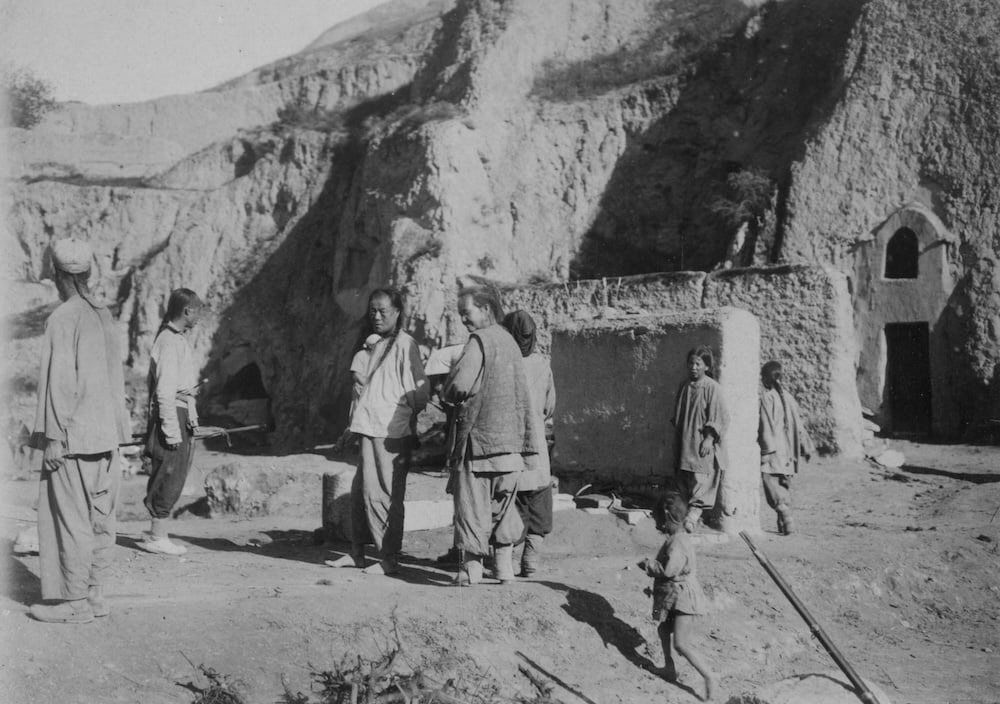
Almost a century ago, Mao Zedong ended up in northern China with the haggard remainder of the Red Army that had survived a yearlong, 10,000-kilometre military retreat. There, he began to contemplate the near-complete collapse of their movement. They settled in Yan’an, a town on a dissected plateau formed of dust blown in from the desert and dry basins of central Asia. As the wind meets the uplands around Yan’an, it slows, and much of the dust it bears falls down, compacting over millennia into loess, a sediment whose grains cohere in a loose but self-supporting fashion. This means loess, though soft enough to excavate by hand tools, can form sheer cliffs and remain standing when cut. Thanks to this unusual quality, Yan’an is dimpled with cave-houses. When Mao arrived in 1937, he dwelled in the side of a valley whose carved-out slopes also held a library, a hospital, and the headquarters of the Communist Party. Mao tended vegetables outside his home. He read. He chain-smoked. For ten years he watched the river coursing through Yan’an, yellow with sediment suspended in its waters, sediment that would be carried for thousands more kilometres to the distant sea.
Nathan Mifsud is a writer based in Melbourne. You can sign up to my newsletter for occasional updates: