A lifetime of soap
The promenades lining the river that divides the city are so far below street level that as you descend to them the honking of traffic becomes soft and the urgency of daily life ebbs away. It was a muggy August. I had flown to Ahmedabad from Manchester a few days before. I was having broken, feverish sleep; my body couldn’t decide if it was hot or cold. At the five-way roundabout below my three-star hotel I flagged the driver of an immaculate auto-rickshaw with bright-red laminate seats. We joined the dance of mostly two- and three-wheeled traffic and air moved blessedly against my skin. The Sabarmati was swollen today. Twice since I had arrived the promenades had been covered by water that upon receding left behind dozens of snakes and turtles and even once a monitor lizard. I watched the river surge, an implacable force, birds wheeling between the moving islets of water hyacinth torn free from upstream, on the hunt for snails and mosquito larvae.
I wandered the muddy roads and monsoon-stained buildings just past the ashram, peacocks everywhere. With the aid of a passerby I located what I was looking for: Kalamkhush, a paper workshop. In a stroke of great fortune my visit coincided with that of two women studying journalism. We were partners in wonder. More than that—they could translate the workers’ explanations. We watched men beat and soak and press scraps of khadi cotton. These strips were hung until dry, smoothed and cut into a thick paper whose texture is a joy beneath the hand. I purchased three small khadi notebooks, a meagre 320-rupee transaction documented in triplicate: a receipt for me, two carbon copies for the shop. When I observed the careful, unhurried creation of these records, did I grin like an idiot? Maybe. It was a ritual of trade, and the use of an accounting pad made in the workshop itself had an auteuristic quality that recalled Gandhi’s role as an author-publisher.
Behind the paper workshop lay a complex of other village industries that we were invited to freely explore—the Gujarat Khadi Gramodyog Mandal, founded in 1940 as part of the movement to promote Indian self-sufficiency. After taking in the cavernous paper-making room of pulp vats and sheet moulds and drying racks, the three of us walked to a matching pair of two-story concrete buildings whose frames were picked out in faded terracotta red, their external staircases lightened by cantilevered landings and delicate handrails. Criss-crossing a grass courtyard beneath neem trees, we entered one room after another. A man sat cross-legged on the floor assembling spinning wheels, the completed ones in teetering piles around him. A second man sanded chairs; too humid right now to commence varnishing. Women offered us intense mango pickles from shelves lined with jars of cold-pressed sesame oil and herbal tooth powders and skin ointment for buffaloes.
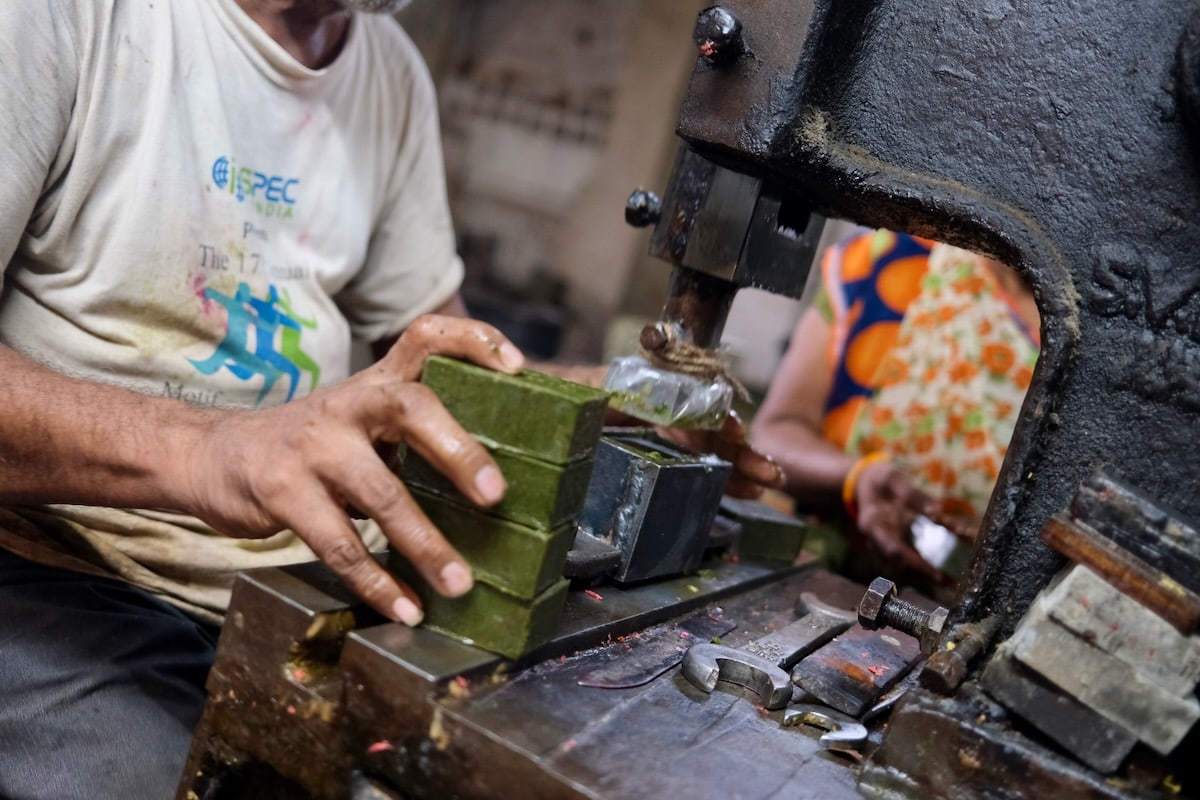
Most memorable for me was the soap production. In a white-walled room with soap-slick floors—I’ve forgotten how to describe the smell exactly; pungent but not unpleasant—trays containing hundreds of bars made with neem sat ready for packaging up. It’s done by just two people, Baldev and Urmila, a married couple who have been making soap for forty years. The process starts by combining oils with flakes of lye poured from large white sacks, ladling the mix into setting trays, and slicing those with a wire cutter. Then they imprint each bar using a treadle press as old as Gandhi, so Baldev said. We watched this last step. Urmila stacked blank billets as Baldev stamped them one by one in a rhythmic, clattering pattern. Did they ever swap tasks? Urmila laughed and said no: if she lost a finger, what would she do at home? As I recall this I think of my mother’s hands, my nanna’s, her father’s, swinging and grasping and twisting, and of my fingers tapping away.