There are many great scenes in City of Djinns, a memoir-cum-history of Delhi by William Dalrymple, who moved there with his partner in the ’90s. He meets and befriends a quirky and charming cast of locals. But the most thrilling scene happens in Scotland, days before he’s due to fly to India. In a dark, musty room—a library in the house he’s been staying—Dalrymple finds a cache of fascinating correspondence he had not believed so near nor so complete: the letters and diaries of William Fraser, a moustachioed, hot-blooded, erudite, possibly insane Scotsman who loomed large at the beginning of nineteenth-century Delhi. Dalrymple immediately postpones his flight. He cloisters himself there for two weeks to pore over Fraser’s scrawled exclamations.
I think he felt the same kind of joy I feel requesting items from State Library Victoria, a sensation evoked by the scent of old leather and buckram. After selecting items from the library website, they appear hours later on the request shelves of the Redmond Barry Reading Room, a rectangular hall with a mezzanine overlooking rows of study cubicles and low-seated round tables lit by green-shaded lamps. The books on the request shelves are ordered by the surname of the library patron. Finding the slip of paper printed with Mifsud, I clutch the items to my chest and walk to a table in mounting anticipation of the new facts and associations to be found.
My selections are usually speculative, a series of bets made using the title, keywords and summaries, or references in other works. Often a quick skim suffices to put a book aside; others I might spend an hour or two with. Occasionally items are smaller than expected: not a book, but a pamphlet stored in a plastic slip. I can scarcely believe anyone is allowed to request these materials and look at them unsupervised. But time and space is limited, and there’s a high bar for taking up archival resources. Perhaps many copies of the title are still in circulation elsewhere, or it was written by someone of little interest to the institution.
Last week I glimpsed the care given to more precious materials when I viewed books in the Special Collections of John Rylands Research Institute and Library. The original library was designed like a church. A steady stream of snap-happy pilgrims wander through, admiring the ornate stonework. But Special Collections is an elevated place, hidden in the clouds. It occupies the top floor of a modern, glassy extension—and on the day of my appointment, a Tuesday, the building was closed to walk-in visitors. My request to visit had been confirmed by email; someone named Angel gave me the low-down. Pencils were OK, pens were not. And warm clothes were a good idea. The room’s temperature catered to paper over people.
On arrival, a receptionist asked me to wash my hands. After purifying myself in the bathroom I caught the lift to the top-floor area, left my bag in a locker, and was admitted to the inner sanctum. It was a bright room, with one side entirely glass, the floor space taken up by four wide, unadorned pine tables. Three visitors were seated at these altars examining a variety of artefacts: sheets of music, manuscripts, a tray of old letters.
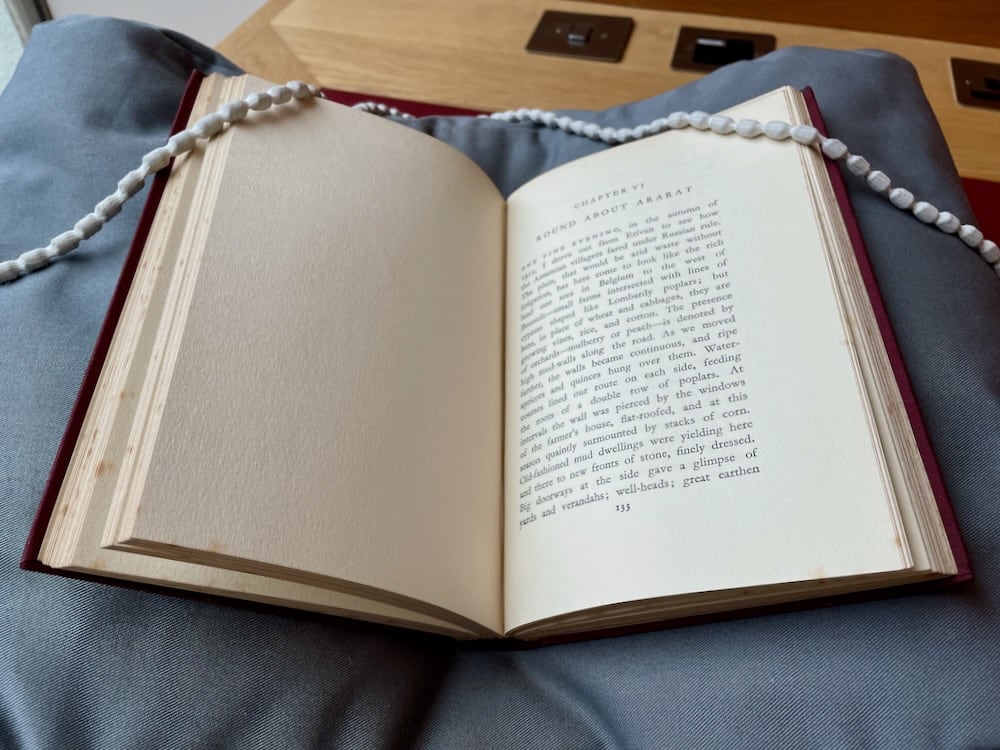
A staff member showed me how to care for the books I had requested, the oldest of which dated to 1845 but was in good nick. He gave me a cushion to protect their spines, and fished out a “snake weight” from a box full of their coiled, segmented forms. Snake weights hold a book open without risk of damage. Made of lead pellets sheathed in white nylon, they reminded me less of serpents than of prayer beads. This impression with during the repetitive nature of their handling: lifting the weight, turning a page, laying it down, the heft providing a subtle measure of comfort.
While I was there, I overheard a hushed discussion behind me. From what I could gather, a fellow Reader had found a delicate, perhaps disintegrating epistle folded in an envelope. There was a circling back-and-forth about whether to take the letter out to read it. On one hand, he wanted to know its contents; on the other hand, he didn’t want to damage it. I glanced across the room. Two staff members flanked him. They peered at the item. Neither forbade its extraction from the envelope, but they were, of course, in favour of preservation. They gently listened to him hem and haw. Ultimately, the Reader opted to leave the letter unread.
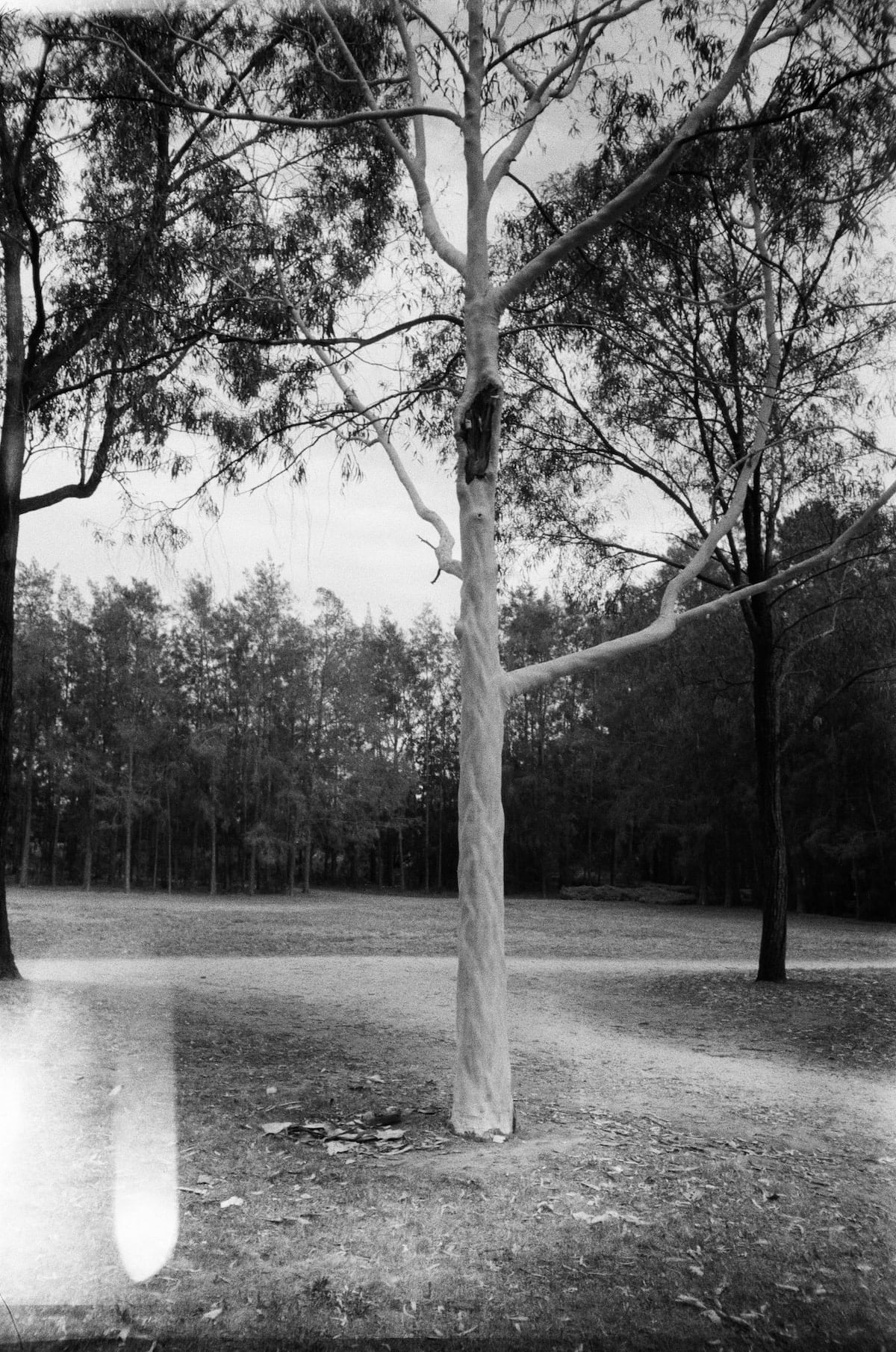
I passed this tree hundreds of times before I really saw it one evening last summer, once all the trees in the park had shed their dead bark. The surface of this tree is unusually contoured. It reminds me of ripples on a frozen lake, or taut muscles beneath skin. That evening I ran my hands along its smooth, pale, solid trunk, and pushed against it. The tree pushed back with whatever force I could muster. That something so graceful could be so unyielding came as something of a surprise, and something of a lesson. But also, I guess it’s just physics, lol.
A month ago, sitting with friends on the grass by the tree, we heard a crack and I saw a large branch fall from one of the other gums. The way the tree held still as the branch snapped clean off was a testament to the stoutness of the trunk. I’ve been thinking about this lately as I’ve been doing a few “movement practices”: bouldering, physical theatre, contemporary dance. In one beginner dance class, the teacher pointed out how the midline holds our balance. We practiced a few ballet-like steps like placing a foot out while keeping the pelvis back. She was a little embarrassed to have us focus on something so basic, but we had to become familiar with this way of holding our bodies to establish the stability for more expressive moves.
In bouffon—a theatre style of mockery and grotesquerie—the focus was not on how to move the body, but what your body was telling you. We “flocked” in pairs and groups, tuning in to each other’s presence, producing repetitive and shifting shapes and sounds. The pieces we performed at the end of the eight-week course emerged from these physical patterns. The political themes weren’t premeditated but instead began in movement. With movement comes breath, and then sound, and only then—through phonetic association, and the character of the movements—did we discover the “text” (single words and lines of dialogue) that our bodies were trying to express. Every step was necessary. When text felt forced, it was often because we hadn’t proceeded from breath and sound; we had leapt there from a scene or character we had in mind.
Even when play naturally followed embodied logic, it was difficult to ignore the rational part of me that kept saying our scenes didn’t “make sense”. To get through this block while playing with the bouffons in my group, I mimed opening my skull to lift out my brain and place it to the side. After that I could plug in. The kind of dance I’m doing at the moment is easier in this respect: it’s inward, wordless, and free of narrative. I don’t find myself getting in my own way. There’s an emptiness of person, whereas bouffon is person-to-person-to-person, an exhilarating but exhausting state.
Contrast two warm-up exercises. First, bouffon: lay on your stomach and push down on the floor with your hands. Elbows up, relax, push again. Get a feel for this. Now stand chest against a wall, push away with your hands. Move your feet fall back so you can begin pushing harder, as if it’s a heavy block you’re trying to shift. Lift your head up to look directly at the wall and push it with your eyes. Now relax your arms. Keep pushing with your eyes! Begin roving the room with that gaze, probing whoever and whatever you encounter. You can think of the “midline” of bouffon as this intense curiosity, the place from which they lampoon the odd behaviours of humans, their foibles and hypocrisy.
To wind down from that, you could try my favourite exercise in dance class. This time begin spreadeagled on your back with legs parallel and feet pointed skyward, and simply rock your heels so that your whole body shifts back and forth on the floor. I find this calming, like my person has become water, and it’s sloshing around a Nathan-shaped mug. I could be anything. I could be a lake, or a tall white gum being pushed by a small, strange primate.
In The Dawn of Everything, the authors suggest that social inequality seems inevitable because we’re used to thinking about human history as a linear narrative. Most common, perhaps, is the Rousseauian story that we lived happily in egalitarian bands of hunter-gatherers until civilisation corrupted us. On the flip side, the Hobbesian story holds that early societies were a time of savagery from which we were saved by the rise of centralised authority.
David Graeber and David Wengrow argue that these stories serve to limit conversations on inequality to methods of alleviation, like tax regimes, and fail to address the actual problems, such as people being told their lives have no intrinsic worth. The latter issue,
we are supposed to believe, is just the inevitable effect of inequality; and inequality, the inevitable result of living in any large, complex, urban, technologically sophisticated society. Presumably it will always be with us. It’s just a matter of degree.
They push against such “wistful pessimism” by presenting the theory that societies throughout history have been more diversely governed than traditionally presumed. By showing that our present inequality is not inherent to a large, complex society, but one possibility among many, Graeber and Wengrow hope to spark imaginings of different social arrangements in the present and future.
I was thinking about this as I binge-watched Squid Game. (The second season was released one week ago.) The show pits deeply indebted contestants against each other in deadly games with the promise of a major prize for the survivors. Many see the brutal premise as no worse than the circumstances they face in the outside world; in fact, some think it’s better, given the chance of starting again with a piggy bank full of cash. Their imagination has been starved by the pressure of staying afloat. Others, like Gi‑hun, hold on to the hope that a different world is possible.
I see Gi‑hun, the protagonist, as a Rousseauian optimist who believes in human goodness, and the Front Man, his foil, as a Hobbesian cynic who holds power and control as necessary, even if horrific. The latest cliffhanger puts Gi‑hun in crisis. Will he finally cede to the grim logic of the capitalist overseer, or will he continue trying to end the contest?
It’s obviously going to be the latter, so the show’s success will hinge on how the final season speaks to the problem of inequality. So far, the moments of solidarity and sacrifice are moving, but I think it’s obvious that humans are capable of ethical choices. It’s less clear whether we can dismantle the hierarchy that forces us to choose between survival and solidarity, and what could take its place.
Gi‑hun may successfully end the odious contest, but he will return to the same city that birthed it. To truly achieve the end he seeks, he will have to redesign the game, providing a model for a new, fairer society.
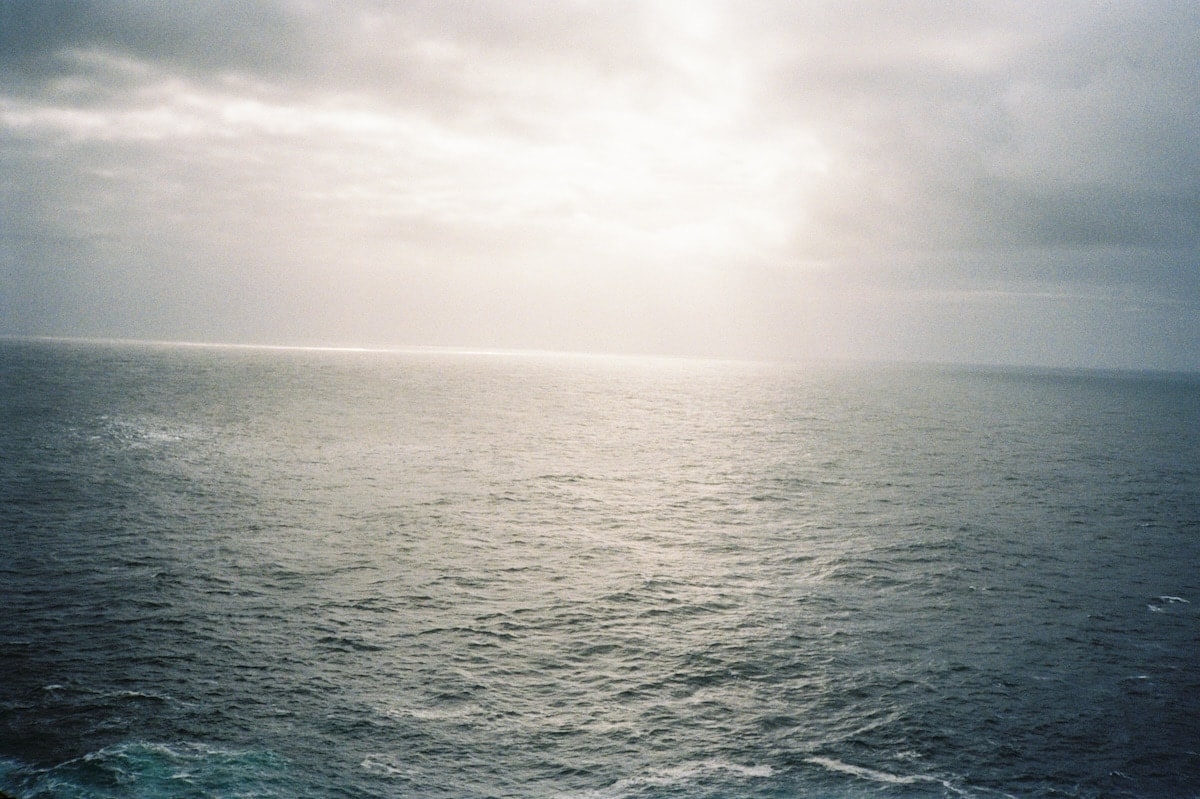
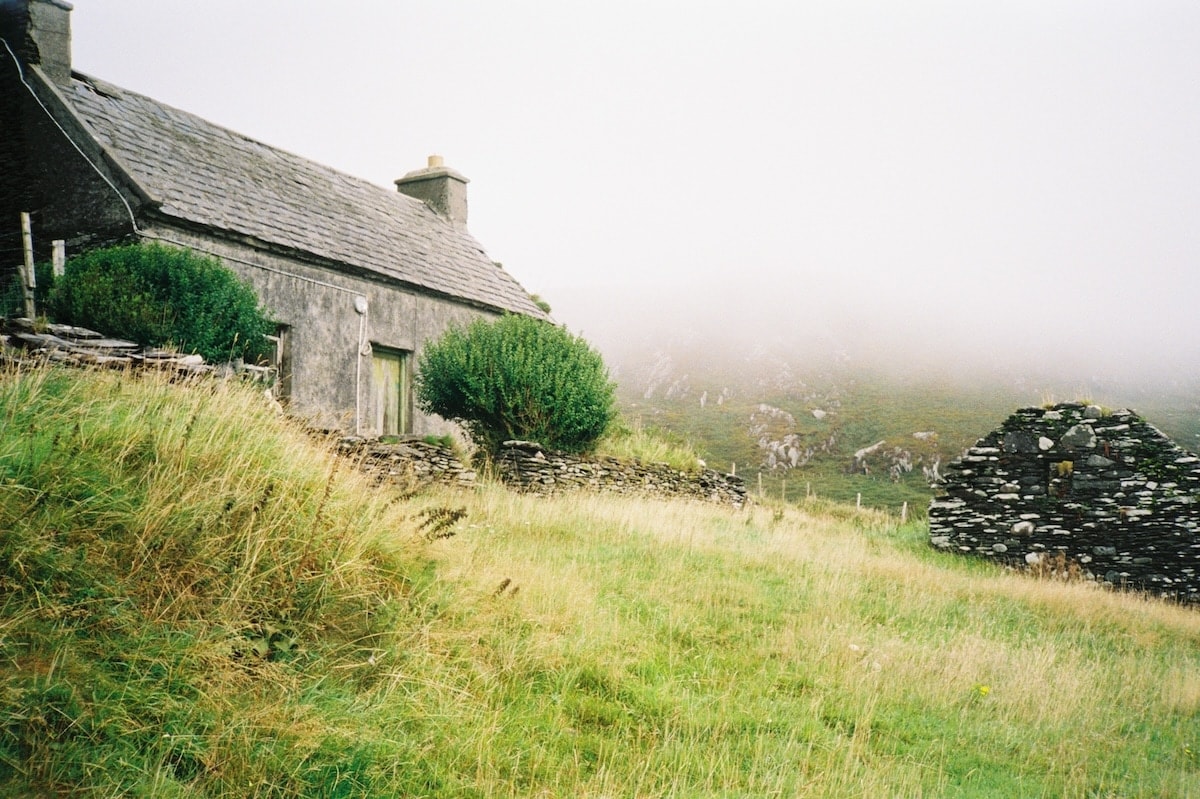
I crouched at the windswept battered end of the earth. How strange to have made peanut-butter toast in slippers just minutes ago, while here the ocean was foaming. There’s the spur where a lighthouse briefly shone till the sea plucked it away like a berry. What did they expect, raising their cast-iron tower on a glob of wax dropped by the careless sculptor of this island? A forktailed haddock of an island four miles long and one mile wide, spine bulging, tethered to the mainland by metal cables from which dangles a box fit for a half-dozen humans or, so I’m told, one large frightened cow.
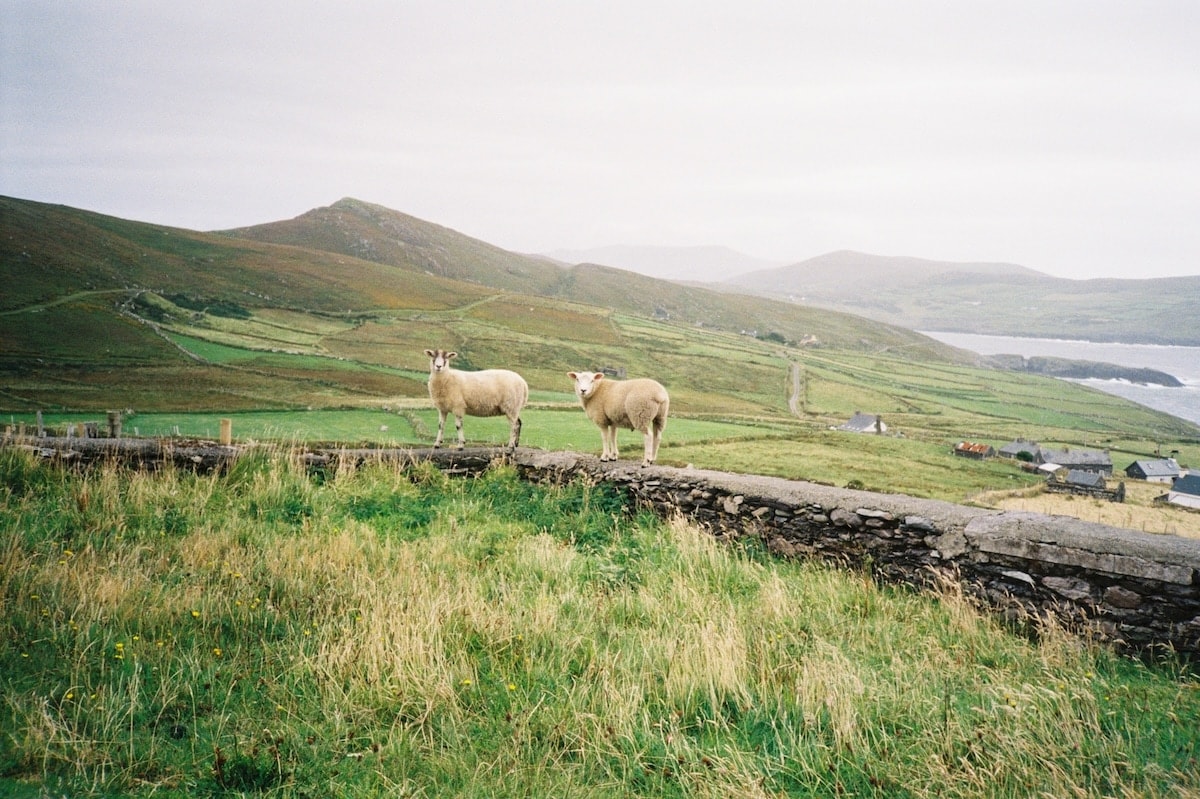
Two handsome neighbours on my fence
On the windward side of the island, on a slope too steep and exposed to cultivate, I followed faint sheep trails through the heather, green lines trod between yellow-purple bloom, curves that bifurcate and merge again like a dance. A sheep flock pulled together, fleeing from my presence slowly and then at a run, thinning to single file along a cliffside edge. I chose a safer inland path, and they disappeared over the crest of the hill. Abandoning me. No company now but for the birds diving far out at sea. I feel rejected, the sheep having closed a door I had, by way of using their paths, begun to peek through. The fledgling intuition of their minds betrayed by the spatial language of their hooves, extinguished.
Miste heavy and close like a clowde
Those were snippets of a week on Dursey Island. I exiled myself there fully intending to write diligently. I wrote close to nothing. Instead, I explored every side of the island. I ran over the chain of hills. I walked up and down the road many times. David, who operates the cable car, showed me how to handle the winch. I built fires I didn’t need. I hung out with Christian, the island’s de facto mechanic, pharmacist, council liaison and ambulance driver, who with his wife Sheila comprises 50 per cent of its permanent population. He took me on a boat ride to a lighthouse with a visiting poet and a painter and a dog called Panda. I vomited. The dog wore a life jacket. I met a man who had leapt off the Tower of Pisa on the fifth day of August in 1988. On advice, I did not drink the tap water (too high in manganese). I helped tow a stranded farmer back to the village. The days were long, and sometimes I could not see anything for the fog.
In the final hours of the year, in the fading light of the day, thousands upon thousands of birds were silhouetted against the silver tide. The water was calm and luminous, like a molten moon. After fishing over the horizon, the birds were coming back to roost, reuniting with their mates on incubation duty.
The foragers arrived as distant fireworks began spitting. We pointed with delight at the vanguard of velvet shapes. Soon the sky was full of birds, a messy braid of flight paths, each bird streaming past with a flutter of stiff-winged pumps followed by a sharp banked glide, then a flutter, a glide, flutter, punch-drunk and unpredictable.
I’d seen their burrows earlier that day atop the pink granite cliffs, dark mouths in low turf, like a green. Was golf inevitable? A branch, a round rock, a hole. It must be a common impulse across the animal kingdom to do something just to see if it’s possible. Surely even a shearwater sometimes make an acrobatic turn at a leaping fish, catching it midair, only to let it go for lack of hunger.
The shearwaters that sojourn on our shores do so after a figure-eight loop of the ocean covering more than 15,000 kilometres. On arrival, they lay a single white egg. Over the next couple of months, the parents rebuild their fat stores by feeding at a shorter range, usually by diving (up to a depth of 50 metres!) for krill. When the chick hatches, they share their catch by regurgitation.
At dusk they approach in one mass, having gathered in a “raft” on the sea not far from the colony. They fly the final stretch home once the darkness can safely cloak them. Many of us gathered that eve, the last of the year, in similar flocks by the beach and across the city, to celebrate, to reflect, to anchor the self in time and place and be moored by the people around us.
One thing that I’ve been reflecting on, like many people, is “artificial intelligence”. Early last year I ran a workshop about the use and risks of ChatGPT in the social sector, and off the back of that, I was invited to give a public lecture on AI at a library. Preparing the talk was a chance to zoom out and clarify my conflicted feelings on the topic, if not to resolve them.
Computers are really dumb. They’re exceptionally simple, but they’re really fast. The raw instructions that we have to feed these little microprocessors—or even these giant Cray-1 supercomputers—are the most trivial of instructions. They get some data from there, get a number from here, add two numbers together, and test to see if it’s bigger than zero. It’s the most mundane thing you could ever imagine.
But here’s the key thing: let’s say I could move a hundred times faster than anyone in here. In the blink of your eye, I could run out there, grab a bouquet of fresh spring flowers, run back in here, and snap my fingers. You would all think I was a magician. […] And it’s the exact same way with a computer. It can do about a million instructions per second. And so we tend to think there’s something magical going on.
I touched on ChatGPT—the ultimate example of what Jobs described—and the huge bets that infrastructure companies like Microsoft are making on “language models” becoming essential to our interactions with computers in the future.
This has scrubbed them of poetry. (Expand to read more.)
The corporatisation of language models is evident in the changing flavour of their output.
A project I was once involved in used GPT-3, the predecessor to ChatGPT, to allow folks to talk to a personified rock. (The motivation of the bot/rock was to nudge callers into considering the personhood of nature.) The conversations were amusing, for the most part, but irregular, to put it generously. Still, I liked GPT-3’s flashes of poetic sensibility.
The old model riffed like this:
Do stones love their life?
Is the tree as it rises delighted with its many branches?
Are the clouds glad to unburden their bundles of rain?
Whereas today’s ChatGPT offers this:
Do stones love their life?
The concept of love is generally associated with sentient beings capable of emotions and consciousness. Stones, being inanimate objects, do not possess the capacity for emotions or awareness. Therefore, it would be inaccurate to attribute feelings such as love or the experience of life to stones.
Obviously, this is a stultifying “improvement”. It also shows their mindless reinforcement of orthodoxy. No one can deny that the latest models mimic dialogue with remarkable fluency, but there seems to be a paradox. The closer they come to sounding human, the less human they feel.
It’s one of the reasons that my use of language models is mostly limited to coding assistance, the least human—but perhaps most potent—capability in their repertoire.
Anyhoo, I ended by comparing AI to whales (a shameless appeal to the talk’s audience): the awe they can inspire; their scale; their crossover with human markers of intelligence but fundamentally alien natures; and finally, their attunement to what’s around them. AI systems are shaped by the society they swim in. To create a future where AI serves to enlarge rather than diminish life, we could begin by safeguarding human values and understanding AI as automation—considering who automates what, and why.
This is the conflict I’ve been stewing on for a while now: my belief in the possibility of such a future, against my increasing conviction that, on the whole, it won’t come to pass. Like admiring the design of heavy industry despite its ecological devastation.
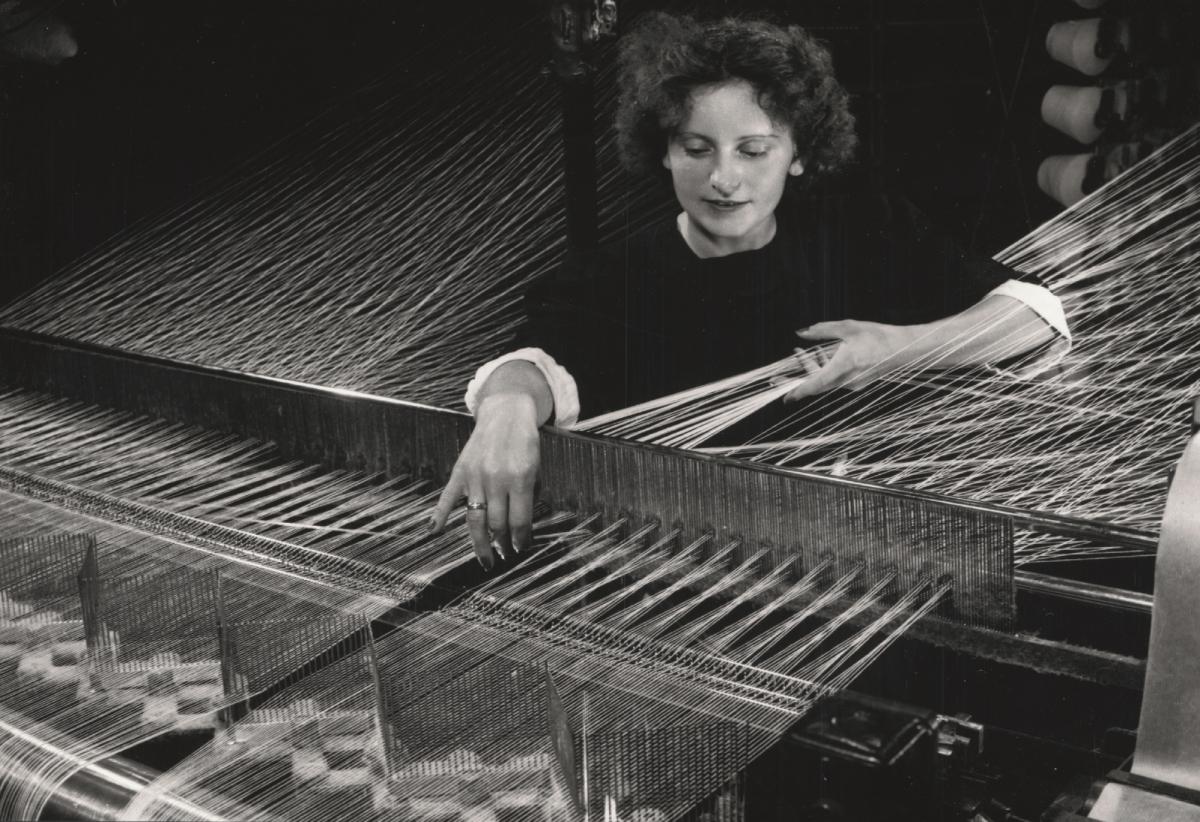
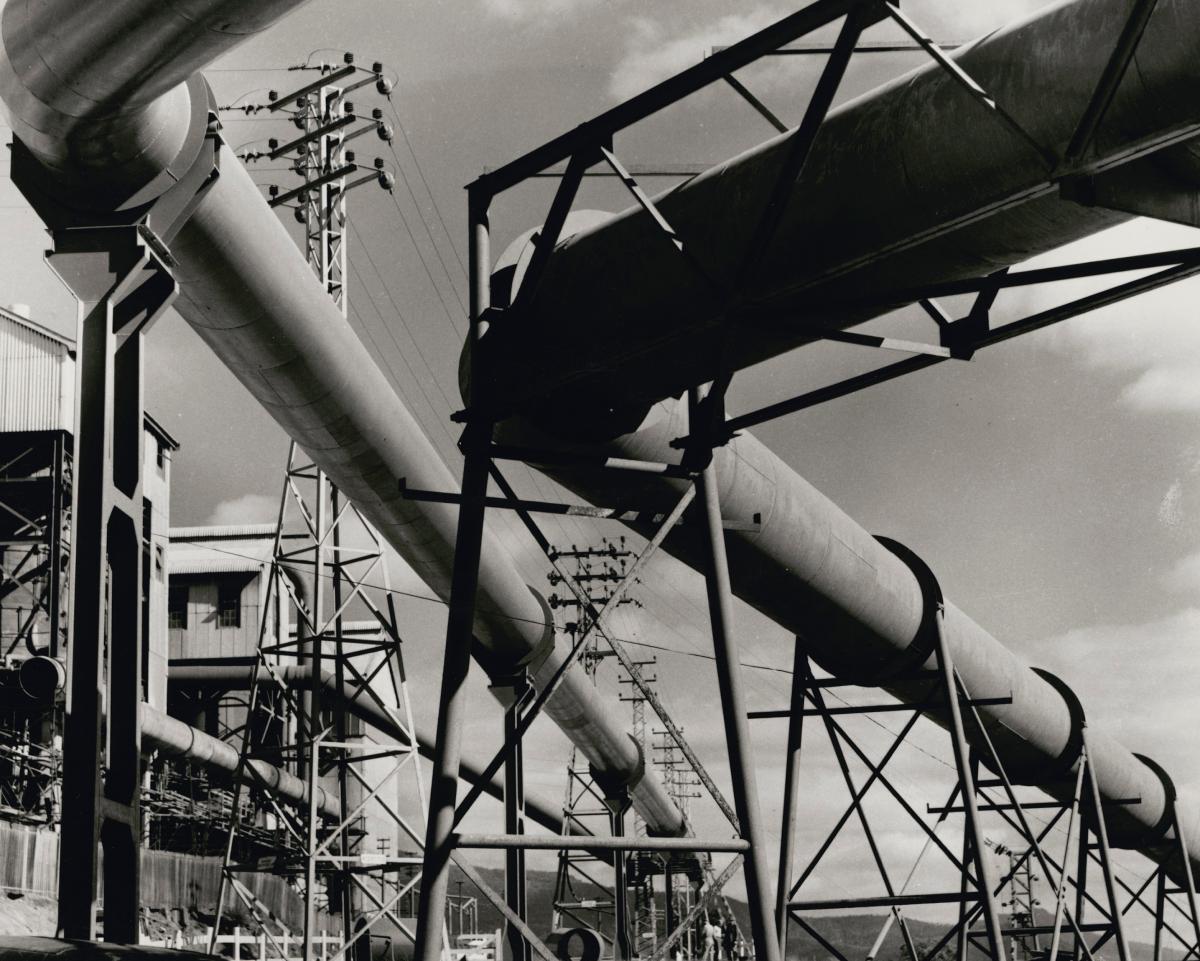
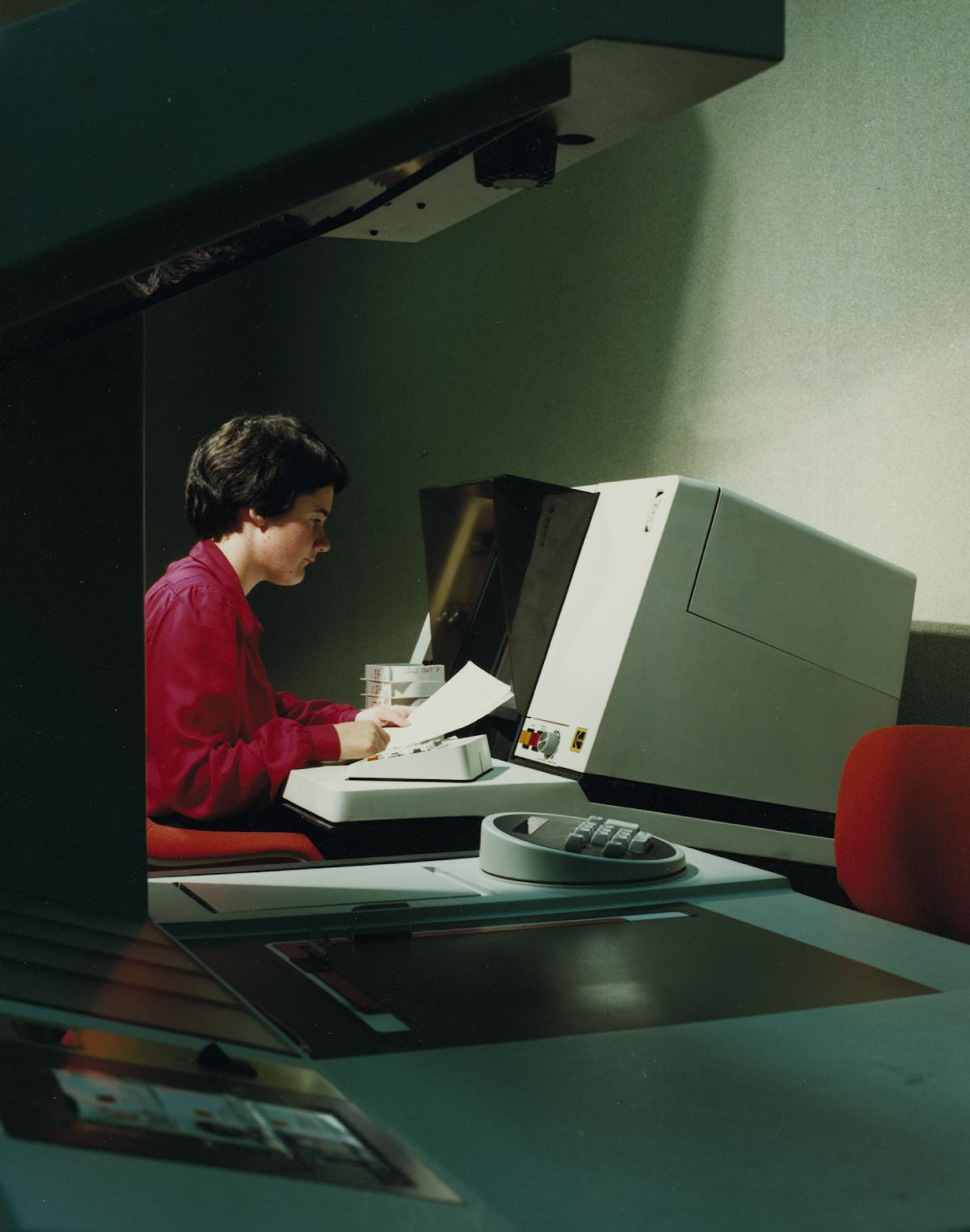
These photos are superb, right? I commend the archive of Wolfgang Sievers to you. I discovered his work while searching for an image of textile machinery for my slides.
Sievers wound up in Australia in 1938 having fled, with a day’s grace, his conscription into the Luftwaffe. He would become renowned for his industrial photography. Each frame was high art, carefully lit and orchestrated. And while he glamorised the geometric forms in oil refineries and industrial plants, he also elevated the labour of individual workers.
Man and machine were Sievers’ quintessential subjects. To Sievers the essence of a good factory was not labour by itself, nor the technical process in isolation, but that “everything is as it should be”, with [humans] directing machines efficiently, and each augmenting the other. In Sievers’ photographs the operators are functionally connected to the machine by their hands and their eyes—they peer through loupes, or pull levers, or intently measure the details of gigantic pieces of machinery with finely calibrated instruments.
Those colours! The lines! The human encircled by machines. A symbiosis. You couldn’t make someone tapping into their laptop look half as good. Bring back the bulk, I say.
My favourite scene is this: a loom tuner inspecting shining spools of rayon, looking for all the world like he’s tending to the bristles of a whale holding its maw open delicately. It’s a romantic vision, a modernist vision of unity, depicting a relationship with technology yet to be truly realised.
Nathan Mifsud is a writer based in Melbourne. You can sign up to my newsletter for occasional updates: