On the topic of how language reflects relationship to country, I went down a rabbit hole learning about frames of spatial reference. You might have known that Australian Aboriginal languages tend to use geocentric (e.g. “north” and “east”) direction terms rather than egocentric terms like “left” or “right”. Speakers on the Cape York Peninsula say things like “move your cup over to the north-northwest a little bit” or “the boy standing to the south of Mary is my brother”.
What was new to me (though not surprising) is that this dependence on geocentric terms goes beyond abstract cardinal directions. Many languages have direction terms tied to the landscape, especially the river, coast, winds, elevation and sun. One language, Bardi, even has terms linked to tidal flow that reverse every six hours: joodarrarr “with the tide” and arrinarr “against the tide”.
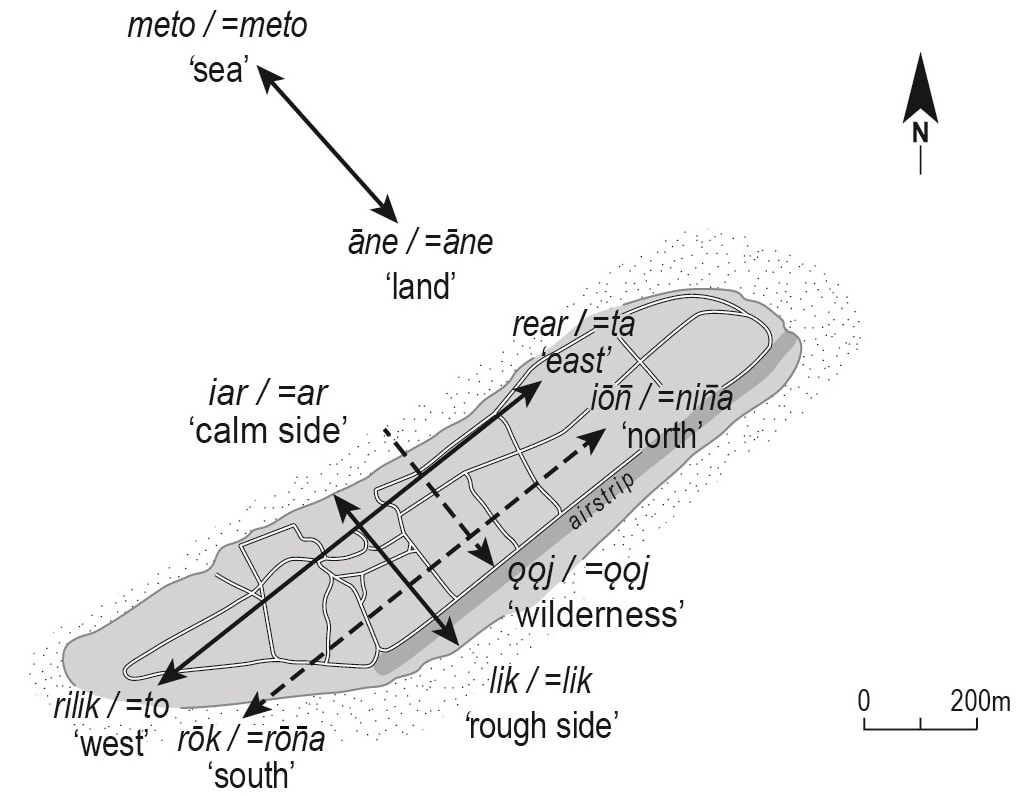
But even concepts like “north” have variation across cultures based on physical context. Alice Gaby and colleagues interviewed speakers of Marshallese (an Oceanic language of the Marshall Islands, the nation north of Nauru) and found that when an island’s orientation wasn’t perfectly perpendicular to a cardinal axis, “the cardinal axes rotate such that … the orientation of iōn̄ ‘north’ [can become] quite skewed away from ‘true’ north.”
This is easily seen on Kili Island, where the iōn̄-rōk “north-south” and rear-rilik “east-west” axes actually run parallel:
That said, given the almost east-west lay of the island, the use of iōn̄ and rōk is rare. Interestingly, Kili Islanders use o̧o̧j “wildernessward” to refer to movement away from the calm, sheltered interior of the island to the rough-water side, though it’s just an airstrip. The land cleared for the airstrip was once uninhabited forest, and the usage has stuck.
As we commonly represent time with reference to space (“forward”, “back”, “long”, “short”), researchers have also investigated how different frames of spatial reference correspond with cultural representations of time. In one remote Aboriginal community, time follows the sun’s path, such that east—where the sun rises—is associated with the past, and time proceeds along an axis to the west.
I find this cognitive variety beautiful and instructive. Maybe alternate systems of spatial and temporal orientation, even briefly tried on as an imaginative exercise, can foster a greater sense of belonging to the land around us. What kinds of geocentric axes exist where you live?
What counts as “wilderness”? A lot has been said about this. As good a starting point as any is Kathleen Jamie’s excoriation of the notion that there’s any distinction between wild and not-wild in the UK, where
every square inch of it is ‘owned’, much has seen centuries of bitter dispute; the whole landscape is man-made, deforested, drained, burned for grouse moor, long cleared of its peasants or abandoned by them. It’s turned into prairie, or designated by this or that acronym; it’s subject to planning regulations and management plans. It’s shot over by royalty, flown over by the RAF, or trampled underfoot in the wind-farm gold-rush. Of course there are animals and birds, which look wild and free, but you may be sure they’ve been counted, ringed maybe, even radio-tagged, and all for good scientific reasons.
The distinction is fraught in Australia, too. Land that a British person might call “wild” has likely been stewarded by Aboriginal folk, some of whom use “wild” in a markedly different way. When Deborah Bird Rose visited a cattle station in the Northern Territory where extreme erosion was evident, she asked Daly Pulkara, one of her teachers, what he called the country:
He looked at it long and heavily before he said: ‘It’s the wild. Just the wild.’ Daly went on to speak of quiet country – the country in which all the care of generations of people is evident to those who know how to see it. Quiet country stands in contrast to the wild: we were looking at a wilderness, man-made and cattle-made. This ‘wild’ was a place where the life of the country was falling into the gullies and washing away with rains.
According to Rose, “quiet” is a Kriol term that means “tame, domesticated, not dangerous, under control”. An uncanny implication that I find here, based on the meaning of quiet in standard English, is that degraded country is loud—perhaps because it’s crying out for respect.
Elsewhere, William Cronon has argued that the issue with wilderness is that it represents
the false hope of an escape from responsibility, the illusion that we can somehow wipe clean the slate of our past and return to the tabula rasa that supposedly existed before we began to leave our marks on the world. […] This, then, is the central paradox: wilderness embodies a dualistic vision in which the human is entirely outside the natural. If we allow ourselves to believe that nature, to be true, must also be wild, then our very presence in nature represents its fall.
He later writes:
Wilderness is the place where, symbolically at least, we try to withhold our power to dominate. […] In the broadest sense, wilderness teaches us to ask whether the Other must always bend to our will, and, if not, under what circumstances it should be allowed to flourish without our intervention.
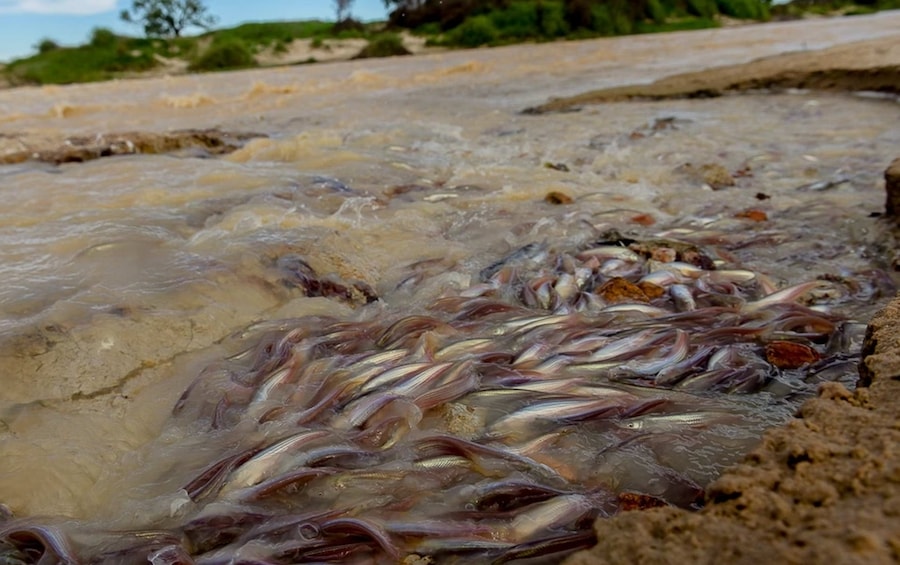
I’m reminded of Kati Thanda, a vast salt lake in South Australia that drains hundreds of kilometres of arid desert, a watershed that extends into Queensland and the Northern Territory. When those places get flooded (sometimes destructively so), the lake’s ecosystem—months later—blooms. Red turns green. Millions of birds fly in from far-off coastlines. Insects multiply. Fish swim upstream, keen to travel newly opened channels.
All of this is aided by the fact that the basin’s flows encounter a distinct lack of interference: no dams, diversions or large-scale extraction of water, as suffered by the Murray-Darling system. It’s not as if nobody lives in the watershed. Many do. But the boom-bust cycle of the land means people along the rivers understand how drawing excess water could affect people downstream. The only problem is the gas industry.
So far, the only animals known to have evolved a gearing mechanism are planthoppers. The nymphs sport protuberances that interlace to keep their legs in precise synchrony as they leap about in search of sap to suck. Very cool.
If you went back in time and told this to René Descartes, he wouldn’t be too surprised. He believed that animals were complex but not so different from automata. Think of the wide array of movements that human fabrications can produce, he wrote. Like cuckoo clocks, which achieve their magic with few pieces compared to the slew of bones, muscles, nerves, arteries and veins that animals employ for motion.
All those parts in an animal could be replaced by cogs and pistons, he argued, and we would have no way of knowing. But if machines took on our appearance, we would know fellow humans by their soul: the ability to think, reason and feel. Descartes suggested that the soul (or mind) was separate from the body. This is what allowed us to evaluate sensory information and form representations of the world.
Many people now think the mind emerges from neural activity rather than being a distinct entity. Nonetheless, an information-processing view of cognition is the dominant paradigm in modern psychology and neuroscience. (Hence the popularity of cognitive-behavioural therapy, which seeks to correct “distorted” thoughts — that is, to tweak one’s information-processing routines.) The human brain is often called a “prediction machine”, anticipating the future based on new data and past events, fine-tuning the algorithm etched in its furrows and folds.
Given this paradigm, when someone skeptical about the current wave of machine learning describes GPT and its ilk as being no more than super-powered auto-complete — sure to reach a ceiling of capability — the response goes: well, “mere” prediction is how we interact with the world. Look at the sophisticated behaviour that emerged in humans!
Do machines truly mirror us? And if we see a resemblence, does this reflect our increasing alienation from the natural world? Here’s Czech philosopher Erazim Kohák (via L. M. Sacasas):
We ourselves have constructed that world for our dwelling place, replacing rude nature with the artifices of technē, yet increasingly we confess ourselves bewildered strangers within … its anonymous machinery, and [are] tempted to abolish the conflict between our meaningful humanity and our mechanical life-world by convincing ourselves … that we, too, are but machines.
Kohák was writing in the 1980s. Our “mechanical life-world” is more encompassing than ever. Have we become reluctant to identify with the machine — more aware of our loss? Meghan O’Gieblyn, quoted by Ezra Klein in a recent column, seems to think so:
[A]s AI continues to blow past us in benchmark after benchmark of higher cognition, we quell our anxiety by insisting that what distinguishes true consciousness is emotions, perception, the ability to experience and feel: the qualities, in other words, that we share with animals.
Klein continues by paraphrasing:
This is an inversion of centuries of thought, O’Gieblyn notes, in which humanity justified its own dominance by emphasizing our cognitive uniqueness. We may soon find ourselves taking metaphysical shelter in the subjective experience of consciousness: the qualities we share with animals but not, so far, with AI.
A rebuttal of Descartes, then. But fully acknowledging the inheritance we share with animals means remaking society. Mandy Brown points out how the AI narrative, with its focus on cognitive benchmarks and apocalypse scenarios, acts as a smoke screen that benefits entrenched hierarchies (in which, though she doesn’t mention them, nonhuman animals are at the bottom). Once we relinquish the notion that certain people or species are more worthy or intelligent than others, we might regain a sense of our “meaningful humanity”, even amongst machines.
Out running this morning, a part of my brain chattered about what I could next write on this blog. A quieter section of the orchestra took charge of my feet, leading me across my favourite bridge onto a dirt track by the river. Soon: the uproarious company of thousands of flying foxes.
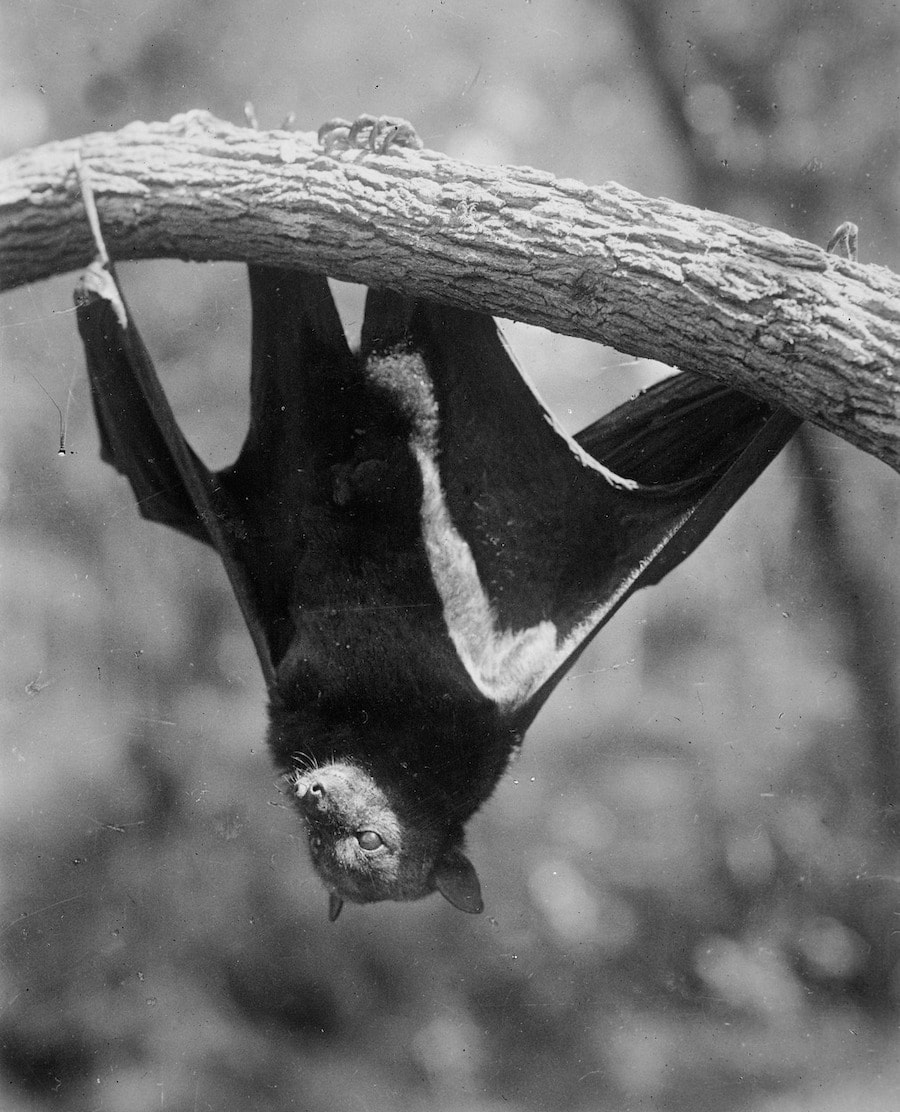
It’s mating season, and everyone was abuzz. After being caught in my own head, I suddenly felt as if I was in theirs, each upside-down bat a rapidly firing neuron in a dispersed (mist-like!) intelligence. Listen to Jon Tjhia’s field recording of the Yarra Bend colony at dusk. I’ve spent hours of my life watching brainwaves jitter sideways; those nonstop overlapping screeches are just about the perfect aural representation of a mind in action.
Flying foxes are also known—and lamented—as fruit bats, but when they raid fruit trees, it’s precarity, not avarice. They prefer eucalypt blossoms, banksia, paperbark, tea-trees, lilly pillies. They’ve fled the famine of their former homes and the gunfire and torture-tactics of orchard owners, and even then anthropogenic global heating causes them to die in droves.
I’m reminded of an Ed Yong line six months into the Covid pandemic:
Through intensive agriculture, habitat destruction, and rising temperatures, we have uprooted the planet’s animals, forcing them into new and narrower ranges that are on our own doorsteps. Humanity has squeezed the world’s wildlife in a crushing grip—and viruses have come bursting out.
Viruses need not be so inevitable. People already sick or stressed are most vulnerable to disease; the same applies to our fellow animals. If we can reduce the stresses we place on the species around us, we can all thrive together. The alternative is what Deborah Bird Rose called a death vortex. More stress leads to more illness. More illness, more chance of zoonotic transmission. More transmission, more vilification of the carrier species. More efforts at controlling such wildlife, more stress. A loop that amplifies death in both of our entangled societies.
To contrast this violence, Rose has lovingly described the reciprocity between flying foxes and eucalypts, showing how multispecies entanglement can allow life to flourish:
Trees put out their delectable and beckoning flowers, and flying foxes sense this great call; they leave their home camp and come racing to the blossoming trees. Their responses include their long tongues that are well adapted to sucking up nectar, and their body fur that picks up thousands of grains of pollen and distributes over 70% of it intact every night. [T]he renewal of woodland and forest life hinges on this relational exchange. Forest futures are borne on fur and tongue, and on the wings that beat through the night carrying the animal to the tree, and carrying the tree’s possibilities along to other trees.
The pastoral tradition called for a return to nature, but this tale of co-evolution is an example of how the pasts and futures of all beings are enmeshed. There’s no returning to something that we’ve always been part of and benefited from. We need only try harder to return the gifts of our kin in kind.
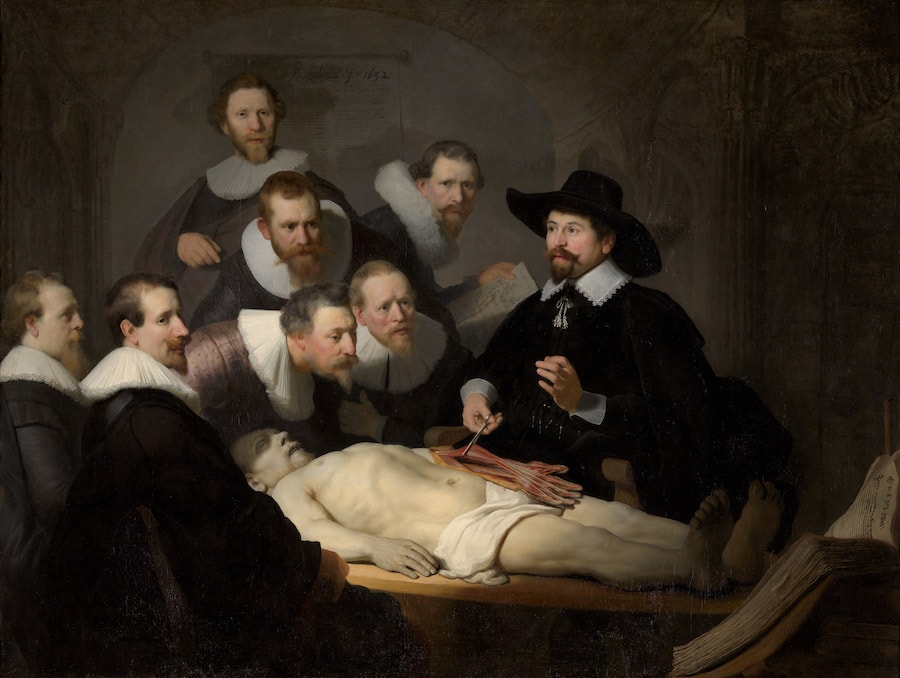
In The Rings of Saturn, W. G. Sebald speculates that Thomas Browne—a 17th-century English writer who practised as a doctor—could have actually observed the anatomy lesson painted by Rembrandt. It’s there, sitting in that Dutch anatomy theatre, that Browne may have witnessed a curious phenomenon he would years later recall like so:
the white mist that rises from within a body opened presently after death, and which during our lifetime, so [Browne] adds, clouds our brain when asleep and dreaming.
I was curious about the idea that our dreams correspond with psychic mist, likening the unconscious to a haze, so I looked for the original source of this quote. “Upon the darke thick miste” starts by Browne describing a great fog on a November day in 1674 that covered most of England and Holland,
of larger extent then mists are commonly apprehended to be, most men conceiving that they reach not much beyound the places where they behold them. Mist makes an obscure air but they beget not darknesse, for the atomes and particules thereof admit the light, but if the the matter thereof be very thick, close, and condensed, the mist growes considerably obscure and like a clowde…
He goes on to observe:
There is a kind of continued mist in the bodies of Animalls, especially in the cavous parts, as may be observed in bodies opened presently after death, and some thinke that in sleepe there is a kind of miste in the brayne; and upon exceeding motion some animalls cast out a mist about them.
I wonder if Browne had read Homer, who used the word achlys (mist) to describe the clouding of the eyes that precedes death. Certainly he was familiar with the double-meaning of miste/myst in Middle English (only a little before his time): water vapour, but also spiritual matters that elude understanding—mysteries. Dreams being a prime example!
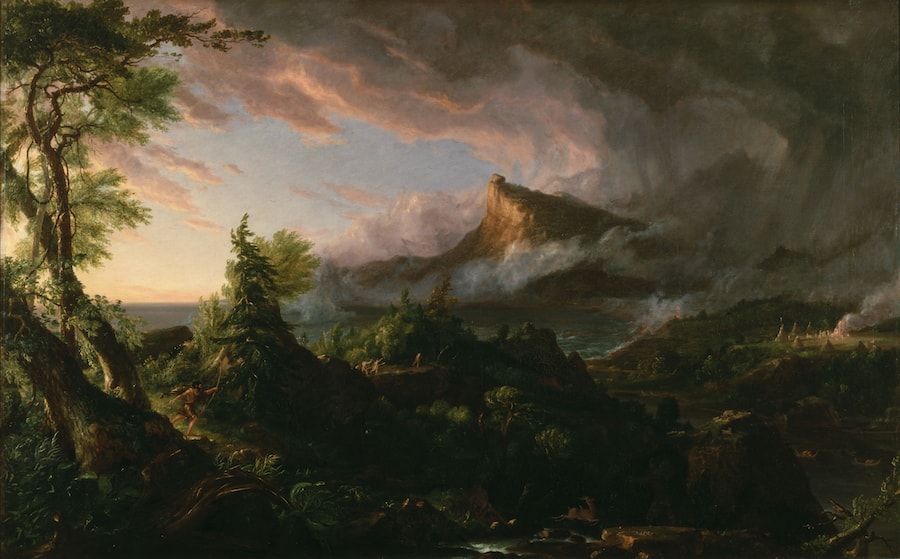
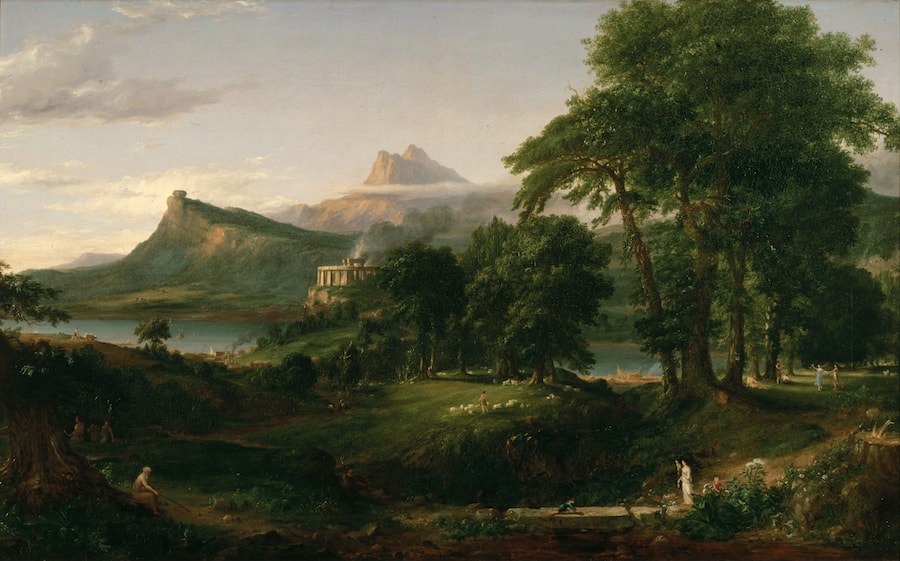
Tantalisingly: in the Romantic era of the 19th-century Western world, mists and clouds were often a symbol of wildness, or of being in a state of darkness, in thrall to an uncertain future. Look at some of the paintings of the time. Wanderer above the Sea of Fog leaps to mind as tying the sublime to the vapour-saturated. Thomas Cole’s The Course of Empire series is also instructive: following a “savage” period featuring men in skins, empire’s “advancement” to an idyllic pastoral state corresponds with the mist retreating to a wisp around the mountain.
But that was a stage now past. Decadence, destruction and desolation were to come. “We are in a Mist”, wrote the poet John Keats to his friend. “We feel the burden of the Mystery.” Society faced a branch in the path shrouded by dark vapours.
While pastoral scenes through the ages haven’t always included mist, they are always a symptom of what was missed: a time when humans lived in perfect harmony with the world; a rural life unbesmirched by civilisation. A state of being that—if it ever existed—has dispersed like morning mist on a warm day.
Nathan Mifsud is a writer based in Melbourne. You can sign up to my newsletter for occasional updates: