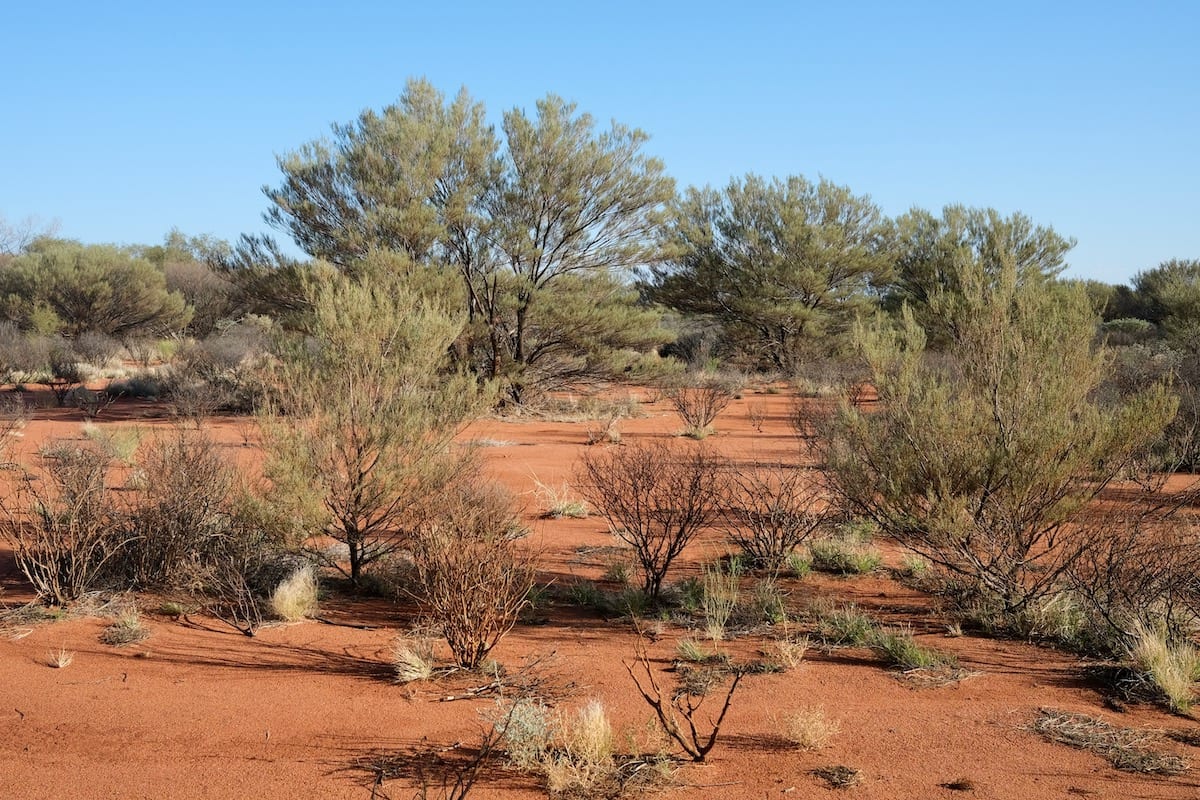
The only Vietnamese restaurant in Alice Springs is ten minutes southeast of the main settlement. To get there, you first drive towards the airport, then turn left shortly before the “Welcome to Alice Springs” sign, onto on a road that, like many roads in Central Australia, cuts a straight line through yellow-brown scrubland. The left-hand view is so indistinguishable from the right that the road feels temporary, as if it is not a true interruption of the landscape but a ghostly imprint, like the translucent lines on Google Maps when it knows of a newly built subdivision but the satellite imagery still shows paddocks. After three kilometres on this road, take another left and turn into the driveway flanked by green-white gate pillars.
In Tinh and Lan Nguyen’s restaurant, there’s a choice of two seating areas: inside a dining room with TV and frigid air-con, or outside, beneath a metal roof in the garden. The only catch, we learned when the waitress pointed to a notice by the cash register, is that we could not move tables under any circumstances, whether that be wind, temperature or flies. We opted to eat outdoors. It was a balmy evening. The menu listed over 200 dishes. An old man—Tinh, I presume—came by and, as we said each number that we wanted, wrote the dish names on a kitchen docket, evidently having memorised every number since the restaurant opened for Chinese New Year in 2008.
As we ate, Xiaojing told us how one of her relatives had memorised numbers as a telegraph operator. There are far too many Chinese characters to encode in dots and dashes like the letters of the Latin alphabet. Each character was instead given a four-digit code, and operators exchanged sequences of these codes on the telegraph lines. Common characters were learned by rote; the rest looked up in a codebook. This was considered a cushy job: the relative’s father had secured it with Party connections so his daughter could avoid being assigned to farms and factories, like Xiaojing and other “sent-down youth” of the time.
In the Western Desert region, Pintupi and Luritya people say jagged bolts are the work of Lightning Men taking aim at trees, whereas Lightning Women make sheet lightning. After we finished dinner, we exited through the green-white pillars and immediately saw sheet lightning over the road, revealing a mass of clouds stacked like dark fabric offcuts. Then the sky went black. Without streetlights or big-city glow, it was difficult to tell how far away the storm was. On the highway to Alice Springs we had gone through many localised storm cells with telltale blue curtains along their fronts, but that evening returning home from the restaurant, we only realised how near the storm was when rain began streaking the windows and wind buffeted the car.
A terrific bolt of lightning struck somewhere ahead of us. We slowed from 80 to 50. After a few hundred metres, coruscating lights showed among the silhouetted trees and spinifex, like a Christmas display in a front yard, though no houses were on this stretch of road. We peered into the rainy night, and as we passed, realised it was the site of the strike: a tree trunk and its branches thrown outwards, dancing with flames. A Lightning Man had found his mark. Strangely, my memory of the scene is silent—I don’t recall the sound of thunder, crackling fire or even the patter of rain against the glass—as if the windshield was the boundary of a snow globe containing the outside world that, shaken by the gods, stirred not flurries of porcelain chips but a lightning storm, as befits summer in the Southern Hemisphere. Perhaps this is what was truly meant by the welcome sign of the resort at Uluru imploring us to “touch the silence”: that in the face of a desert landscape’s shape-shifting grandeur and relations with the sky, one will be struck deaf and mute.
I wish that was how I felt at Uluru. We first visited the rock at sunset, eating pad Thai from a takeaway shop called Ayers Wok, and mostly I was distracted by the tourists hovering in helicopters like dragonflies drawn to an ember. After we drove back to the resort, we learned that a lunar eclipse was in progress. I calculated which direction to look. We took the emergency torch from the closet and navigated the unlit sands between the resort complex and the road, trying to find a location where the sky was not obscured by trees or buildings. The clouds were dense. Suddenly, the moon winked into existence, and there was another big red rock, far away.
Two days after the lightning strike in Alice we returned in daylight to look and found a quarter-acre of blackened bush. Hopping a barbed-wire fence, we met a field of skeletal branches. Near the battlefield’s centre a cross of white ash carpeted the dirt, two feet wide, twenty feet long. At the intersection of the cross projected upward a waist-high trunk, seemingly the tree that had copped the strike, with a flame still burning in its dead heart. I knew that lightning caused bushfires; I had seen evidence earlier in the week near Kata Tjuta on a 39-degree day, the horizon wreathed in smoke. But it was something else to stand in the fresh results, a reminder of the land’s agency, with transformations indifferent to human presence.
So it was with Lhere Mparntwe, the river that bisects Alice Springs. I was expecting something like the blue line on the map, but when we visited it was a dry watercourse. Most crossings are not bridges but dips, the road bordered by frozen waves of sand. There is something incredible about so many people collected around a phantom, something that comes alive only rarely, when there has been sufficient rainfall in the upstream catchment. The resulting flow purportedly moves slow enough to walk abreast of its leading edge. I imagine skipping with townsfolk in the sandy riverbed, cajoling the water snake, daring it to close its jaws around us.
The other name of Lhere Mparntwe is Todd River, after Charles Todd, who oversaw construction of the Overland Telegraph Line, and whose wife Alice is commemorated in the town’s name. The eponymous “spring” is not a true spring but a section of the river next to the telegraph station where, due to impermeable bedrock, a small pool of water persists through most dry spells. When I saw it, even this was just about dry, but a persistent tropical cyclone later allowed the waterhole to rejuvenate as the river flooded—a rare enough event that locals say once you see the Todd flow three times, you’ll stay in Alice for good.
Alice itself sprung up around the telegraph station, one of twelve on the Overland Telegraph Line, placed every 200 kilometres or so to boost the electrical signal between Adelaide and Darwin. The batteries were labour-intensive to maintain: copper and magnesium sulphate solutions housed in assemblages of glass, cork and zinc, each measuring a mere 1.5 volts—the equivalent of a modern AA battery. About 80 of these primitive batteries had to be hooked up to keep telegraph messages click-clacking along the line. They took up an entire room.
The Overland Telegraph Party would make a fantastic band name. They certainly dressed the part. Frontman Todd and his party constructed the line using the route of John McDouall Stuart’s sixth—and first successful—attempt to cross the continent through the centre. Stuart and his nine companions completed their survey in 1862. A mere decade later, 3,200 kilometres of desert contained a precious wire hung from thousands of poles. On 22 August 1872, Todd sent the first telegram from Darwin to Adelaide (probably something like NEXT GIG IN SIX MONTHS ASSUMING WE SURVIVE THE RETURN TRIP STOP).
At the same time, an undersea cable between Java and Darwin was being laid, its wires insulated with natural latex and protected by tarred hemp, galvanised iron and cement. The first direct message from London to Adelaide was sent in October 1872. A latency of months had been cut to hours. They used the dot-dash code devised by Samuel Morse, who was dubbed the Lightning Man for his pioneering electric telegraphy. Newspapers declared the tyranny of distance defeated. By connecting Australia to the rest of the world, it was the end of silence.
Hej! I’m writing this in Boo, a town east of Stockholm. It’s muggy but pleasant; a spread of dense greenery and falu-red cottages nestled between hulking shoulders of granite. Sweating my way up and down the eroded valleys, I can imagine the ice that once filled the gaps from ridge to ridge; roads and street signs and hedges replaced by a smooth white plain.
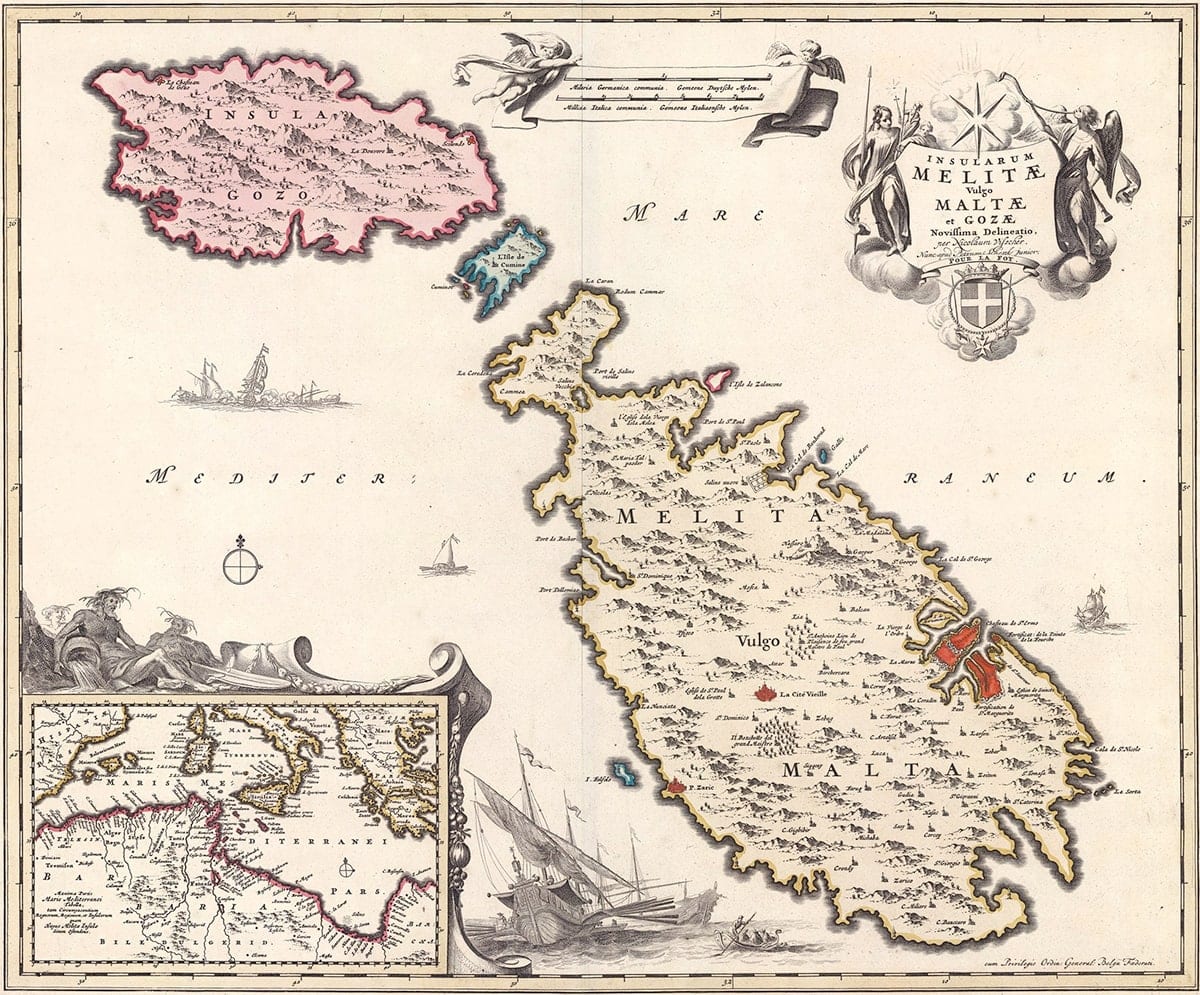
These imaginings might just reflect my wish to return home—or more specifically, to a routine (I don’t love Melbourne’s cold). This being my first post-COVID overseas trip, I’ve been struck anew by how disruptive (and expensive!) travel can be. But also, of course, how wonderful. I’ve been accompanying C during the European racing season. There’s a meet tonight, and then we part ways: she to the States for the next race, and me to Malta, where I plan to walk the 200-kilometre perimeter of its three islands.
The material there will be straightforward travel writing, but this experience will also feed a project I started recently, inspired by a subset of the Maltese alphabet called sun letters. I’ve been diving into history and folklore, so the timing of this visit is perfect in that respect—and perfectly awful in another: Malta will be hot, very hot, double the temperature that suits a walk. I will do my best not to complain every day.
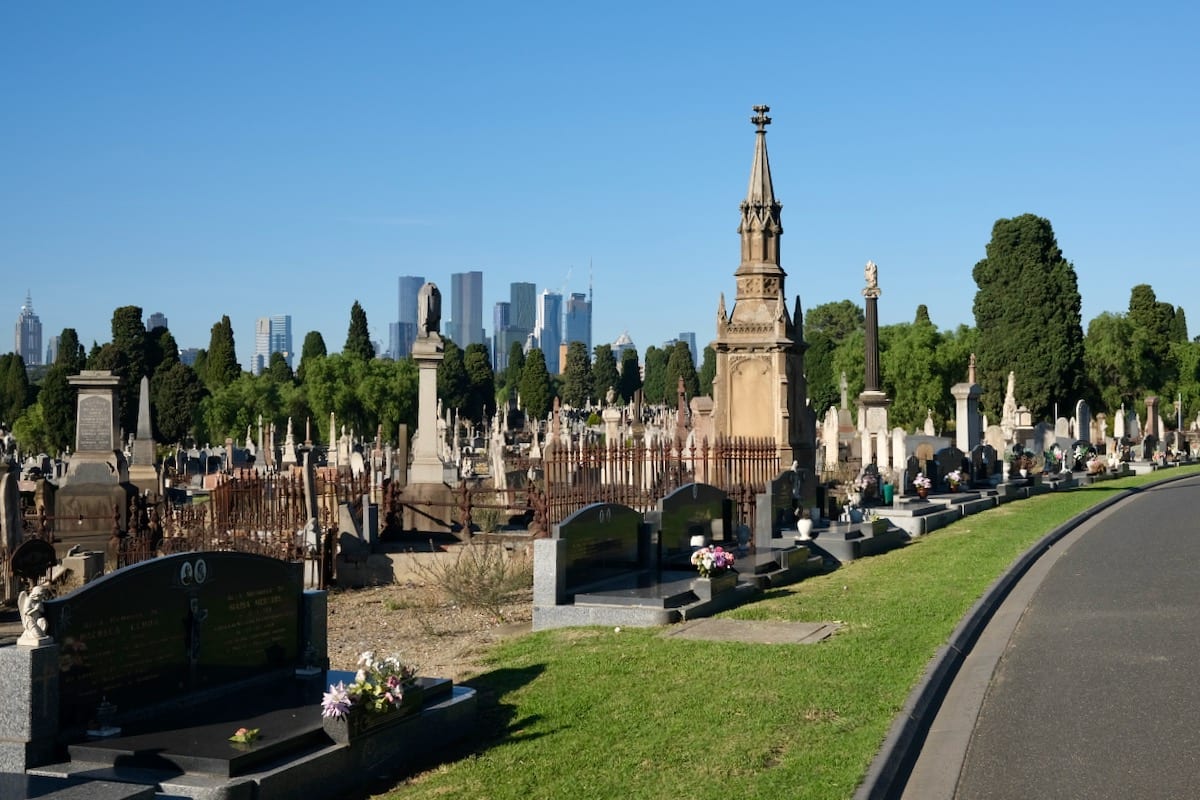
I find myself reciting those eight glorious syllables out loud, over and over, sal-va-tor-eh sa-luh-mang-kuh, each sound elastic in my mouth, the dead my captive audience. Salvatore occupies a front-row plot on my morning shortcut through the city’s main cemetery, his headstone angled so that it catches my attention as I pass, his name too good not to savour each time.
Perhaps the afterlife notifies its residents whenever the living speak their name. I imagine Salvatore rolling over his puffy white clouds, awakened by a torrent of beeps. He glances at the glowing numerals of his clock, which read 8:43 am. Oh God, he sighs. Not this maniac again.
This fate might account for Dante’s impression, in the Inferno, of the first circle of Hell—a place where the virtuous pagans and the unbaptised hang out in limbo, not having sinned enough for the gorier punishments:
Here, as far as I could tell by listening, was no lamentation other than the sighs that kept the air forever trembling.
Yesterday I finished Johnno, David Malouf’s first novel, also narrated by a Dante—a semi-fictional David nicknamed after the Italian poet. One of its closing scenes is a funeral. On hearing the platitudes in the eulogy (“devoted son”, “loyal friend”) delivered by a clergyman who didn’t know the person who’d died—a boy who was irreverent and electric—Dante divines the meaning of death: to be transmuted into abstractions; condemned to exist in loved ones’ minds not with the presence exerted in life but as “a pale, angelic figure in whose company we would never raise our voice or giggle or take off our clothes”.
It’s a heartbreaking moment. Dante isn’t just reacting to the fact that we idealise the dead; he’s pointing out a limit of our imagination. The living tend to command a substantive presence in the mind. I might not know what you’re doing this minute, but I know you’re out there in the world, traipsing about with your individual pains and passions. Once you’re no longer out there, though, your presence will be in some way diminished.
I want to remember people as vividly as they lived. Why does such presence require continuous updating of the ledger? It makes me think of microsaccades: the small, abrupt eye movements we involuntarily make as we focus our vision. In one theory of perception, the purpose of microsaccades is to maintain the retinal image. If your eye muscles were paralysed via injection to prevent them from initiating saccades, the very world around you would fade to black. Our visual system relies on ever-shifting input. Perhaps this is the case for mental imagery at large.
This idea would’ve tickled the artist Jean Tinguely, whose mechanical contraptions whirl and jerk and creak and clank. There’s nothing like seeing his sculptures in person. At the press of an inviting red button, a scrapyard assemblage leaps to life. He once said that movement is “the only stable thing”. The one thing that we can rely on, everywhere and always.
To know movement is to know the entire brain. The only way that we can affect the world is via muscular contractions (well, to be pedantic, our other recourse is perspiration, but good luck sweating your way out of a knife fight). Given this, it’s been argued that all of our abilities, from memory to language, evolved to facilitate our future movements.
A classic example in favour of the brain-serving-movement theory is the humble sea squirt, which begins life by wafting around the ocean searching for a rock to call home. Upon finding a serviceable abode, it cements itself there—then consumes its own brain! Because the sea squirt feeds by filtering nutrients suspended in passing water, it won’t ever need to move again. The final contribution of its cerebral ganglion is the provision of a light snack.
Now, humans are further up the phylogenetic tree, but we don’t seem altogether different: we can abstract our lives down to a particularly convoluted journey from A to B. The blueprint to our movements is just obscured by the sophistication of our aims, the machinations to achieve them, and the epiphenomena of feelings. Grist to occupy our plump cortices.
I think this reductionist view can be comforting. When unsure about what to do, I can trust that the steward in my skull has been tweaked over millennia to trundle in the right direction. I might be fuzzy about what exactly “B” constitutes—my destination—but in wafting about, I’ll eventually find myself there. A serviceable abode. A place to rest. We’re always making moves, even when things feel static. Our world is being continuously made.
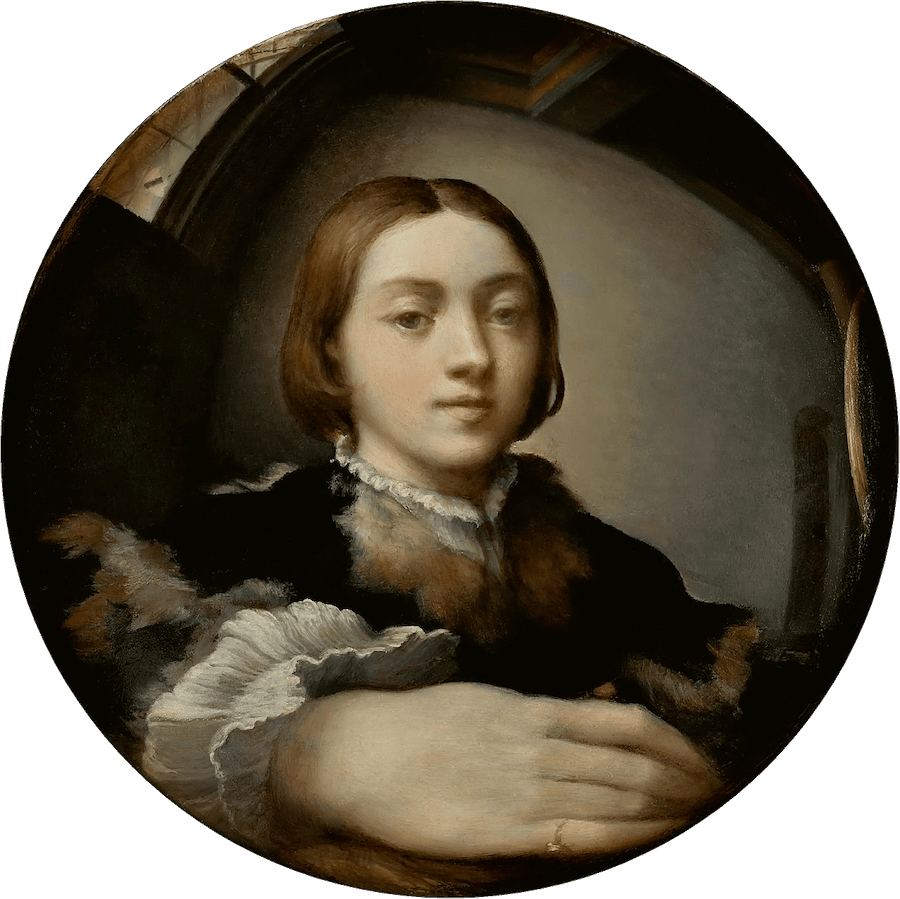
I’ve been exchanging “ekphrastic mixtapes” with friends. Ekphrasis means one form of art describing another. Most commonly, it’s a written response to visual art, such as John Ashbery’s Self-Portrait in a Convex Mirror, after the above work by Parmigianino painted 450 years earlier on a special convex panel that mimics the mirror’s distortion (I’d love to see it in person).
Ashbery’s poem is inscrutable, but evocative. Reading it again in this time of the pandemic, one line took on new meaning: “[A] globe like ours, resting / On a pedestal of vacuum, a ping-pong ball / Secure on its jet of water”… a rendering of the (deceptive?) stability of our daily loops, the banal, against a chaotic global backdrop.
The catalyst of the first mixtape was a photograph of a deserted train platform near Fukushima being reclaimed by nature. You can hear my 30-minute auditory response here. It contains the story of this whole year, as I experienced it: an unsettling beginning; a more hopeful turn; an exploratory end.
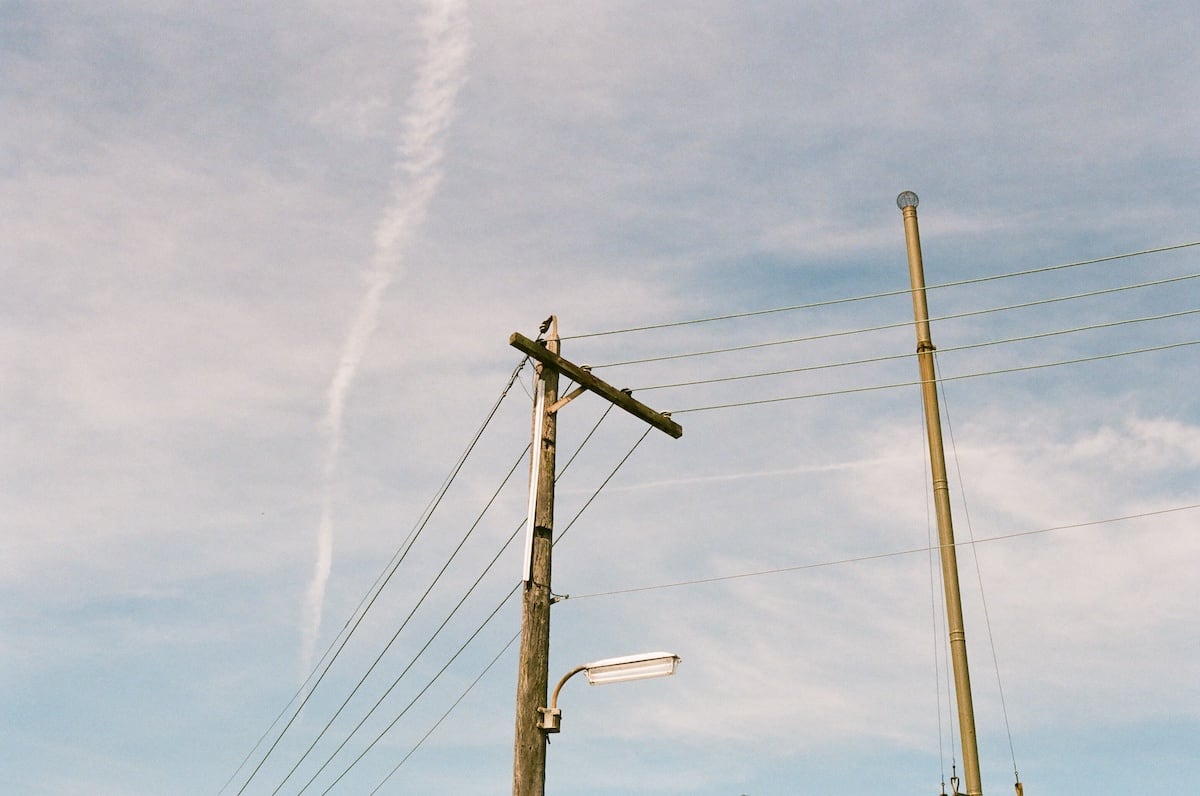
I often took photos of the sky when I lived in Petersham, in Sydney’s inner west, because it was the first time I had lived under flight paths. If I had my camera out and a plane rumbled into frame, passing low and large over the buildings and treetops, it was hard to resist squeezing the shutter button.
Wisps of their passage would do. In the photo above, there are two condensation trails: a close, diffuse vertical streak, and a subtler one parallel to the power lines.
The formation of contrails was a minor mystery to me. Something I’d always wondered about, but not looked up. I recently filled that gap while reading The Cloudspotter’s Guide. You probably know this much: a cloud is a mass of liquid droplets or ice crystals. Most clouds form as moist air rises and cools, because temperature drops with altitude. When it gets cold enough, evaporated surface water condenses back into liquid.
Here’s what was new to me. Like partygoers early in the night, water vapour needs encouragement to start con-dancing—a “nucleus” to clump around. Salt is popular, but water vapour is down to boogie with all sorts of suspended grit, even sulfur compounds in the wake of a jet engine.
Planes fly high up where the air is very cold. Because their exhaust is hot, humid and full of impurities (the brave souls first on the dance floor), conditions are often just right for engine gases to instantly cool into droplets and freeze into crystals.
That’s how we get contrails. Neat, right?
Sadly, they’re guests that often overstay their welcome, spreading in the wind to become sheets of cirrus. These clouds trap heat radiated from the Earth at a greater rate than they reflect heat from the sun. Some scientists suspect that this “radiative forcing” effect is aviation’s largest contribution to global warming—worse than its carbon dioxide emissions! It’s tricky to estimate the relative heating effect of contrails, because air traffic never stops—a notable exception being the grounding of US flights for three days following the 9/11 attacks. And measurements during that blip of clear skies were damning for contrails.
While the pandemic is tragic (and especially damaging to academia) it’s also an incredible opportunity in some niches, enabling once-unimaginable natural experiments: How do whales react to quiet oceans? How much of Delhi’s air pollution is from inside versus outside sources?
The dramatic drop in travel this year will allow atmospheric research groups to reduce uncertainty about aviation’s non-CO2 cloud effects, building scientific consensus and shaping long-term policies, like re-routing flights to areas and altitudes that minimise contrail formation. Much as I dig their geometric presence in the heavens.
Nathan Mifsud is a writer based in Melbourne. You can sign up to my newsletter for occasional updates: