Hot air
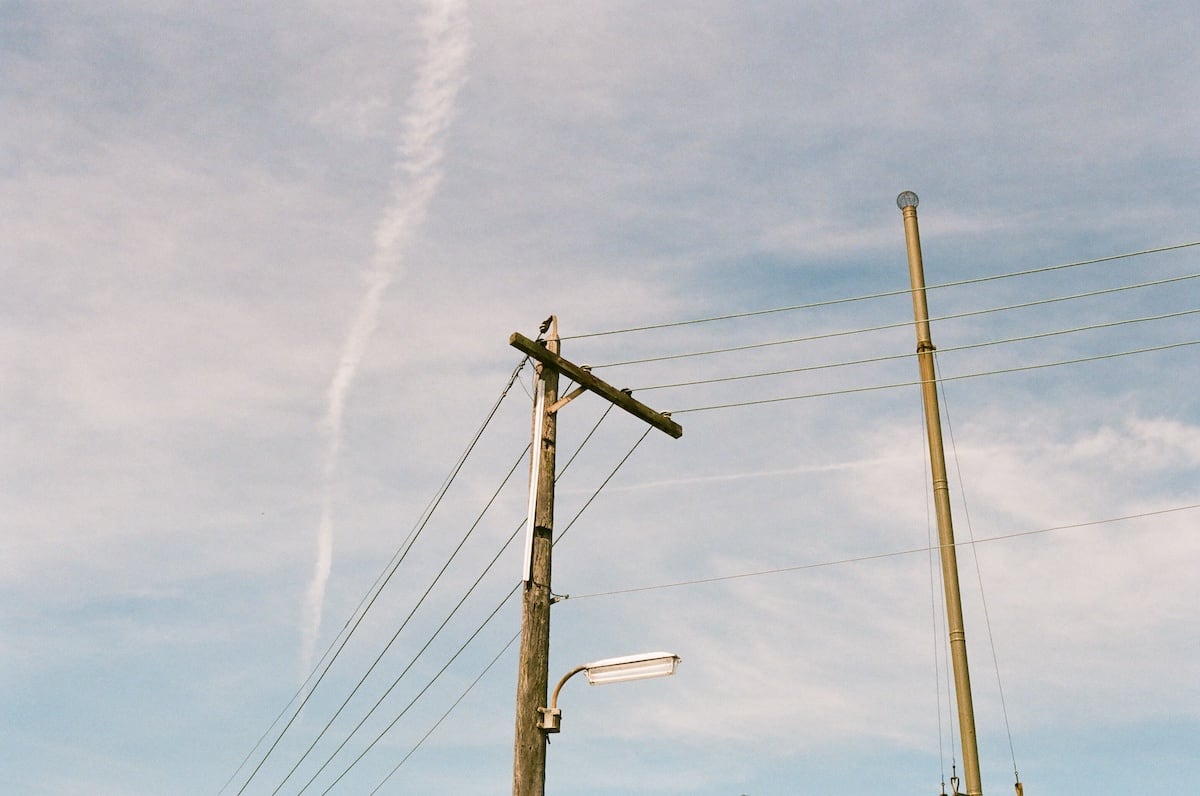
I often took photos of the sky when I lived in Petersham, in Sydney’s inner west, because it was the first time I had lived under flight paths. If I had my camera out and a plane rumbled into frame, passing low and large over the buildings and treetops, it was hard to resist squeezing the shutter button.
Wisps of their passage would do. In the photo above, there are two condensation trails: a close, diffuse vertical streak, and a subtler one parallel to the power lines.
The formation of contrails was a minor mystery to me. Something I’d always wondered about, but not looked up. I recently filled that gap while reading The Cloudspotter’s Guide. You probably know this much: a cloud is a mass of liquid droplets or ice crystals. Most clouds form as moist air rises and cools, because temperature drops with altitude. When it gets cold enough, evaporated surface water condenses back into liquid.
Here’s what was new to me. Like partygoers early in the night, water vapour needs encouragement to start con-dancing—a “nucleus” to clump around. Salt is popular, but water vapour is down to boogie with all sorts of suspended grit, even sulfur compounds in the wake of a jet engine.
Planes fly high up where the air is very cold. Because their exhaust is hot, humid and full of impurities (the brave souls first on the dance floor), conditions are often just right for engine gases to instantly cool into droplets and freeze into crystals.
That’s how we get contrails. Neat, right?
Sadly, they’re guests that often overstay their welcome, spreading in the wind to become sheets of cirrus. These clouds trap heat radiated from the Earth at a greater rate than they reflect heat from the sun. Some scientists suspect that this “radiative forcing” effect is aviation’s largest contribution to global warming—worse than its carbon dioxide emissions! It’s tricky to estimate the relative heating effect of contrails, because air traffic never stops—a notable exception being the grounding of US flights for three days following the 9/11 attacks. And measurements during that blip of clear skies were damning for contrails.
While the pandemic is tragic (and especially damaging to academia) it’s also an incredible opportunity in some niches, enabling once-unimaginable natural experiments: How do whales react to quiet oceans? How much of Delhi’s air pollution is from inside versus outside sources?
The dramatic drop in travel this year will allow atmospheric research groups to reduce uncertainty about aviation’s non-CO2 cloud effects, building scientific consensus and shaping long-term policies, like re-routing flights to areas and altitudes that minimise contrail formation. Much as I dig their geometric presence in the heavens.