Tending a whale
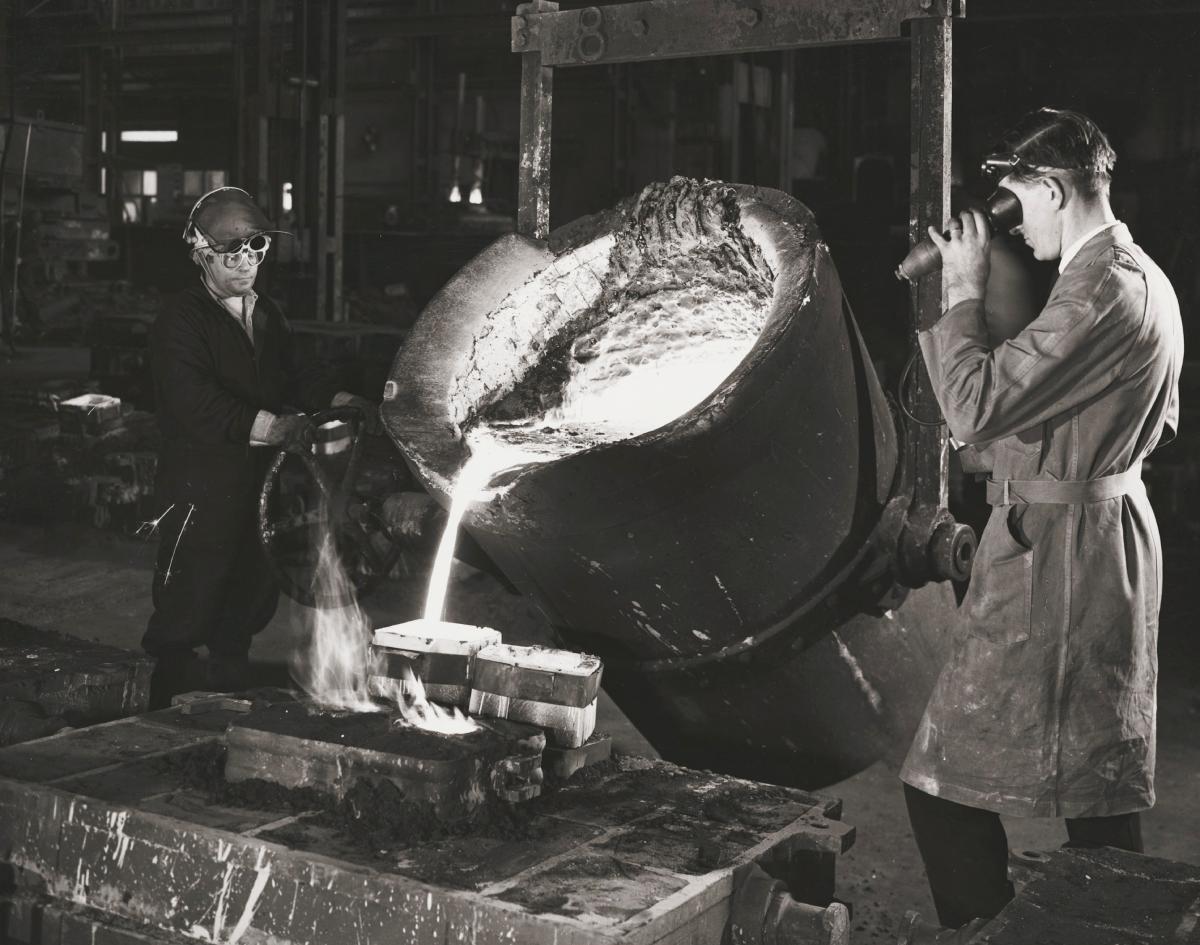
Foundry workers, Burnley, Victoria, 1968, Wolfgang Sievers
In the final hours of the year, in the fading light of the day, thousands upon thousands of birds were silhouetted against the silver tide. The water was calm and luminous, like a molten moon. After fishing over the horizon, the birds were coming back to roost, reuniting with their mates on incubation duty.
The foragers arrived as distant fireworks began spitting. We pointed with delight at the vanguard of velvet shapes. Soon the sky was full of birds, a messy braid of flight paths, each bird streaming past with a flutter of stiff-winged pumps followed by a sharp banked glide, then a flutter, a glide, flutter, punch-drunk and unpredictable.
I’d seen their burrows earlier that day atop the pink granite cliffs, dark mouths in low turf, like a green. Was golf inevitable? A branch, a round rock, a hole. It must be a common impulse across the animal kingdom to do something just to see if it’s possible. Surely even a shearwater sometimes make an acrobatic turn at a leaping fish, catching it midair, only to let it go for lack of hunger.
The shearwaters that sojourn on our shores do so after a figure-eight loop of the ocean covering more than 15,000 kilometres. On arrival, they lay a single white egg. Over the next couple of months, the parents rebuild their fat stores by feeding at a shorter range, usually by diving (up to a depth of 50 metres!) for krill. When the chick hatches, they share their catch by regurgitation.
At dusk they approach in one mass, having gathered in a “raft” on the sea not far from the colony. They fly the final stretch home once the darkness can safely cloak them. Many of us gathered that eve, the last of the year, in similar flocks by the beach and across the city, to celebrate, to reflect, to anchor the self in time and place and be moored by the people around us.
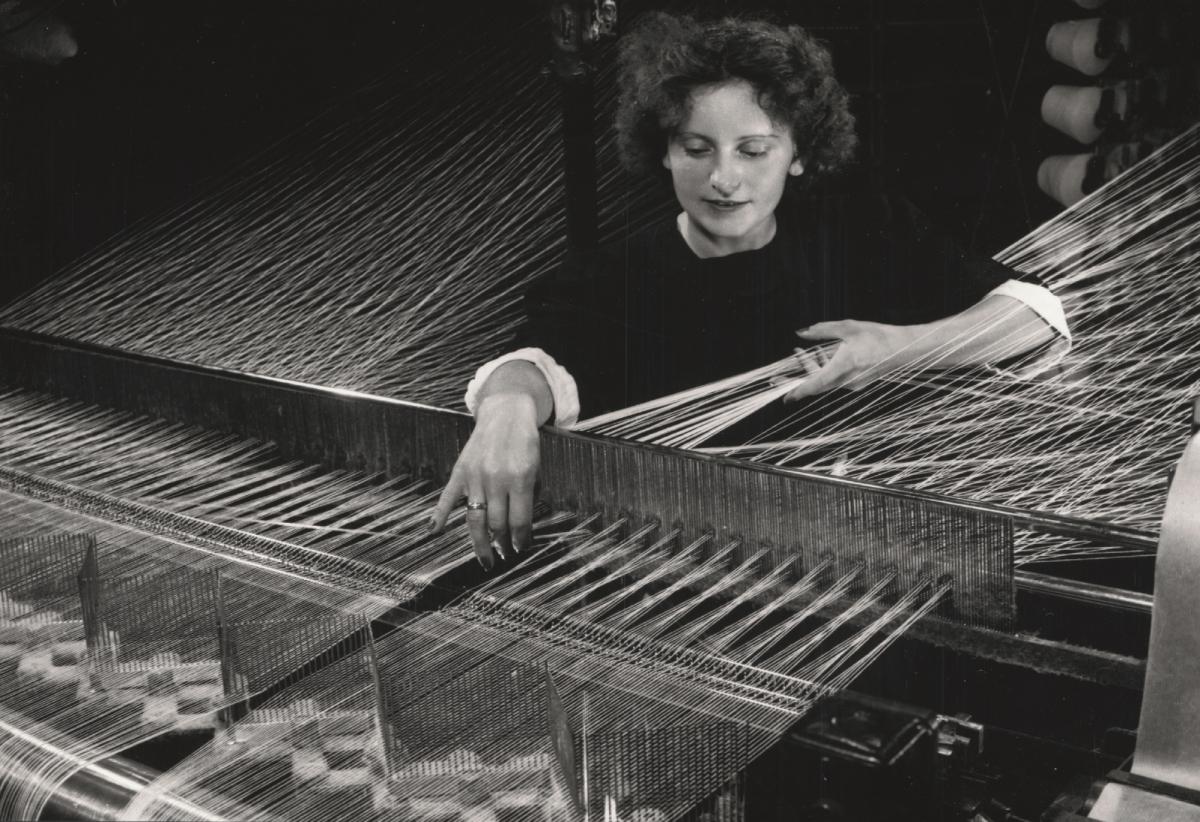
Adjusting thread, Wangaratta, Victoria, 1950, Wolfgang Sievers
One thing that I’ve been reflecting on, like many people, is “artificial intelligence”. Early last year I ran a workshop about the use and risks of ChatGPT in the social sector, and off the back of that, I was invited to give a public lecture on AI at a library. Preparing the talk was a chance to zoom out and clarify my conflicted feelings on the topic, if not to resolve them.
Setting aside “doomer” concerns—a smoke screen for the harms that AI systems already enact—I grounded the talk in the historical overlap of textiles and computing, from the invention of the Jacquard loom and true causes of the Luddite rebellion to the needlework that got us to the Moon.
I explained the factors driving the current AI renaissance: the shift from “expert systems” to “machine learning” coupled with way more data and way faster computers.
To quote Steve Jobs in 1983, over forty years ago:
Computers are really dumb. They’re exceptionally simple, but they’re really fast. The raw instructions that we have to feed these little microprocessors—or even these giant Cray-1 supercomputers—are the most trivial of instructions. They get some data from there, get a number from here, add two numbers together, and test to see if it’s bigger than zero. It’s the most mundane thing you could ever imagine.
But here’s the key thing: let’s say I could move a hundred times faster than anyone in here. In the blink of your eye, I could run out there, grab a bouquet of fresh spring flowers, run back in here, and snap my fingers. You would all think I was a magician. […] And it’s the exact same way with a computer. It can do about a million instructions per second. And so we tend to think there’s something magical going on.
I touched on ChatGPT—the ultimate example of what Jobs described—and the huge bets that infrastructure companies like Microsoft are making on “language models” becoming essential to our interactions with computers in the future.
This has scrubbed them of poetry. (Expand to read more.)
The corporatisation of language models is evident in the changing flavour of their output.
A project I was once involved in used GPT-3, the predecessor to ChatGPT, to allow folks to talk to a personified rock. (The motivation of the bot/rock was to nudge callers into considering the personhood of nature.) The conversations were amusing, for the most part, but irregular, to put it generously. Still, I liked GPT-3’s flashes of poetic sensibility.
The old model riffed like this:
Do stones love their life?
Is the tree as it rises delighted with its many branches?
Are the clouds glad to unburden their bundles of rain?
Whereas today’s ChatGPT offers this:
Do stones love their life?
The concept of love is generally associated with sentient beings capable of emotions and consciousness. Stones, being inanimate objects, do not possess the capacity for emotions or awareness. Therefore, it would be inaccurate to attribute feelings such as love or the experience of life to stones.
Obviously, this is a stultifying “improvement”. It also shows their mindless reinforcement of orthodoxy. No one can deny that the latest models mimic dialogue with remarkable fluency, but there seems to be a paradox. The closer they come to sounding human, the less human they feel.
It’s one of the reasons that my use of language models is mostly limited to coding assistance, the least human—but perhaps most potent—capability in their repertoire.
Anyhoo, I ended by comparing AI to whales (a shameless appeal to the talk’s audience): the awe they can inspire; their scale; their crossover with human markers of intelligence but fundamentally alien natures; and finally, their attunement to what’s around them. AI systems are shaped by the society they swim in. To create a future where AI serves to enlarge rather than diminish life, we could begin by safeguarding human values and understanding AI as automation—considering who automates what, and why.
This is the conflict I’ve been stewing on for a while now: my belief in the possibility of such a future, against my increasing conviction that, on the whole, it won’t come to pass. Like admiring the design of heavy industry despite its ecological devastation.
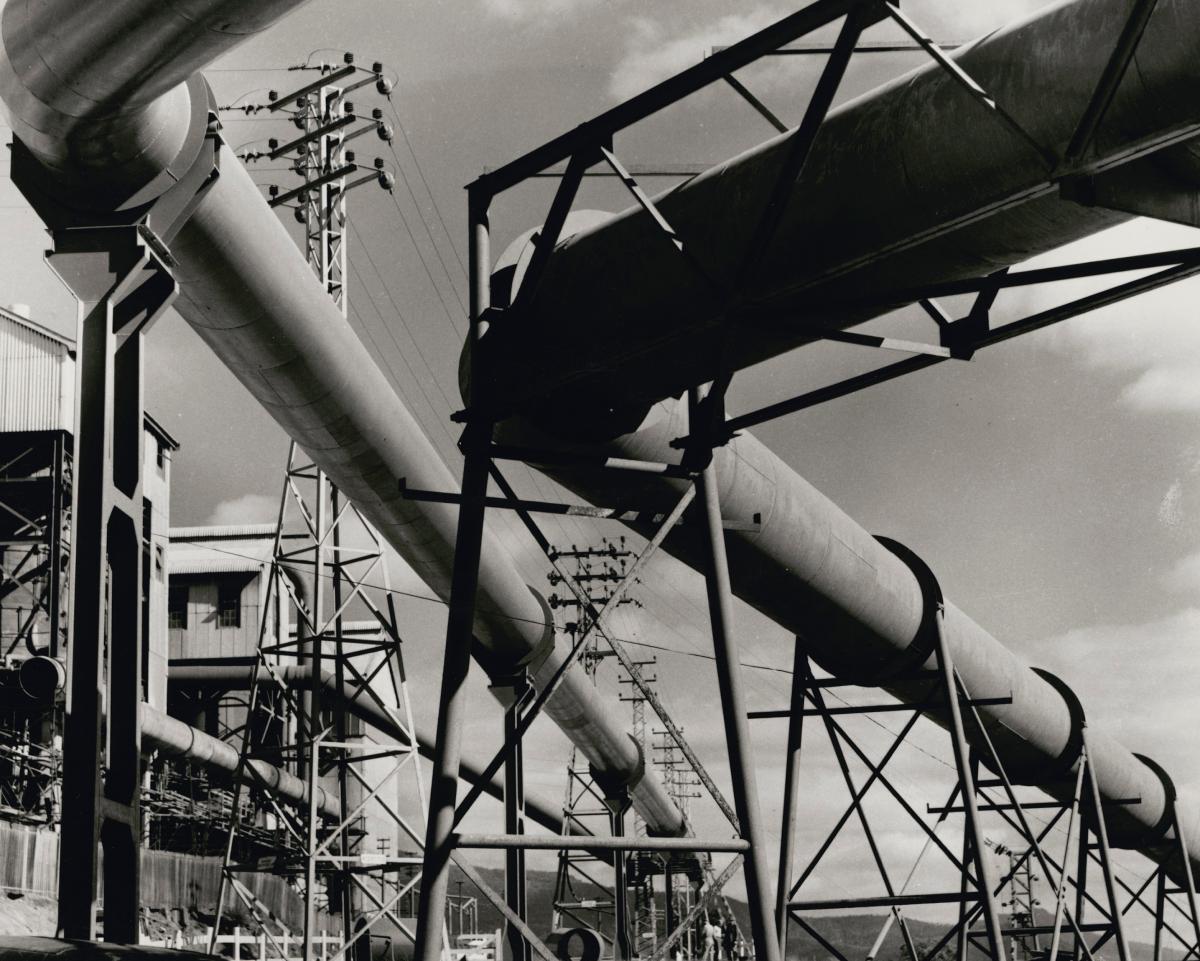
Zinc refinery, Risdon, Tasmania, 1959, Wolfgang Sievers
These photos are superb, right? I commend the archive of Wolfgang Sievers to you. I discovered his work while searching for an image of textile machinery for my slides.
Sievers wound up in Australia in 1938 having fled, with a day’s grace, his conscription into the Luftwaffe. He would become renowned for his industrial photography. Each frame was high art, carefully lit and orchestrated. And while he glamorised the geometric forms in oil refineries and industrial plants, he also elevated the labour of individual workers.
A catalogue essay for a retrospective put it like this:
Man and machine were Sievers’ quintessential subjects. To Sievers the essence of a good factory was not labour by itself, nor the technical process in isolation, but that “everything is as it should be”, with [humans] directing machines efficiently, and each augmenting the other. In Sievers’ photographs the operators are functionally connected to the machine by their hands and their eyes—they peer through loupes, or pull levers, or intently measure the details of gigantic pieces of machinery with finely calibrated instruments.

Data entry, Doncaster, Victoria, c. 1979, Wolfgang Sievers
Those colours! The lines! The human encircled by machines. A symbiosis. You couldn’t make someone tapping into their laptop look half as good. Bring back the bulk, I say.
My favourite scene is this: a loom tuner inspecting shining spools of rayon, looking for all the world like he’s tending to the bristles of a whale holding its maw open delicately. It’s a romantic vision, a modernist vision of unity, depicting a relationship with technology yet to be truly realised.